Skip to content

For a custom acrylic display, thickness should be chosen from the unsupported span, product load, support layout, handling, and finish requirement—not from the overall outside size alone. A small countertop riser may be appropriate in a lighter gauge, while a long shelf, tall freestanding unit, or display using security hardware often needs a thicker section, a folded return, or a support change. The same number can be right in one geometry and wrong in another.
For buyers sourcing custom acrylic display stands, I use thickness as a starting point for a structure review, not a fixed catalogue choice. The practical goal is to specify enough stiffness and stability without adding material where a better load path would solve the problem more efficiently.
Start With the Component’s Job, Not a Sheet Gauge

The first question is what each acrylic part actually does. A front graphic panel, a short riser, a shelf carrying products, and a tall side wall may all appear in one display, but they do not have the same structural demand.
In our drawing review, I separate cosmetic panels from load-carrying parts before proposing a gauge. A thin graphic insert can be sensible when it is fully supported; using that same thickness for a long shelf simply because both parts look clear is a common and expensive shortcut.
| Display component | Useful starting question | What normally changes the selection |
|---|---|---|
| Graphic, divider, or short insert | Is it supported across most of its area? | Handling, edge finish, print, mounting |
| Countertop riser or formed holder | Does the bend or return stiffen the part? | Product footprint, bend geometry, daily use |
| Shelf or tray | What is the clear distance between supports? | Load, depth, span, acceptable deflection |
| Side, back, or door panel | Is it part of a box or a freestanding structure? | Height, hinges or fasteners, access, vibration |
| Base plate | Does it resist tipping as well as bending? | Centre of gravity, footprint, secured or loose installation |
Why Unsupported Span Usually Matters More Than the Overall Size

Acrylic does not need to fail outright to make a display look wrong. A shelf can gradually look bowed, a door can feel flexible, or an unsecured tall stand can feel insubstantial. The distance between effective supports is usually the first structural measurement to clarify.
For a long shelf, a middle support, a turned-down front lip, a rear panel, or a different bracket layout can reduce deflection more efficiently than making every part thicker. This is why I would first ask for the clear span, not just the display’s outside width. A design with two short supported spans may use material more efficiently than a single heavy panel.
Curvature and ribs can also add stiffness to formed acrylic parts, while large unreinforced acrylic sheet should not be treated as a structural member for a large or heavy assembly. Plaskolite’s fabrication guidance similarly emphasizes support layout, local stress, and the limits of typical material data.
A Practical Thickness Starting Guide for Displays
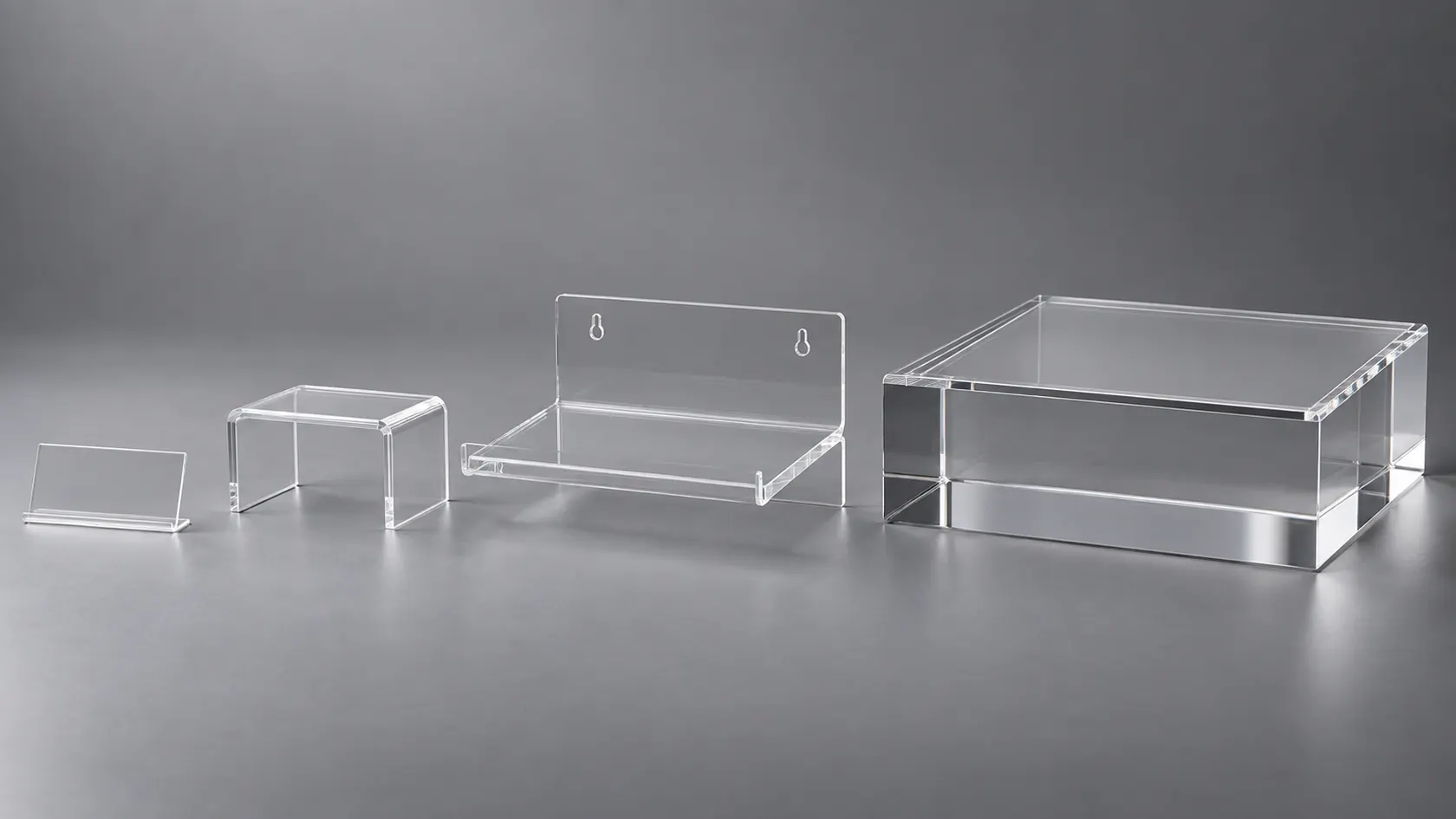
The table below is a project-planning guide, not a load-rating chart or a replacement for engineering review. It helps a buyer describe the likely direction of the design before a drawing, sample, and intended use are confirmed.
| Application pattern | Typical starting direction | Confirm before release |
|---|---|---|
| Light literature holder, label panel, or short insert | Lighter sheet can be practical | Handling, bend detail, mounting method |
| Small countertop riser or compact product holder | Moderate sheet or formed geometry | Product weight, contact area, edge visibility |
| Tiered display with short shelves | Structure-led selection | Shelf depth, rear support, bonded joints, product placement |
| Long or deep loaded shelf | Reinforce, shorten the span, or increase section as needed | Clear span, distributed versus point load, acceptable sag |
| Tall freestanding display | Base and stability review first | Centre of gravity, counter fixing, customer handling |
| Display case, door, or hardware-mounted panel | Thickness and connection detail together | Hinge/lock position, hole clearance, opening cycles |
If the product is unusually heavy, valuable, overhead, safety-critical, or subject to high abuse, the display should receive a project-specific structural review. Thickness alone does not make a design safe.
Choose Thickness Together With the Fabrication Method

The same acrylic thickness can behave differently in the factory depending on how it is cut, bent, machined, polished, bonded, printed, and assembled. For a premium clear display, the visible edge and joint are often as important as the gauge.
Cast and extruded acrylic can each be appropriate, but the choice should follow the finish and process rather than a blanket rule. I would review the sheet type when a project has polished visible edges, tight-fit slots, complex machining, bonding, or a heat-formed shape. Nominal thickness also needs to be checked against the actual material and fit-up when slots, tabs, or hardware alignment are critical.
Before drilling or adding hardware, we look at hole locations, local edge distance, fastener compression, and whether the fitting should allow the acrylic to move. Tight clamping, sharp internal corners, and stressed holes can create local risk even when the main panel looks generously specified.
Solve Stability and Appearance Together

A thicker panel can create a premium visual effect, but visual weight is not the same as structural need. Conversely, a thinner material can work well when folds, a rear panel, brackets, or an internal frame provide the real stiffness.
For a tall counter display, I would review the base footprint and centre of gravity before simply increasing the side-wall thickness. For a multi-tier unit, I would check whether the rear panel can become a structural element. For a display with a polished front edge, I would balance the desired edge presence against weight, shipping volume, and the risk of scratches during packing.
This is where an early sample is useful: it checks the product fit, the perceived quality, the assembly sequence, and the deflection buyers will actually see—not just whether individual dimensions match the drawing.
Do Not Let Holes, Joints, and Shipping Become the Weak Link
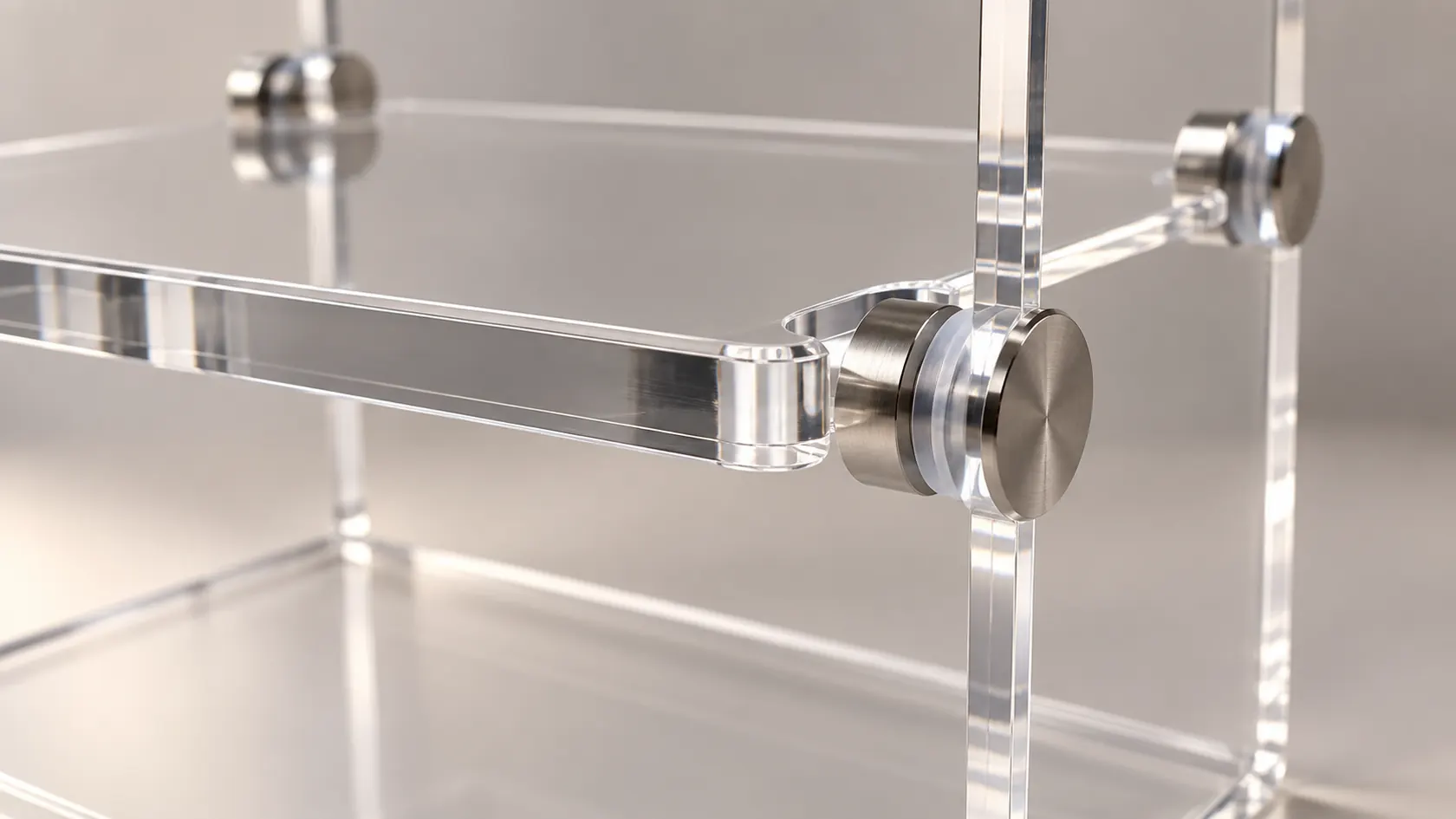
Thickness selection can be undermined by a weak connection detail. A shelf may be stiff enough across its span but still be vulnerable around a drilled hole, a sharp slot corner, a bonded seam, or a hard-clamped fastener. The design should show those details clearly rather than treating them as secondary production notes.
In our experience, two review points deserve early attention: where a buyer will repeatedly pick up or open the display, and where transport loads reach the acrylic. I would normally ask whether the unit ships assembled or flat-packed, then decide whether foam, edge protection, temporary film, or a revised assembly sequence is needed. A thicker part can still arrive scratched or stressed if the pack-out ignores its visible surfaces and joints.
What to Send for a Thickness Review and Quote

The fastest useful recommendation comes from a drawing or reference image paired with the use case. You do not need a fully finished production drawing to start, but the functional information must be clear enough to identify spans, supports, and loads.
Send these items when requesting a custom acrylic fabrication review:
- Overall dimensions and a sketch, drawing, or reference image.
- The product being displayed, its weight, and where it contacts the acrylic.
- The clear distance between supports for each shelf, tray, or panel.
- Whether the display is freestanding, wall-mounted, countertop-secured, or part of another fixture.
- Required finish, colour, print, hardware, lighting, and visible-edge expectations.
- Quantity, sample requirement, packaging preference, and required delivery date.
We can then propose a thickness direction alongside the complete structure—not only the sheet. That makes it easier to compare a heavier gauge with alternatives such as a return bend, support rail, rear panel, or revised shelf layout before the design reaches sampling or production.
Request a Custom Display Thickness Review

For custom projects, the right acrylic thickness is the one that suits the display’s actual load path, finish, handling, and shipment—not the one copied from a previous job. Send your drawing, dimensions, product weight, display quantity, and any printing or hardware requirements. We will review the structure and help you prepare a practical acrylic display specification for quotation.