Skip to content

A sneeze guard can look reassuring from ten feet away. It is clear. It is clean. It stands between the cashier and the customer like a simple answer to a messy problem. That is exactly why so many businesses trust it too quickly.
I have seen this happen in a very practical way. A buyer once showed me photos of a checkout counter setup and said, “We already installed the barrier, so we should be fine.” But when I looked closer, I saw open sides, a huge payment gap, and a shield that covered only the center line of the counter. On paper, it looked protected. In real use, it was full of weak points.
That is the issue I want to talk about here. Many sneeze guards are not useless, but many are badly designed, badly placed, or badly understood. They block something, yes. But they often fail to protect staff the way managers think they do.
I do not say that to be dramatic. I say it because checkout counters are active spaces. People lean in. They point. They pass products around the barrier. Air moves. Staff turn sideways. Customers speak around the edge instead of through the front. The barrier may stay still, but the real interaction never does.
One detail I always weigh early is this: a barrier that looks good in a catalog can still fail the moment real human behavior enters the counter space.
So this article is not just about what a sneeze guard is. It is about why many of them fail in checkout settings, what design mistakes cause that failure, and how I think about building acrylic guards that actually work better in daily use.
That question matters more than most people think. Because once you start looking past the clear panel itself, the real problems begin to show.
What Is a Sneeze Guard and How Is It Supposed to Work?

A sneeze guard is a transparent barrier placed between two people. In checkout spaces, it usually sits between the customer and the staff member. Its job sounds simple. It helps block droplets that come out when people talk, cough, or sneeze.
That is the clean textbook version. Real life is a little rougher.
I usually explain it to buyers like this: a sneeze guard is not a magic wall. It is just one control layer. It can interrupt a direct path. It can reduce a straight-line spray. It can create some separation. But it does not erase all exposure.
Basic Definition and Purpose
At its most basic level, the guard creates a physical barrier. That barrier is meant to stop larger respiratory droplets from traveling directly from one person’s face to another person’s face.
This matters most in close-range service points, such as:
- supermarket cash desks
- pharmacy counters
- restaurant cashier stations
- front desk reception areas
- ticketing counters
- service windows
A lot of buyers assume the panel itself is the whole story. I do not see it that way. I see it more like a seatbelt. Helpful? Yes. Complete protection by itself? No.
Common Materials Used
Most sneeze guards are made from one of three materials:
| Material | Main Strength | Main Weakness | Typical Use |
|---|---|---|---|
| Acrylic (PMMA) | High clarity, easy fabrication, lighter weight | Can scratch more easily than glass | Retail counters, cashier guards, custom barriers |
| Polycarbonate | Very strong impact resistance | Usually costs more, surface can mark differently | High-abuse public settings |
| Glass | Strong scratch resistance, premium look | Heavy, breakage risk, harder to customize | Permanent installations |
I work with acrylic a lot, so I know where it shines. It gives excellent clarity. It is easier to cut, bend, polish, and customize. It also makes sense for many B2B projects where dimensions change from one counter to the next.
Typical Locations Where They Are Installed
You can find sneeze guards almost everywhere customer-facing service happens. The common point is always the same: two people come close enough to exchange products, money, cards, or words.
Here is a quick view:
| Location | Main Interaction | Common Risk Point |
|---|---|---|
| Grocery checkout | Scanning and payment | Card terminal gap |
| Pharmacy counter | Conversation and item handoff | Side leaning and close speech |
| Restaurant cashier | Fast payment and order pickup | Narrow shield coverage |
| Reception desk | Repeated face-to-face questions | Open lower and side areas |
The Core Protective Mechanism
A sneeze guard mainly works by breaking the direct route of larger droplets. If a customer coughs straight ahead, a properly sized clear panel may stop much of that direct spray from reaching the worker’s face.
That sounds good, and it is good. But it is also incomplete.
A barrier is strongest when the interaction stays directly behind it. Once people move around it, reach around it, or let air pass around it, its protective effect drops fast.
This is where I think many buyers make the wrong assumption: if the front panel exists, they believe the exposure problem is solved, even though most exposure at a checkout counter does not stay neatly in front of the panel.
And that brings us to the uncomfortable part. The barrier often fails not because the idea is bad, but because the real checkout environment is far messier than the drawing.
Why Many Sneeze Guards Fail in Real Checkout Environments
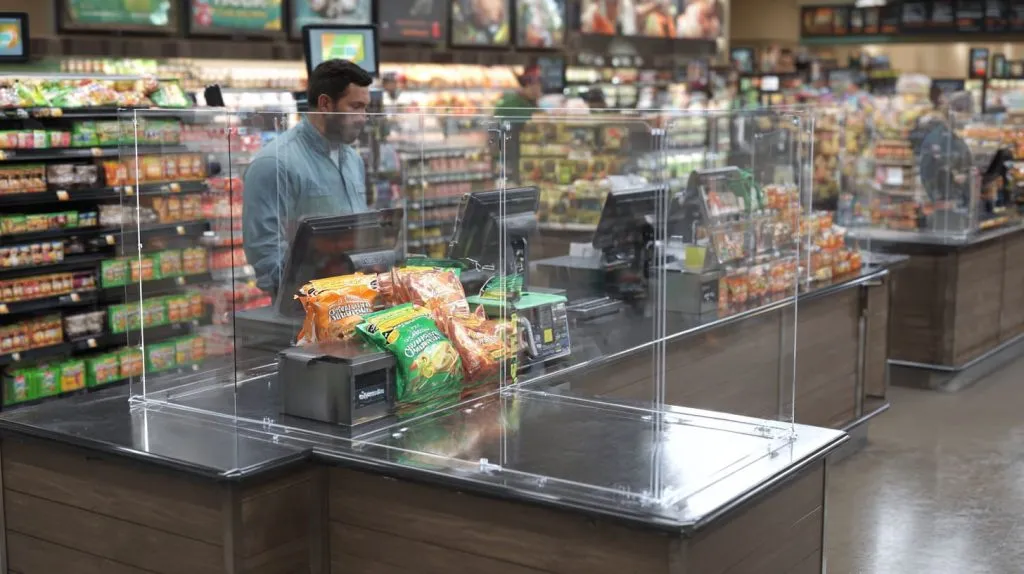
This is the section that matters most to me. I have no interest in pretending every shield works well just because it is transparent and mounted on a counter. Many do not.
The gap between theory and counter reality is where the failure starts.
Large Gaps Around the Counter Area
A sneeze guard can cover the front center area and still leave huge open paths around the sides, bottom, or transaction opening. That happens all the time.
A checkout counter is not a flat wall. It usually includes:
- barcode scanners
- payment machines
- bagging zones
- receipt printers
- product pass-through areas
- curved or stepped counter edges
Each of those details can create exposure paths.
I once reviewed a barrier design that looked wide enough in the front photo. But once the side angle came in, the flaw was obvious. The customer could simply speak around the right edge and face the cashier directly. The front was covered. The real interaction was not.
| Gap Type | Why It Happens | Why It Matters |
|---|---|---|
| Side opening | Shield is too narrow | Air and droplets bypass barrier |
| Bottom cut-out | Large pass-through slot | Exposure near hands and torso rises |
| Payment machine gap | Device sits outside shield zone | Customer leans around panel |
| Top under-sizing | Shield not tall enough | Face-level exposure remains possible |
Guards That Are Too Small or Poorly Positioned
Size is one of the biggest reasons for failure. A lot of standard sneeze guards are made to fit shipping boxes, not real counters.
That sounds blunt, but I mean it.
Many low-cost units are too narrow, too short, or mounted too high. They may cover only the center face area. But checkout conversations do not stay frozen in one perfect line. Staff turn. Customers move. The interaction spreads across a zone, not a single point.
One thing that often changes my recommendation is not the shield size on paper, but where the customer naturally stands when paying, asking questions, or packing items.
A barrier that is 600 mm wide may look decent in a product photo. At a busy counter with a payment terminal on one side and product handoff on the other, it can feel almost symbolic.
Airflow and Ventilation Bypassing the Barrier
This problem is less visible, so many people ignore it.
Indoor air does not move in a polite straight line. It drifts. It pulls. It curls around corners. Air from ceiling vents, doors opening, people walking past, or cooling systems can move particles around the barrier instead of into it.
So even if the panel blocks a direct burst, it may not block the full movement of smaller particles in the space.
Here is how I think about it in simple terms:
| Condition | What People Assume | What May Actually Happen |
|---|---|---|
| Front panel installed | Airflow is blocked | Air moves around edges |
| Strong HVAC above counter | Space feels ventilated | Flow may carry particles behind shield |
| Entry door nearby | Fresh air reduces risk | Repeated drafts can redirect exposure |
| Open side design | Barrier still helps enough | Air bypass becomes much easier |
Customers Leaning Around the Shield
Human behavior ruins many clean designs.
A customer cannot hear well, so he leans around the panel. A cashier points to the card terminal, so the customer steps sideways. A shopper wants to ask about a return, so she speaks around the edge instead of through the front. Suddenly the shield is sitting there like furniture while both people move outside its useful zone.
This is where things often go wrong: people do not interact with counters the way diagrams do, and a design that ignores that fact will disappoint you later.
That is why I never judge a sneeze guard only by front elevation drawings. I want to know where people stand, how they reach, and what they do when the line gets busy.
Once you notice those patterns, another truth becomes hard to ignore: the problem is not only the panel. The problem is also the air itself.
How Airflow Physics Reduces the Effectiveness of Many Shields
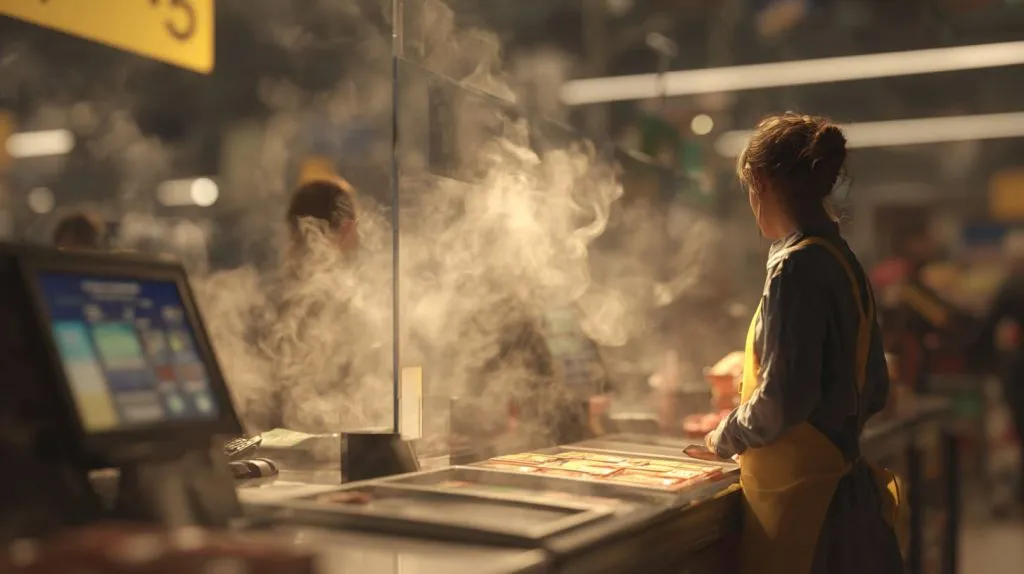
I know “airflow physics” can sound dry. But this is one of the biggest reasons people overtrust sneeze guards.
A lot of business owners think in straight lines. If the panel sits between two people, they assume the problem ends there. Air does not respect that logic.
Droplets vs Aerosols
Not all particles behave the same way.
Larger droplets are heavier. They tend to fall faster. A barrier can do a useful job stopping many of them if they travel directly toward the panel.
Smaller aerosol particles can stay suspended longer. They can move with indoor air currents. They do not need to smash into the panel head-on to remain part of the exposure picture.
Here is a simple comparison:
| Particle Type | General Behavior | Barrier Effect |
|---|---|---|
| Larger droplets | Fall faster, more direct path | Barrier can block many direct hits |
| Smaller aerosols | Stay airborne longer, move with air | Barrier effect is more limited by airflow |
That difference matters. It means a shield can help and still not be enough by itself.
Air Circulation in Indoor Retail Spaces
Retail spaces rarely have stable air conditions. Doors open. People queue. Cooling systems run. Warm and cool air mix. Staff move back and forth. This creates airflow patterns that do not show up in simple product photos.
I have stood near checkout areas where I could literally feel a side draft hit my arm every few seconds. In that setting, it made no sense to judge the barrier only from the front.
When I look at a retail barrier design, I do not only ask, “Will this block a sneeze?” I also ask, “Where is the air going after it reaches the edge?”
Research Findings from Public Health Studies
Public health guidance over the past years has pushed one point again and again: barriers alone are limited. They can reduce direct exposure in certain situations, but they are not a complete airborne control method. Their performance depends on surrounding airflow, user movement, and other controls in place.
That is why well-managed spaces usually combine barriers with:
- better ventilation
- distancing where possible
- workflow changes
- cleaning routines
- sometimes masking or other protective practices depending on the setting
I tend to distrust any design pitch that treats the clear panel as a full solution, because the real world almost never gives one product that kind of power.
Why This Matters More at Checkout Counters
Checkout counters are high-turnover contact points. The same worker may interact with dozens or hundreds of people in a shift. Even a small design weakness gets repeated all day.
A weak barrier in a low-contact office desk might be a minor issue. The same weakness at a grocery checkout becomes a repeated exposure pattern.
| Environment | Interaction Frequency | Barrier Mistakes Become… |
|---|---|---|
| Reception desk | Moderate | Noticeable |
| Pharmacy | Moderate to high | More serious |
| Supermarket checkout | High | Repeated all day |
| Fast-service cashier | Very high | Easy to magnify |
Once I put it in those terms, the next question becomes obvious: if barriers can fail so easily, what design mistakes keep causing that failure?
Design Mistakes That Make Sneeze Guards Ineffective
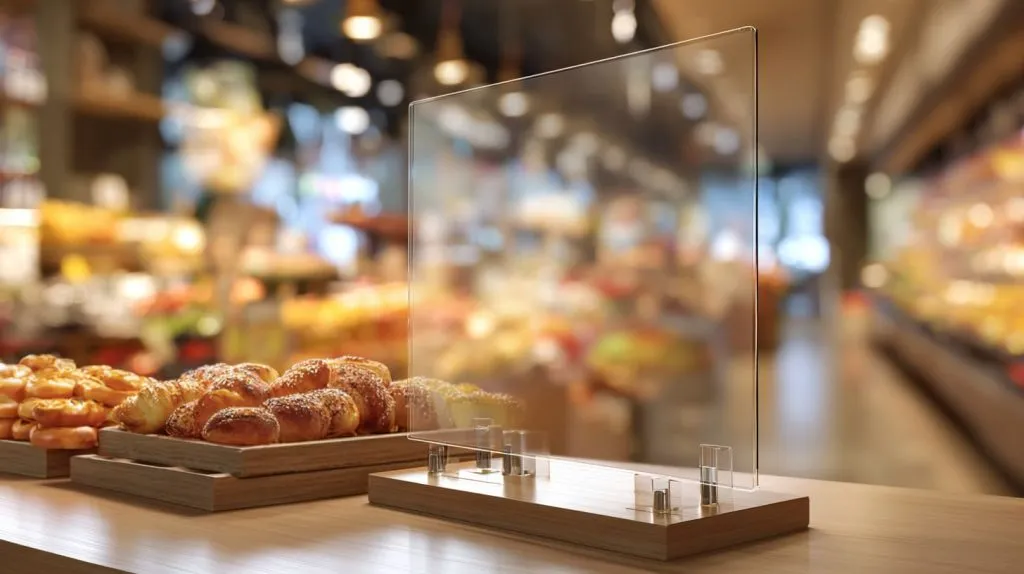
Some design mistakes are so common that I can spot them in a few seconds. Others hide behind “good enough” decisions that only reveal their problems after installation.
The frustrating part is that most of these mistakes are preventable.
Incorrect Height and Width
Height and width are the first two details I look at. A barrier must cover the actual interaction zone, not just decorate the center of the counter.
If it is too narrow, side bypass happens.
If it is too short, face-level protection weakens.
If it is too high from the counter surface, lower openings become too exposed.
A lot of people order from standard sizes without checking real staff height, customer posture, or device placement. That shortcut usually creates blind spots.
The mistake I see most often is choosing a panel size from a supplier list before mapping where the cashier’s head, the customer’s face, and the payment device actually line up.
Excessive Cut-Out Openings
Openings are necessary. I know that. Products must pass through. Cards must be inserted. Receipts must move. But the size and location of those openings can make or break the design.
A huge cut-out in the middle of the panel weakens the whole purpose of the guard. It is like building a fence and then leaving the gate wide open all day.
Common Opening Problems
- openings placed too high
- openings made too wide “just in case”
- one large central cut-out instead of a small low slot
- multiple unnecessary holes for different tasks
Better Thinking for Openings
| Opening Design Choice | Risk Level | Why |
|---|---|---|
| Large center opening | High | Direct path near speech zone |
| Small lower slot | Lower | Keeps opening below breathing line |
| Side opening near terminal | Medium to high | Encourages side leaning |
| Separate low handoff slot | Lower | Better for item transfer |
Thin or Unstable Materials
Material thickness gets underestimated all the time. A panel that bends, wobbles, or shifts during use will not hold its intended position. That creates new gaps and weakens user confidence.
I have seen thin clear panels look fine on day one and then start bowing, vibrating, or leaning after repeated daily use. In a busy store, that matters.
Acrylic can work very well, but thickness has to match span, mounting style, and traffic level.
Thickness and Stability Overview
| Thickness | General Use | Limitation |
|---|---|---|
| 3 mm | Light-duty, small barriers | Can feel light or flexible on larger spans |
| 4–5 mm | Common retail counter use | Better balance for many projects |
| 6 mm+ | High-traffic, larger structures | More stable, stronger visual presence |
Poor Mounting Methods
A good panel on a bad base still becomes a bad installation.
Temporary mounting methods often fail in small but important ways:
- tape loosens
- clamp alignment shifts
- unsupported bases slide
- uneven counters tilt the structure
- daily cleaning knocks the panel out of place
When I review a drawing, I never separate the sheet from the mounting. The sheet is only half the product. The mounting decides whether the guard stays where it should.
I have learned this the hard way: a beautifully cut panel can become a poor barrier if the mounting allows even minor movement during a normal cashier shift.
That brings us to another issue that buyers often reduce to cost alone, even though it affects function, lifespan, and appearance at the same time: material selection.
The Importance of Proper Material Selection

Material choice sounds simple until the project starts dealing with cleaning, impact, clarity, cost, weight, and fabrication limits all at once.
Then it becomes very real.
Acrylic vs Polycarbonate vs Glass
Each material has its place. I do not think there is one universal winner. I think there is a better fit for a specific counter, budget, and usage pattern.
| Material | Clarity | Impact Resistance | Weight | Fabrication Ease | Cost Level | My General View |
|---|---|---|---|---|---|---|
| Acrylic | Excellent | Good | Light | Excellent | Moderate | Best balance for many custom retail projects |
| Polycarbonate | Very good | Excellent | Light | Good | Higher | Good for tougher environments |
| Glass | Excellent | Depends on type | Heavy | Limited custom flexibility | Higher overall install cost | Good for premium fixed setups |
Why Acrylic Is Widely Used
Acrylic is widely used for good reasons, not just because it is cheaper than glass.
It offers:
- clear visibility
- lower weight
- easier CNC cutting and edge finishing
- easy custom shapes and openings
- strong visual cleanliness
- efficient production for B2B custom projects
I work with acrylic often because it makes real design work easier. If a buyer needs a specific slot location, a side return panel, polished edges, or a custom footprint, acrylic gives me room to solve the problem without turning the whole project into a heavy installation exercise.
What usually steers me toward acrylic is not only the material price, but how much easier it lets me solve awkward counter shapes without making the project slow or clumsy.
Thickness Considerations
Thickness is not a decoration detail. It affects stability, appearance, and durability.
For light-duty counters, 3 mm to 5 mm may be enough depending on size and support. For busier spaces or wider spans, 6 mm or more often makes more sense.
A Simple Thickness Guide
| Counter Type | Suggested Thickness Range | Reason |
|---|---|---|
| Small reception barrier | 3–4 mm | Lighter span, lower handling stress |
| Retail checkout shield | 4–5 mm | Better balance of cost and stiffness |
| Busy supermarket barrier | 5–6 mm+ | More stable under repeated daily use |
| Large custom freestanding unit | 6 mm+ | Better structural confidence |
Surface, Cleaning, and Visual Use
Material also affects daily maintenance. That matters more than many people expect.
A barrier that looks scratched, cloudy, or unstable after a few months can send the wrong message to customers and frustrate staff. A clear guard should stay clear enough to support normal communication, not become a visual annoyance.
I always tell buyers this: if a guard becomes hard to clean or unpleasant to look through, staff will start treating it as an obstacle instead of a protective tool.
Once the right material is chosen, design starts to matter even more. Good material cannot rescue a weak layout.
Best Design Practices for Effective Checkout Protection

This is where a sneeze guard moves from “something installed” to “something that actually helps.”
A better design does not need to be fancy. It needs to be honest about how checkout counters really work.
Full Coverage Barrier Design
The first goal is coverage. Not decorative coverage. Real coverage.
A good checkout barrier should extend across the active interaction width, not just the visual center line. In many cases, side returns or side panels help block lateral bypass that a flat front panel cannot control well.
What Full Coverage Often Includes
- front width that matches the active service zone
- side returns where customer angle movement is common
- enough depth to reduce edge bypass
- stable lower contact with the counter surface
| Design Feature | Why It Helps |
|---|---|
| Full front span | Covers the real talk-and-pay zone |
| Side panels | Reduces side bypass |
| Lower contact with counter | Limits open front gap |
| Combined barrier zones | Supports complex POS layouts |
Strategic Opening Placement
Openings should be small, useful, and placed low enough to avoid direct face-level exchange.
That means:
- keep pass-through areas below breathing height
- avoid oversized center windows
- separate payment and product transfer functions if needed
- place transaction points where people do not need to lean around the guard
I prefer small, intentional openings over one oversized “multi-use” cut-out. That one decision usually solves more risk than people expect.
Proper Height and Distance
Height should match the likely breathing zone during interaction. Distance matters too. If the barrier sits too far back, it may leave the exchange point exposed. If it sits too close to one user but not the other, behavior may shift around it.
I try to think in movement lines, not only measurements. Where will the staff member stand? Where will the customer tap the card? Where will the bag go? Where does the face naturally move during a question?
That is the kind of thing that separates a useful barrier from a symbolic one.
Stable Mounting Structures
A good barrier must stay put. That sounds obvious, but stability is one of the most ignored details in many projects.
Mounting Methods I Prefer
- fixed slot bases
- routed stands
- screw-fixed brackets where allowed
- anti-slip support details
- well-balanced freestanding feet for removable units
| Mounting Method | Good For | Watch Out For |
|---|---|---|
| Fixed bracket | Permanent counters | Less flexible for repositioning |
| Base stand | Easy installation | Needs enough footprint |
| Slot-in acrylic base | Clean appearance | Must match thickness well |
| Clamp system | Temporary setups | Can loosen over time |
A small wobble may not seem serious at the start, but I treat that as a warning sign because movement usually grows with daily cleaning, repeated contact, and staff frustration.
Design gets much better when it responds to the exact counter instead of forcing every counter into one generic shape. That is why custom work matters so much here.
How Custom Acrylic Guards Improve Safety
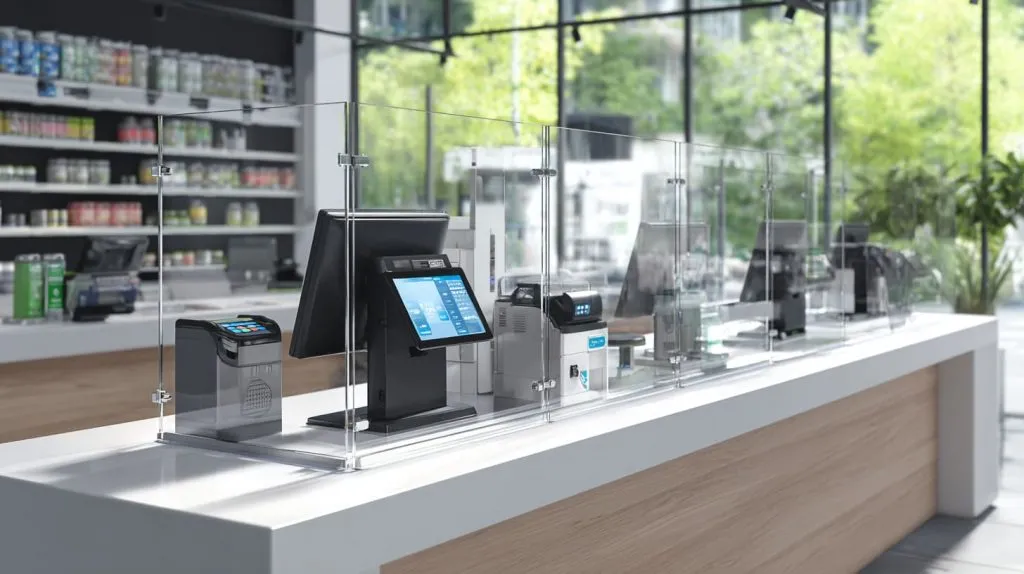
This is the part where I feel the difference between generic supply and real project work.
A standard sneeze guard can help in some spaces. A custom acrylic guard usually works better when the counter shape, device placement, and user behavior do not fit a simple template. And honestly, many checkout counters do not.
Tailoring Size to Specific Counters
No two checkout counters are exactly the same. Even when they look similar, small differences change the barrier design:
- scanner position
- counter depth
- card terminal angle
- bagging direction
- cashier stance
- customer queue line
A custom guard lets me size the panel around those details instead of pretending they do not exist.
I trust custom sizing most when I know the counter has one awkward feature, because one ignored scanner or one offset payment point can ruin an otherwise decent barrier.
Integrating POS Equipment and Product Flow
This part gets overlooked a lot.
The barrier should work with the POS system, not fight it. If the guard blocks product movement or makes payment awkward, people will start bypassing it. Once that happens, safety drops and frustration rises.
Good Custom Integration Often Includes
- openings aligned to card terminal location
- pass-through slots that suit product size
- side cuts for device arms or cable routes
- panel shapes that avoid scanner interference
- support legs placed away from busy hand zones
| Counter Element | Generic Barrier Problem | Custom Acrylic Solution |
|---|---|---|
| Card terminal | Customer leans around shield | Opening aligned below direct speech line |
| Barcode scanner | Panel blocks workflow | Cutout or adjusted footprint |
| Bagging area | Side bypass exposure | Extended side return or wider front |
| Receipt zone | Reaching around edge | Controlled access opening |
Professional Fabrication Advantages
Custom work only helps if fabrication is done well. Rough edges, poor polishing, weak bonding, or inaccurate dimensions can turn a custom project into a headache.
Professional acrylic fabrication gives practical advantages:
- CNC precision for exact slot locations
- polished edges for safer handling
- clean bends and joints
- better consistency across bulk production
- more reliable fit during installation
I care a lot about edge quality and dimensional accuracy because those small details are often what buyers use to judge whether a factory really understands the project or just copied a drawing.
Benefits for Retail Businesses
A better custom guard does more than improve protection. It also supports daily use.
Practical Business Benefits
- staff feel more comfortable
- customers understand where to interact
- the counter looks cleaner and more professional
- the installation lasts longer
- replacement and maintenance become easier to manage in repeat projects
| Business Goal | How Custom Guards Help |
|---|---|
| Staff protection | Better coverage and fewer bypass points |
| Workflow | Less awkward reaching and leaning |
| Store appearance | Cleaner, fitted visual look |
| Project repeatability | Easier to standardize after first successful design |
| Brand consistency | Custom size and finish can match retail environment |
And that is really where my view lands. The best sneeze guard is not the cheapest clear sheet that can stand on a counter. It is the one that respects how people actually use that counter.
That is also the right place to wrap this up.
Conclusion

I do not think sneeze guards are useless. I think many of them are oversimplified. That is a big difference.
A well-designed sneeze guard can help reduce direct exposure. But a poorly designed one can create a false sense of security. That false confidence is what bothers me most. It makes people believe the job is done when the real weak points are still wide open.
Throughout this article, I kept coming back to the same lesson. Failure usually comes from a few predictable issues:
- the shield is too small
- the openings are too large
- the airflow goes around it
- the customer moves around it
- the material is too thin
- the mounting is too weak
- the design ignores the real checkout workflow
The point I keep returning to in my own work is simple: I would rather build a barrier around actual behavior than approve a neat-looking drawing that falls apart the moment the store gets busy.
That is why I believe custom acrylic sneeze guards often make more sense for checkout counters. They let me adapt the width, height, slot position, side coverage, and support structure to the real environment. That is not about making things complicated. It is about making them honest.
I have worked with enough custom acrylic projects to know that tiny details carry big consequences. A slot moved a few inches lower. A side return added to one edge. A thicker sheet for a wider span. A better base that does not wobble after a week. Those are not glamorous decisions. But those are the decisions that usually separate a useful protective barrier from a piece of clear decoration.
If you are planning sneeze guards for a retail counter, pharmacy, cashier station, or service desk, I would urge you to look beyond standard sizes and ask harder questions. How do people stand there? Where do they lean? Where does the air move? Where do products pass? What will staff actually do during the busiest hour of the day?
If you want a custom acrylic solution built around the way your counter really works, you can contact us through Feilong Acrylic at flacrylic.com. I prefer starting with drawings, photos, and actual usage details, because that is how I make the guard fit the job instead of forcing the job to fit the guard.