Skip to content
What motivates this comparison?
The question didn’t come from a big corporate meeting or a formal product launch. It started in the middle of an ordinary workday—an email from a design engineer asking if clear acrylic or UV acrylic would look better for a high‑end display case. Ten minutes later, another message arrived from a buyer who wanted to reduce glare for retail shelves. By noon, I had three similar inquiries sitting in my inbox. That’s when I realised this wasn’t just coincidence—it was confusion shared across our industry. Many professionals, even experienced ones, struggle to decide which acrylic sheet type truly fits their project.
Why this matters for B2B custom‑acrylic manufacturing (and for you at Feilong Acrylic)
At Feilong Acrylic we specialise in custom orders for cosmetic organisers, store displays, household items. Every B2B client doesn’t just buy “acrylic sheet” — they buy the right sheet for their application. A mismatch in material type can lead to dissatisfied clients, extra cost, longer lead time, or worse—returns. So understanding the real differences between “clear acrylic”, “UV acrylic”, and “non‑glare acrylic” is essential.
How I approached the research
I spent time reviewing supplier datasheets, technical blogs, and customer feedback. For example, one article notes that UV‑filtering acrylic blocks up to 98% of harmful UV light.I also pulled in user‑forum comments where a designer found non‑glare acrylic softened print contrast.All of that experience plus our factory’s real production context feeds into this blog.
1. What is Clear Acrylic Sheet?

Definition & manufacturing overview
Clear acrylic sheet (also called “standard acrylic” or PMMA sheet) is a transparent plastic material made from polymethyl methacrylate. It comes typically in cast or extruded form.In manufacturing, cast acrylic offers superior optical clarity and better thermoforming behaviour than extruded.
Key physical/optical properties (clarity, light transmission, impact resistance)
- For transmission of visible light, acrylic can reach ~92% in good quality.
- Compared with glass: acrylic is lighter (about half the weight) and can have up to ~17× impact resistance versus ordinary glass.
- On the flip side: though clearer and lighter, it is softer surface‑wise, more scratch‑prone than glass.
Typical applications and use‑cases (displays, frames, signage)
Because of its clarity and cost‑effectiveness, clear acrylic is used for:
- Retail display cases and stands
- Cosmetic organisers and boxes
- Framing where cost is sensitive, and glare/reflection is acceptable
- Indoor signage and shelving where no extreme requirements
Pros & cons to consider (for custom orders)
| Pros | Cons |
|---|---|
| Bright, glass‑like clarity that keeps designs clean and modern | Strong glare under direct lighting; lacks built‑in UV or anti‑glare protection |
| Lightweight and easy to cut, polish, and bond—ideal for rapid fabrication | Outdoor exposure can cause yellowing or surface wear over time |
| Reliable choice for large‑volume or budget‑sensitive custom projects | Not ideal when premium optical quality or museum‑grade finish is required |
In our factory at Feilong Acrylic, clear acrylic is often the starting point for most bulk orders—it’s fast, predictable, and works well in many scenarios. But experience has taught me one thing: the simplest choice isn’t always the smartest one. Let’s see when and why that “default” might need a rethink.
Now that you have a handle on clear acrylic, let’s switch gears and explore UV‑filtering acrylic. The difference may surprise you.
2. What is UV‑Acrylic Sheet (UV‑Filtering / UV‑Blocking Acrylic)?

Definition & how it differs from standard clear acrylic
UV‑acrylic is essentially an acrylic sheet that has been formulated or coated to block harmful UV radiation, typically UV‑A or UV‑B wavelengths, rather than let them pass through. For example, an article states UV‑filtering acrylic blocks up to 98% of UV light.This makes it different from standard clear acrylic which does not inherently block that much UV.
UV‑protection mechanism & specification (e.g., % UV blocked)
The mechanism can be built‑in (additives in the sheet) or surface coatings. The specs vary: up to ~98%. For instance: “UV filtering acrylic blocks up to 98% of harmful UV light; UV transmitting acrylic allows up to 92% of UV ray transmission.”
Typical applications (museum frames, outdoor signage, protective glazing)
Because of its UV‑blocking property, UV acrylic is used when the substrate behind the sheet is sensitive to fading or UV damage. Examples:
- Framing of artwork or documents in well‑lit spaces
- Outdoor signage exposed to sunlight
- Display cases for sensitive items (antique cosmetics collection, museum pieces)
Pros & cons (cost, color shift, fabrication issues)
Pros:
- Protection of contents (fading, UV damage)
- Still has many of the clarity/impact benefits of standard acrylic
Cons: - Higher cost than standard clear acrylic
- Some UV filtering versions may have slight color cast or reduce visible light transmission slightly
- Fabrication (cutting, edge polishing) may need care if coatings are present
- For applications where UV is not a concern, paying extra may not add value
When I walk the floor at our factory in Dongguan, I often hear “Jacky wants UV‑sheet for outdoor display” — so it’s a real demand. But I also caution: “Are you sure you need it?” Let’s move on.
If UV protection is important, what if glare is your enemy? That’s where non‑glare acrylic comes in.
3. What is Non‑Glare (Anti‑Reflective / Matte‑Finish) Acrylic Sheet?
Definition & manufacturing method (matte texture, coating)
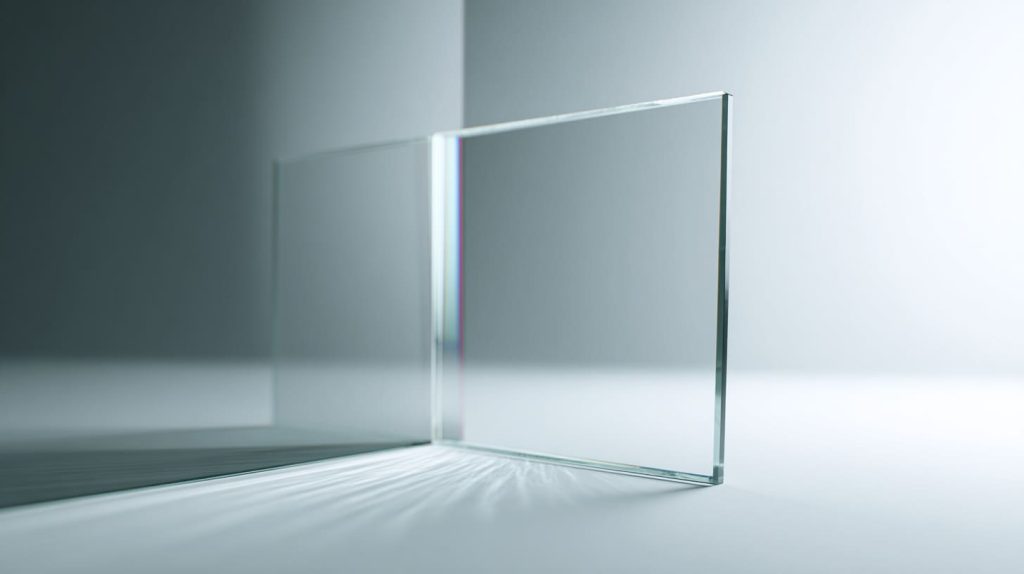
Non‑glare acrylic (sometimes called anti‑reflective or matte finish acrylic) uses a surface treatment or coating to scatter reflected light rather than let it reflect like a mirror. For example: “Non‑glare sheeting … uses a super‑light matte finish on the surface to diffuse incoming light and minimise reflections and glare.”
Optical behaviour: how it reduces glare/reflection, trade‑offs (clarity vs anti‑glare)
By diffusing reflections, non‑glare acrylic helps in bright light or display environments where glass or standard acrylic would reflect light and distract from the content. But there’s a trade‑off: some loss of sharpness, slight haze or softness in the view, reduced contrast behind the sheet. For example, a user on a framing forum noted:
“The dull finish reduces print contrast.”
Typical applications (art frames, exhibits, retail displays in bright light)
Because glare is the enemy in many public displays, non‑glare acrylic fits well for:
- Art galleries, exhibits under intense lighting
- Retail display cases under strong shop lighting
- Signage or display surfaces where reflections would impact readability
Pros & cons (surface finish, scratch resistance, cost)
Pros:
- Reduced glare/reflection = better visibility in challenging lighting
- Keeps viewer focussed on content behind acrylic
Cons:- Slight compromise on crisp clarity compared with standard clear sheet
- Matte surface may scratch differently or show wear differently
- Cost may be higher than standard clear; lead time, finishing may be more involved
By now you see: each sheet type is a trade‑space. To pick well, you must compare side by side. That’s exactly what we’ll do next.
4. Side‑by‑Side Comparison of the Three Types

Optical clarity & light transmission comparison
| Sheet Type | Light Transmission / Clarity | Notes |
|---|---|---|
| Clear Acrylic | ~90‑92% in ideal grade | Highest clarity, minimal haze |
| UV‑Acrylic | Slightly less (depends on additive/coating) | Slight reduction in visible light may occur |
| Non‑Glare Acrylic | More scattering of light; clarity slightly reduced | Trade warmth vs crispness |
UV protection & outdoor vs indoor suitability
- Clear Acrylic: minimal built‑in UV protection. If indoor and low light, fine.
- UV‑Acrylic: strong UV blocking (up to ~98%) for outdoor or high‑light exposure uses.
- Non‑Glare Acrylic: mainly anti‑reflection; may or may not include UV protection. If UV is required, ensure specs include it.
Reflection/glare behaviour in each type
- Clear Acrylic: high gloss, strong reflections in bright lighting.
- UV‑Acrylic: same gloss behaviour unless also treated; UV blocking does not equal anti‑glare.
- Non‑Glare Acrylic: designed to reduce reflections; better visibility in high‑light settings.
Fabrication and finishing considerations (cutting, edge polishing, welding, assembly)
- Clear Acrylic: standard fabrication workflows, lower cost.
- UV‑Acrylic: coatings/additives may require adjusted processing parameters (avoid edge damage, coating delamination).
- Non‑Glare Acrylic: surface texture may complicate edge polishing, bonding; finish care needed.
In a custom manufacturing line (like ours at Feilong) we often measure extra QC time for UV and non‑glare variants.
Cost, lead time and manufacturability for custom orders
- Clear Acrylic: lowest cost baseline, fastest lead time.
- UV‑Acrylic: higher cost, may require specific suppliers, slightly longer lead time.
- Non‑Glare Acrylic: cost depends on type of finish/coating; may reach lead time similar to UV variants.
For bulk B2B orders, the incremental cost must be justified by performance need.
Decision matrix: which‑type suits which scenario
| Scenario | Recommended Sheet Type |
|---|---|
| Indoor display, moderate lighting, cost‑sensitive | Clear Acrylic |
| Exterior signage, UV exposure, fading risk | UV‑Acrylic |
| Bright indoor display, glare from shop lights or windows | Non‑Glare Acrylic |
| Mixed demands (UV + anti‑glare) | Specify combined UV‑+anti‑reflection variant (higher cost) |
Whenever I walk through our factory’s cases with clients like Jacky (who has dealt with many Chinese manufacturers), I say: “Let’s map your environment. What’s the lighting? Is it outdoors? Will you risk fading or glare?” Because the wrong sheet type can lead to trouble.
Next I want to wear the manufacturer’s hat and look at the matter from our side, so you can see what goes on behind the scenes.
5. Considerations for B2B Custom Acrylic Manufacturing (from the factory’s perspective)

Material sourcing: raw sheet suppliers, quality specs (transparency, tolerance, certifications)
At Feilong Acrylic we source from trusted suppliers who provide sheets with high transparency, tight thickness tolerances, and eco‑certifications (e.g., GSG). For UV or non‑glare variants, we verify that the sheet specification includes the desired blocking or finish.
Production & finishing: processing differences for clear vs UV vs non‑glare acrylic
- Clear Acrylic: standard laser/CNC cutting, polishing edges, bonding, assembly.
- UV Acrylic: must ensure coatings/additives survive cutting/polishing without delamination.
- Non‑Glare Acrylic: matte finish must be treated carefully so edge polishing doesn’t gloss the surface or remove finish.
Our 5 production lines and 150+ skilled workers handle these variants; but I always remind our team: “Finish matters as much as material type.”Quality control: how to inspect for clarity, UV filtering, surface finish
- Clarity: visual inspection, light transmission tests.
- UV filtering: some suppliers provide lab reports; we may run spot tests or rely on certificates.
- Surface finish: for non‑glare sheets, we inspect for uniform matte texture, absence of polishing marks or gloss spots.
Custom branding / application: what your customers (like Jacky) expect when asking “clear vs UV vs non‑glare”
Jacky may ask: “Will this display case go into a storefront with large windows after noon? Will the cosmetics inside fade or get glare? What sheet should we use?” Our job is to translate that to specs: UV block > 90%? anti‑glare finish? whatever client priorities. If we just default to clear acrylic and ship, we may hit rework or client dissatisfaction.
Lead‑time & cost trade‑offs: balancing high quality, fast delivery, personalization and bulk
Since our motto is “Deliver high‑quality, custom solutions with fast lead times that are suitable for personalized or bulk orders,” we must balance: choosing a specialty sheet (UV/non‑glare) may push cost and lead time. We communicate transparently: “Here’s the trade‑off: up front cost goes up, lead time maybe 2‑3 days more.”
Common mistakes / pitfalls when specifying the wrong sheet type
- Choosing clear acrylic for outdoor signage → fading or damage over time.
- Choosing non‑glare acrylic for a display where clarity is critical (e.g., high‑end jewellery) → viewer perceives softness/haze.
- Ordering UV acrylic but not verifying coping/edge finish → coating delaminates at edges.
- Failing to tell the manufacturer the end‑use environment (lighting, exposure) → wrong sheet type ordered.
If you’ve read this far—great. But I want to help you wrap it up with actionable steps. Next: What should you devise when placing a custom order with your manufacturer? Let’s go.
6. Best Practice Recommendations & Selection Guide for Custom Orders

Step‑by‑step selection checklist for your clients
- Define environment: indoor/outdoor, lighting level, direct sunlight exposure.
- Define display purpose: is optical clarity the top priority? Is glare going to be a problem? Is fading or UV damage a risk?
- Match sheet type: use decision matrix from part 4 above.
- Confirm specs with manufacturer: sheet type name (clear/UV/non‑glare), percentage UV block (if relevant), surface finish description, supplier certificate.
- Confirm fabrication implications: machining, bonding, edge finishing compatible with chosen sheet.
- Confirm lead time and cost: ask for incremental cost differences between clear vs UV vs non‑glare.
Questions you should ask when specifying sheet type (environment, lighting, display purpose)
- Will the product be placed behind glass windows or under bright shop lights?
- Is the material behind the acrylic sensitive to UV (e.g., printed graphics, cosmetics, packaging)?
- Is glare or reflection going to interfere with visibility or user experience?
- What is the expected service life and maintenance environment (cleaning, transportation, scratch risk)?
Packaging, shipping and end‑user care considerations (to maintain optical quality)
Even with the right sheet, packaging and shipping matter. For example:
- Use protective film and avoid scratching surfaces, especially matte finishes.
- Provide cleaning instructions: e.g., non‑ammonia cleaner for acrylic to avoid coating damage.
- Consider climate‑controlled shipping if outdoor exposure or UV‑sensitive content is involved.
Future trends / innovations (e.g., new coatings, hybrid options)
In the acrylic sheet world, innovations continue: hybrid sheets that combine UV‑blocking + anti‑reflection coatings; abrasion‑resistant or anti‑static surfaces. Some brands highlight museum‑grade acrylic with 99% UV block + anti‑glare finish.Staying aware of supplier options helps you offer better custom solutions and stay ahead of competitor factories.
Conclusion
Summary of key take‑aways: when to choose each sheet type
• Use Clear Acrylic when clarity, cost, and simplicity matter— and the environment is moderate (indoor, low glare, low UV risk).
• Choose UV‑Acrylic when protection from fading, exposure to sunlight or strong lighting is needed.
• Opt for Non‑Glare Acrylic when glare/reflection is the main enemy— for example in retail displays under bright lighting.
Final advice for B2B custom manufacturers and their clients
When you’re specifying custom acrylic items, don’t assume “all acrylic is the same.” Take a moment to ask the right questions about environment, lighting, exposure, viewing angle. As the manufacturer, we must guide clients like Jacky through material choices so they don’t regret them later.
Why at Feilong Acrylic we prioritise the right sheet type for each application
At Feilong Acrylic we believe custom solutions aren’t just about shape or branding—they’re about fit for purpose. Our mission is to deliver high‑quality, custom solutions with fast lead times. That means selecting the right sheet type from the start, avoiding rework, reducing risk, and exceeding our B2B clients’ expectations. Because in the end, the right material means fewer problems, better performance, and happier clients—and that’s what keeps us focused.