Skip to content

On my workbench, a bright acrylic sample sat next to a matte ABS phone case. Both looked sturdy, but the difference in texture and shine was impossible to miss. This simple contrast made me pause. Why do we reach for one material over the other when building display stands, device housings, or custom parts? That question is where this comparison begins.
Why compare acrylic and ABS?
Sometimes the brief sounds simple: “We need a sturdy shell” or “Give me glass‑like clarity.” But as soon as cost, lead time, and true‑to‑spec machining enter the chat, acrylic and ABS square off in the same ring. I want to show where each one shines.
Snapshot of key differences
| Property | Acrylic (PMMA) | ABS | Quick Read |
|---|---|---|---|
| Transparency | ~92 % light transmission | Usually opaque, clear grades ~80 % | Need see‑through? Pick acrylic. |
| Impact resistance | Brittle under shock | High toughness, rubber phase | ABS survives drops better. |
| Machining ease | Mills cleanly, can craze | Forgiving, slower tool wear | Both work, tool choice matters. |
Before diving into the chemistry, let’s pause, roll up our sleeves, and see what these plastics are made of.
Chemical Composition & Molecular Structure

Monomer building blocks
I like to picture acrylic as a tidy chain of methyl methacrylate beads—everything lined up, nothing fancy. ABS feels more like a three‑ingredient stew: acrylonitrile for stiffness, butadiene bubbles for rubbery punch, and styrene to keep the mix workable.
Polymer morphology & variants
- Acrylic: fully amorphous—great for light travel, not so great for sudden hits.
- ABS: little rubber pockets inside a stiff shell; that combo soaks up energy when you drop it.
- Variants worth noting
- Weather‑able ABS with added UV blockers.
- Cross‑linked acrylic sheets that resist heat deformation.
Molecules sorted—now let’s put them under a stress test.
Mechanical & Physical Properties

Impact strength & toughness
Last year I demo‑dropped two 200 mm squares from shoulder height. The acrylic one snapped like sugar glass. The ABS only scuffed. Izod numbers agree: ABS runs 10–20 kJ/m², acrylic often stays below 2 kJ/m².
Tensile and flexural strength
Yet hold a flat panel under load and acrylic stays stiffer. It bows less in a shelving test, handy for display racks that shouldn’t sag.
Density & weight considerations
| Plastic | Density (g/cm³) | Sheet Weight (1 m² × 5 mm) |
|---|---|---|
| Acrylic | ~1.19 | ≈ 5.95 kg |
| ABS | ~1.05 | ≈ 5.25 kg |
That half‑kilo per square meter seems minor until you’re air‑freighting a thousand panels.
Our parts now have numbers behind them. Let’s see how they look under the lights.
Optical & Aesthetic Properties

Transparency & light transmission
I once placed an LED strip behind two samples. Acrylic glowed like a boutique sign; the clear ABS looked fine until minor haze dulled the edges.
Colorability & surface gloss
ABS accepts matte texture straight from the mold—great for tool handles. Acrylic wants a polish pass but rewards you with piano‑black shine.
Scratch resistance & surface hardness
A nail swipe leaves a faint mark on ABS, a brighter one on uncoated acrylic. Add a hard coat and acrylic suddenly wins, especially for retail shelving where keys and rings scrape daily.
Already picturing product photos? Hang on—we still need to test them against heat and weather.
Thermal & Environmental Resistance

Heat deflection & continuous‑use temperature
- Acrylic keeps its shape until ~160 °C.
- ABS starts softening near 105 °C.
If your unit sits close to a halogen lamp, acrylic sleeps easier.
UV stability & outdoor weathering
I’ve seen ABS dashboard trims fade from jet‑black to tired grey after one summer. Pure PMMA panels, by contrast, shrug off UV like sunscreen. (Still, our shop always offers UV‑stable ABS for outdoor kiosks.)
Chemical resistance profile
Cooking oil? Both pass. Harsh solvents? ABS whitens and cracks, acrylic crazes. Regular cleaners stay safe, but test first—Jacky once reminded me after a shipment where the client used alcohol wipes and learned the hard way.
Need to shape these sheets? Grab your tools.
Workability & Fabrication Methods

Cutting, machining & CNC routing
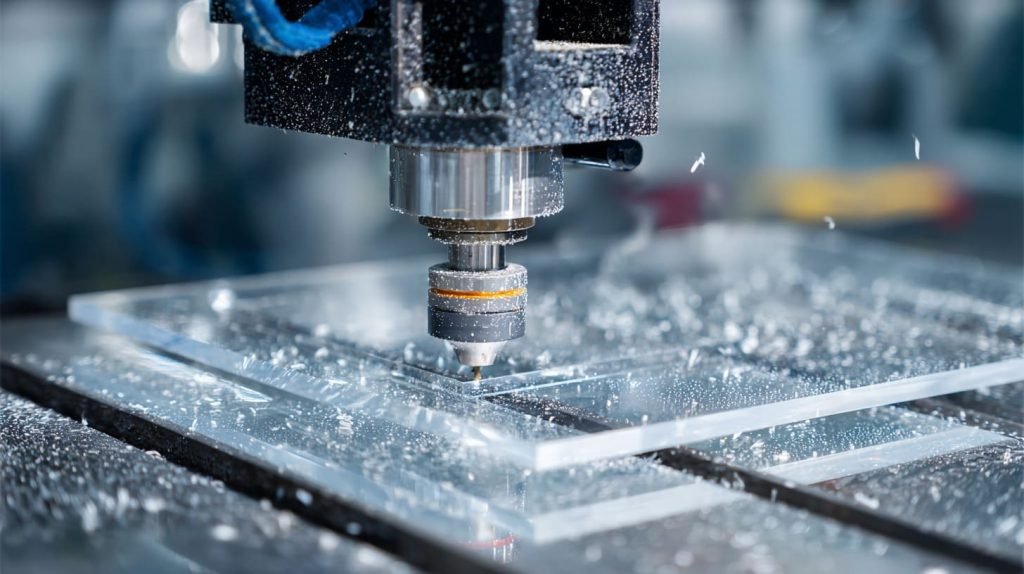
- Acrylic: Sharp carbide bits, high RPM, steady feed. Too slow and edges heat‑crack.
- ABS: More forgiving, chips curl nicely, tool lasts longer.
Thermoforming & injection molding
ABS slumps fast and forms deep draws, perfect for molded shells. Acrylic needs higher heat and risk of bubbles but rewards with better clarity in vac‑form domes.
Bonding, gluing & surface finishing
I still love the magic of solvent welding acrylic—edges fuse invisible. ABS bonds well with ultrasonic staking, handy for electronics housings.
Toolbox closed? Not quite; your calculator wants a word.
Cost & Supply Chain Considerations
| Factor | Acrylic Sheet | ABS Sheet | Quick Note |
|---|---|---|---|
| Raw material price (Q2 2025) | Higher | Lower | Commodity ABS benefits from volume. |
| MOQ for custom color | 300 kg | 100 kg | ABS easier for short runs. |
| Typical lead time (Asia) | 12–15 days | 7–10 days | Slotting into existing ABS capacity is faster. |
| Tooling for injection parts | $$$$ | $$$ | Both costly, but acrylic molds need polish. |
Scale often beats unit price. I’ve talked clients out of ABS just because polishing an acrylic mold once saved weeks of post‑process buffing.
Now, the planet and the paperwork.
Environmental Impact & Recyclability

Recycling codes & end‑of‑life pathways
- Acrylic wears the #7 badge—mixed plastics, tough to sort curbside.
- ABS shows #9; many recyclers still pass. Industrial take‑back programs help.
Carbon footprint & lifecycle assessment snapshots
Producing methyl methacrylate is energy heavy. Styrenic resins aren’t saints either, but combined ABS sometimes edges lower per kilogram. Real numbers swing by plant and region.
Regulatory compliance
Both can hit ROHS and REACH targets. For flame rating, note: standard acrylic is HB; specialty ABS can reach V‑0. I flag this early when quoting parts for telecom racks.
Greener choices logged. Let’s watch real‑world use.
Typical Applications

Acrylic use cases
- Retail displays that crave glass‑like sparkle
- Protective sneeze guards in cafés
- LED light diffusers where clarity meets diffusion
ABS use cases
- Laptop shells taking daily knocks
- Automotive interior trims that must flex in winter
- Rugged tool enclosures—think cordless drill housings
Hybrid constructions
Some of my favorite kiosks pair acrylic touch panels to ABS back plates—clarity up front, resilience behind. Clients like the best‑of‑both‑worlds feel.
Ready to pick one? Let’s build a quick checklist.
Choosing the Right Material for Your Custom Project

Performance‑vs‑aesthetics decision matrix
| Metric | Weight | Clarity | Impact | Unit Cost |
|---|---|---|---|---|
| Acrylic | ●● | ●●●●● | ● | ●●●● |
| ABS | ●●● | ●● | ●●●● | ●● |
Five dots = best in class.
Risk factors in real‑world environments
Ask yourself:
- Will users drop it from waist height?
- Will sunlight bake it eight hours per day?
- Will cleaning staff use solvent wipes?
Case study: Feilong Acrylic cosmetic organizer vs. ABS device cradle
I recently built two prototypes:
- Clear organizer for a beauty brand—laser‑cut acrylic, flame‑polished edges, UV printing. Cost landed higher, but the showroom lit it up like jewelry.
- ABS cradle for a handheld scanner—molded in one shot, matte finish, rubber over‑mold. It survived a 1 m drop test, something acrylic would hate.
Both clients smiled because each material fit its real job, not a marketing checklist.
We’re close to wrapping—but let’s pull the threads together.
Conclusion

Key takeaways
- Acrylic loves clarity and stiffness but fears sudden impact.
- ABS loves toughness and ease of molding but needs help with UV and transparency.
Recommendations for designers & buyers
Prototype small, test hard, and revisit specs with your supplier—ideally early. If you need help, my team at Feilong Acrylic is a message away. We’ll guide you through trade‑offs before the first sheet is even cut.