Skip to content

When you walk into any workshop that deals with custom displays, and you’ll spot a familiar scene: someone holding a sheet of plexiglass in one hand, torch in the other, debating whether to go for the bend. That moment—right before flame meets plastic—is full of hesitation. I’ve been there. The first time I had to make a clean, precise bend on a live project, my hands shook a little. Not because I doubted the material, but because I didn’t fully understand how it behaves under heat.
Since then, torch bending has become one of my go-to techniques. Whether I’m building a freestanding brochure stand or a curved cosmetic tray, it gives me control over the form—clean, joint-free, and visually seamless. But it also demands respect. A few seconds too long in the wrong spot and you've got bubbles, burns, or worse—warped edges you can’t undo.
This guide is everything I wish someone had handed me before I lit that first flame.
Why bending plexiglass with heat is a go-to technique for custom displays
When a client asks for a sleek cosmetic riser or a curved brochure stand, heat-forming lets me turn a flat sheet into a flowing shape—no joints, no glue lines. A single clean bend saves assembly time, keeps costs down, and looks seamless on retail shelves.
Torch bending vs. strip heaters, ovens, and heat guns—quick comparison
| Method | Speed | Best For | Drawbacks |
|---|---|---|---|
| Torch | Fast, on-demand | One-off bends, tight spots | Risk of scorching if you linger |
| Strip Heater | Medium | Repeated straight bends | Higher upfront cost, fixed width |
| Oven | Slow | Large sheets, multiple bends | Space-hungry, uneven heat at edges |
| Heat Gun | Moderate | Light gauges, spot fixes | Hard to keep heat uniform |
Those trade-offs matter; choose the wrong heat source and the sheet may cloud, bubble, or warp.
Twenty seconds, one breath, and we’re ready to peek under the surface at what actually happens when a torch meets plexiglass.
Understanding Plexiglass Heat Behavior

Softening & glass-transition temperatures you need to know
Plexiglass (PMMA) begins to soften around 90 °C (194 °F) and reaches its glass-transition zone near 105 °C (221 °F). Below that range it springs back; above it, gravity takes over. I keep an infrared thermometer nearby, but I also watch for a subtle surface gloss—my “visual thermometer.”
How thickness affects minimum bend radius
A rule I live by is radius ≈ 10 × thickness. A 3 mm sheet can wrap around a 30 mm pipe without whitening. Push tighter and micro-craze lines appear. I’ve tested this in our lab and logged the safe radii:
| Thickness (mm) | Safe Bend Radius (mm) |
|---|---|
| 2 | 20 |
| 3 | 30 |
| 5 | 50 |
| 10 | 100 |
Protective films, coatings, and how they change heat response
Leave the film on and you’ll trap air pockets that blister. Peel it, and bare acrylic picks up dust like a magnet. I peel only a 2 cm strip along the bend line and mask the rest with aluminum foil—cheap, clean, and heat-proof.
The more you know about the plastic’s mood swings, the less it will surprise you. Ready to suit up?
Safety Precautions Before You Start

Essential PPE: eye protection, gloves, respirator
I once ignored goggles “just for a quick bend.” A tiny bubble popped, spitting molten acrylic onto the bench—lucky escape. Since then: ANSI-rated goggles, cut-resistant gloves, and an organic-vapor respirator every single time.
Ventilation and fume management in small shops
Burnt PMMA smells like singed hair mixed with vinegar. I set a box fan next to an open window and clip a simple charcoal filter in front. In winter, a ducted fume hood is worth every dollar.
Fire-safe workspace setup and torch handling basics
Clear a one-meter radius, store solvents away, and keep a charged ABC extinguisher at arm’s length. When I train new staff, I hand them a cold torch first—no flame—so muscle memory builds before heat ever joins the party.
A safe shop isn’t slow; it’s steady. Let’s gather the gear that makes steady possible.
Tools and Materials Checklist

Choosing the right torch (propane, butane, MAPP) and diffuser tips
- Propane: Cheap, broad flame—great for 4 mm+ sheets.
- Butane: Gentle, precise for thin gauges.
- MAPP: Hot and fast; I use it only on very thick edges.
Attach a spoon-shaped diffuser to spread heat and dodge hot spots.
Jigs, clamps, angle guides, and heat-resistant surfaces
A scrap of MDF wrapped in aluminum tape makes a quick jig. Spring clamps hold the sheet against a machinist’s square so every bend on a production run matches.
Marking tools, aluminum foil masking, and edge protectors
Pencil burns away; China marker survives heat. Foil masks guard clear zones, and silicone edge guards stop freshly bent parts from denting while they’re still rubbery.
Gear assembled, checklist ticked. Time to prep the plastic itself.
Preparing the Plexiglass

Removing protective film and cleaning the sheet
I peel just the bend zone, then wipe with 70 % isopropyl. Anything greasy turns into a smoke stain once the torch hits.
Accurate layout: marking straight and curved bend lines
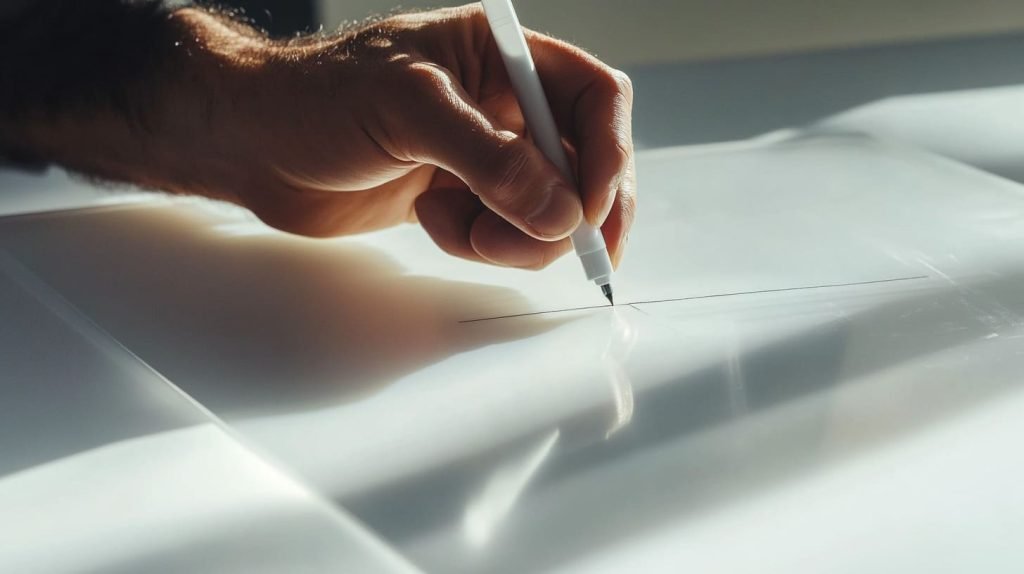
I draft bend lines on CAD, print a template, and tape it under the clear sheet—no guesswork. For curves, a flexible stainless ruler keeps the line smooth.
Pre-heating or light scoring for tight-radius bends
On 2 mm stock I sometimes score 20 % of the depth with a dull blade. This weakens the hinge so I can bend tight without overstressing the outer surface.
Sheet’s clean, lines are crisp, and anticipation is rising. Let’s build the stage for the main act.
Setting Up Your Work Area and Jig

Building a simple bending fixture from scrap wood or metal
Two planks, a piano hinge, and a handle give you a DIY brake. Line the contact face with felt to avoid imprinting the acrylic.
Positioning supports to prevent sagging & deformation
I slide a 10 mm steel rod under wide panels; gravity does the curve while the torch travels the length. Without support the center bows and never fully recovers.
Securing clamps for repeatable angles on multiple pieces
A stop block set at 90 ° turns production runs into a rhythm: heat, lift, press, cool—next sheet.
Fixture locked down, torch hissing softly—this is where plastic meets fire.
Torch Technique: Heating the Bend Line

Correct torch distance, sweep speed, and flame width
I keep the nozzle about 5 cm away and move at 2 cm per second. The flame should be wide enough to cover the bend zone but not lick beyond it.
Adjusting flame temperature for different acrylic grades
- Cast acrylic: Handles heat better—blue-orange flame is fine.
- Extruded acrylic: Softer; I dial back the regulator until the flame turns pale blue.
Visual cues: glossy surface sheen, slight sag, and edge softness
When the surface goes from matte to glassy and the sheet starts to droop, I know the core has reached the sweet spot. A gentle press with a wooden stick should leave a faint dent.
The plastic watches the flame, waiting for that moment to surrender. Let’s move fast before it cools.
Making the Bend

Timing the bend—how to know the exact moment to apply pressure
If you see bubbles, you’re late; if the sheet feels stiff, you’re early. I test by nudging the edge—when it moves with minimal force, I commit.
Using molds or guides for precise angles and curves
For 45-° brochure stands, I rest the sheet against a beveled wood block. For curves, I wrap it around a pre-heated stainless tube and clamp until firm.
Holding the piece until the acrylic sets in place
Acrylic loses heat quickly. I count ten slow breaths—about 30 seconds—before releasing pressure. Any sooner and spring-back ruins the angle.
The bend holds, the shape emerges, but the story isn’t finished until we cool things down right.
Cooling & Annealing
Slow, controlled cooling vs. water quench—pros & cons
| Cooling Method | Speed | Internal Stress | Surface Finish |
|---|---|---|---|
| Air | Slow | Low | Clear |
| Fan-assisted | Moderate | Medium | Clear |
| Water quench | Fast | High | Risk of crazing |
Post-bend annealing to relieve internal stress (thick sheets)
I park 8 mm bends in a 70 °C oven for an hour, then let them drift to room temp overnight. It takes discipline, but customers notice when parts stay flat for years.
A cheap polarized film over a flashlight turns stress into rainbow fringes. No colors? The part is happy.
Cool, clear, and stress-free. Now let’s make those edges shine.
Post-Bend Finishing

Trimming edges and scraping away scorch marks
I shave rough spots with a sharp scraper at 45 °. One light pass is kinder than sanding through a haze of dust.
Flame-polishing or sanding for optical clarity
A quick kiss from a clean alcohol flame melts micro-scratches into a mirror finish. Thicker edges may need wet-sand up to 2000-grit before polishing.
Final cleaning and anti-static treatments
I wipe with a diluted fabric softener—old sign-maker trick—to keep dust from racing back.
Even pros slip up sometimes. When they do, here’s how I rescue the work.
Troubleshooting & Common Mistakes

Preventing bubbles, crazing, and milkiness in bends
Bubbles mean you overheated. Crazing comes from too much stress or solvent wiping pre-bend. Milkiness usually signals moisture—dry sheets at 60 °C for two hours before bending.
Fixing burn marks and soot deposits
Light sand with 600-grit, then flame-polish. Deep burns? Trim the edge and start again; no shame in a fresh cut.
Correcting warped or uneven angles
Reheat only the affected side and press against a straightedge. Patience beats brute force.
Once you tame the common pitfalls, you’ll be ready to explore advanced territory.
Advanced Tips & Alternatives

Line benders and strip heaters for production runs
A heated nichrome element under a slotted groove produces laser-straight bends—ideal for 200-piece orders.
Oven and heat-gun methods for large panels
For museum cases over one meter, I slide the whole sheet into a convection oven, then bend on padded sawhorses with two helpers guiding the edges.
CNC-controlled hot-wire or infrared bending for complex geometries
Our newer IR system plots temperature and time per axis, letting me program a compound S-curve that repeats within ±0.5°. Perfect for architectural light diffusers.
Of course, sometimes you’d rather have someone else worry about all this heat and timing.
When to Outsource to Professionals

Multi-axis bends, tight radii on thick sheets, and high-volume orders
If you need a 12 mm sheet twisted like a Möbius strip for a trade-show sculpture, send it out. The scrap risk alone makes outsourcing cheaper.
Quality, speed, and consistency benefits of professional services
Pros run calibrated ovens, vacuum fixtures, and laser verification. That consistency cuts your QA time to almost zero.
How Feilong Acrylic can execute custom bends to spec
At Feilong Acrylic, we pair CNC-guided IR heaters with seasoned hands. Five production lines, ISO9001 processes, and 13 years of export experience mean your curved vision lands on your dock, shine intact and deadline safe.
Whether you DIY or delegate, the roadmap stays the same: understand the plastic, respect the heat, and never rush the cooldown.
Conclusion

Torch bending plexiglass isn’t black magic. With basic safety, the right jig, and a feel for that glassy moment before the sag, you can sculpt clean curves on demand. Start on scrap, keep your thermometer handy, refine each pass—and watch flat sheets blossom into functional art.