Skip to content

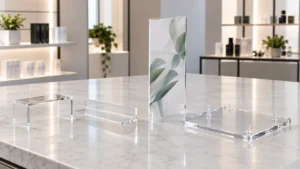
At a recent trade show in Guangzhou, a buyer from Germany stopped by our booth. He pointed to a sleek, edge-lit shelf sample we’d placed on the table and asked, “Is this plastic or composite?” His tone wasn’t skeptical—he was genuinely curious. To him, the piece looked too stiff for acrylic but too smooth for fiberglass. I smiled. That question gets asked more than you’d think.
Why B2B buyers need to distinguish plastics from composites
- If I order the wrong sheet, my cost per unit jumps and the client calls it quality drift.
- When Jacky specs the wrong material, his display may bow in summer heat or crack during winter shipping.
- A precise label up front keeps our projects on schedule—and our friendship intact.
Snapshot of the key differences
- Plastics are single-phase polymers—picture a pure acrylic perfume riser.
- Composites mix phases—imagine that same riser but with glass fibers sandwiched inside for stiffness.
A misnamed material is like a mislabeled airport gate: you end up somewhere you never planned to land.
Curious how those labels came to be? Let’s step back and pin down the basics.
Definitions and Material Basics

What is a plastic? (thermoplastics vs. thermosets)
I walk the factory floor every day, and I can smell the difference. Thermoplastics soften as the extruder heats; thermosets give off a faint curing scent and never melt again. One is reusable; the other is permanent.
What is a composite?
Think of grandma’s fruitcake—bits of nut, cherry, and dough baked into one solid slice. A composite works the same way: fibers or particles float in a matrix, each adding something the other lacks.
When does a plastic become part of a composite?
A plastic resin can moonlight as the matrix: epoxy hugs carbon fibers, PP locks glass fibers, and even PMMA can bond wooden veneers for fancy retail shelves.
Definitions sorted, but real power hides in the structure. Let’s zoom in.
Structure and Composition: Single Polymer vs. Reinforced Matrix

Molecular architecture of common plastics (PP, PET, PMMA)
- PP feels waxy because of its long, semi-crystalline chains.
- PET loves carbonated drinks; its tight packing blocks CO₂ escape.
- PMMA (acrylic) bends the showroom lights just right thanks to its amorphous clarity.
Fiber, particle, and laminate reinforcements in composites
Continuous carbon fibers in a bicycle frame act like bundled steel cables. Add chopped glass into PP and you get a dashboard that shrugs off afternoon sun.
Role of the matrix (polymer, metal, ceramic)
The matrix is the friend who keeps the group together under pressure. It shares the load, seals out moisture, and sets the service temperature ceiling.
Okay, materials peeked under the microscope—now let’s talk factory rhythm.
Manufacturing Processes and Scalability

| Process | Plastics: Typical Cycle | Composites: Typical Cycle | Labor Intensity | Best For |
|---|---|---|---|---|
| Injection molding | 30 s per shot | Rarely used | Low | 50 k phone cases |
| Extrusion | Continuous | Pultrusion (slower) | Low-Medium | Profiles, tubing |
| Thermoforming | 10–60 s | — | Low | Point-of-sale trays |
| Hand lay-up | — | 2–24 h cure | High | Boat hulls, art panels |
| RTM | — | 10–60 min | Medium | Car hoods, wind blades |
Longer cure times often scare buyers, yet composites shine when geometry grows tricky or when weight must drop.
Speed is nothing without strength. Let’s pit them head-to-head.
Mechanical & Physical Properties Comparison

| Property | Unfilled PP | Glass-Fiber PP | PMMA Sheet | Carbon-Fiber Epoxy |
|---|---|---|---|---|
| Tensile Modulus (GPa) | 1.5 | 4.0 | 3.2 | 70 |
| Density (g/cm³) | 0.90 | 1.10 | 1.19 | 1.60 |
| Heat Deflection (°C) | 85 | 125 | 90 | 150 |
| Impact Strength (kJ/m²) | 30 | 50 | 20 | 18 |
Strength-to-weight ratio and stiffness
Twice the modulus often costs only 20 % more in material—worth it when sag ruins display alignment.
Impact and fatigue resistance
Plastics flex; composites resist permanent creep. Yet repeated impact favors ductile polymers.
Thermal, chemical, and UV stability
My rooftop solar bracket learned the hard way: UV can chalk an unprotected ABS in six months, while a fiberglass shell lasted three summers.
Dimensional stability and creep
Fiber frameworks tame long-term creep, perfect for high shelves that must stay level through seasonal swings.
Numbers aside, every dollar spent whispers a story. Let’s follow the money.
Cost, Lifecycle & Maintenance

| Stage | Plastics (ABS) | Composites (GF-PP) |
|---|---|---|
| Raw Resin ($/kg) | 2.2 | 3.0 |
| Tooling ($, 2-cavity) | 15 000 | 18 000 |
| Cycle Time (s) | 35 | 50 |
| Repair Approach | Heat weld | Resin patch |
| Avg. Service Life (yr) | 5 | 8 |
Raw material and production cost drivers
Oil prices sway ABS; fiber supply shakes GF-PP. I hedge by dual-qualifying vendors for both.
Maintenance and repairability
Acrylic cracks? I flow solvent and rebuff. Carbon shell splits? I sand a scarf, layer cloth, vac-bag overnight.
Total cost of ownership (TCO)
Weigh tooling amortization, downtime, and disposal fees. Sometimes the pricier composite wins by lasting longer with fewer returns.
Money talks, but our planet listens too. Let’s hear that side.
Environmental Impact and Sustainability

Carbon footprint of production
Extrusion sipping 120 °C water < autoclave baking at 180 °C for 4 hours. Energy bills and CO₂ bills align.
Recyclability and end-of-life pathways
- Plastics: melt-regrind—simple, yet mechanical properties dip.
- Composites: grind + pyrolysis—tech exists, economics lag.
- Hybrid hope: reclaim fibers, blend matrices into decking boards.
Regulatory trends & eco-labels
EU’s EPR nudges brands toward mono-material designs; Canada echoes with its own plastics pact. I feel the shift in every RFQ Jacky emails.
Sustainability sparks ideas for fresh markets. Where do these materials actually end up?
Typical Applications Across Industries

| Sector | Typical Plastic Part | Typical Composite Part |
|---|---|---|
| Consumer Goods | PET bottle, PMMA makeup tray | Bamboo-fiber PLA spoon |
| Construction | PVC window frame | Wood-plastic composite decking |
| Automotive | ABS fascia, PP trim | Carbon-fiber spoiler |
| Electronics | Clear acrylic showcase (our specialty) | Glass-fiber kiosk shell |
My own showroom holds both: crystal-clear acrylic stands for perfume, matte fiberglass housings for digital signage. Each plays to its strengths.
Form meets function, but aesthetics close the sale. Let’s shape and tint.
Design Flexibility & Aesthetic Options

Forming complex geometries
A three-axis CNC carves acrylic letters in minutes. Composites require patient lay-up, yet curve gracefully where plastics wrinkle.
Surface finishes, colors, and transparency
I can diamond-polish PMMA edges until they glow. Composites accept a paint coat or gel-coat that hides weave and matches brand Pantone.
Integrating functional additives and inserts
Need EMI shielding? Blend carbon black into ABS or embed a copper mesh inside the composite lay-up. Both routes work—budget and weight decide.
Options can overwhelm. How do we choose smartly?
Decision Framework for Purchasing Managers

| Metric | Acrylic Plastic | Glass-Fiber Composite |
|---|---|---|
| Tensile Strength (MPa) | 70 | 140 |
| Clarity (%) | 92 | 0 |
| MOQ (units) | 1 000 | 200 |
| Lead Time (days) | 15 | 25 |
| Unit Cost (\$ for 500) | 4.5 | 5.8 |
Performance vs. budget matrix
Plot desired strength against cost—pick the quadrant that lands you under budget with room for safety factors.
MOQ, lead time, and supply-chain risk
Plastics sprint; composites jog but flex on volume. One hurricane in the fiber region can freeze schedules—diversify vendors.
Case study: acrylic plastic vs. glass-fiber composite for store fixtures
The mall kiosk needed edge-lighting. We chose acrylic for clarity, added ribs for stiffness, cut weight 15 %. Jacky’s team praised cheaper shipping and simpler branding.
Where are materials headed next? Let’s peek around the corner.
Emerging Trends & Innovations

Bio-based and recycled polymers scaling up
rPET demand jumps yearly; I’m already sampling algae-based PMMA for a beach resort client.
3-D printed continuous-fiber composites
Desktop machines now lay carbon tape into nylon. Perfect for jig fixtures—Jacky printed one to align LED strips last month.
Smart composites with embedded sensors
Wind blades report micro-cracks via fiber-optic threads. Imagine retail shelves that ping inventory counts without cameras—closer than you think.
Choosing the right material may still feel like decoding a secret menu. Let’s wrap up with a cheat sheet.
Conclusion

Key takeaways for informed material selection
Pick plastics for clarity, speed, and recycling ease; choose composites when stiffness, weight savings, or multi-functionality trump all else. Evaluate full lifecycle costs and always pilot before a big roll-out.
How Feilong Acrylic supports custom plastic solutions
For 13 + years, my team in Dongguan has turned sketches into ISO-certified acrylic parts—rapid CNC prototypes, laser-cut runs, and OEM branding. Whether you need one crystal-clear display or a thousand edge-lit stands, we deliver fast, honest, and to spec. Jacky knows where to find me—now you do too.