Skip to content
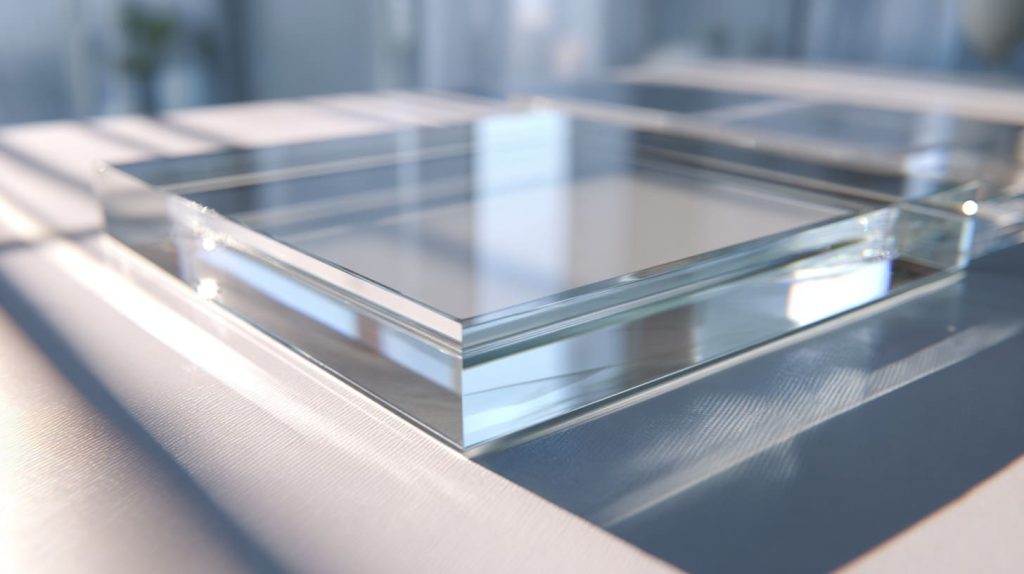
Acrylic can look calm under showroom light.
Clear edge.
Clean surface.
Nice shine.
Good packaging.
The sample sits on the table and everyone feels safe.
But sunlight is not polite.
It does not ask for permission before it starts working on the material. It does not damage acrylic in one dramatic moment. It works quietly. Day after day. Window after window. Summer after summer.
That is why UV protection is often ignored until it is too late.
In custom acrylic product projects, many buyers care first about the visible things. I understand that very well. They check the shape, thickness, polish, logo position, packaging, color, price, and delivery time. These things feel urgent because they are easy to see and easy to discuss.
But UV resistance feels different.
It feels far away.
It feels like a future problem.
It feels like something that can be solved later.
This is where I become careful: when a buyer tells me the product will sit near sunlight, in a window display, in a store entrance, or outdoors, I do not treat UV protection as a small optional detail, because the product may look perfect today and still become a complaint six months later.
That is the painful part.
UV damage usually does not show up during sampling. It shows up after the product has been shipped, installed, touched by customers, photographed by users, and judged by the market. By that time, the factory cannot simply say, “The sample looked good.” The buyer cannot simply say, “We did not know.” The customer only sees one thing:
The product looks old too soon.
And for acrylic products, looking old too soon is dangerous. Acrylic is often chosen because it looks clean, bright, and premium. If it turns yellow, hazy, brittle, or warped, it loses the very reason people selected it in the first place.
So this article is not only about UV light.
It is about the small questions we should ask before production. It is about the hidden cost of ignoring the real environment. It is also about how I think when I help a buyer choose acrylic material for displays, boxes, frames, signage, organizers, and other custom products.
Because in real business, a product does not fail only because the design is bad.
Sometimes it fails because one quiet detail was never discussed.
Before we talk about cost, testing, or design, we need to understand what UV radiation actually does to acrylic. That is where the story becomes more practical.
What Does UV Radiation Actually Do to Acrylic Products?
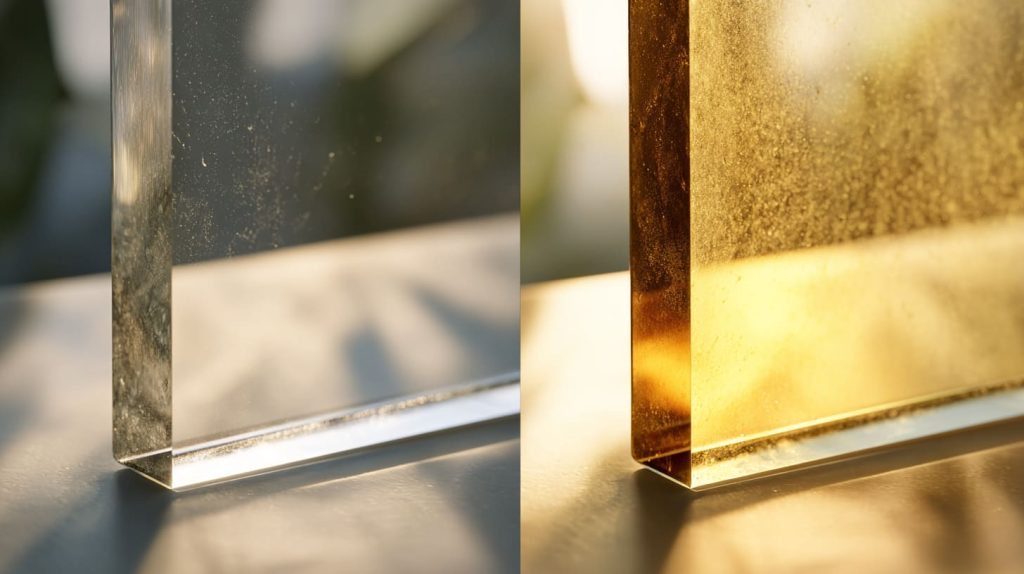
UV radiation is invisible, but its effect is not invisible forever.
Acrylic is loved because it has high clarity. It can look almost like glass, but it is lighter and easier to fabricate. This is why many buyers use it for displays, boxes, frames, cosmetic organizers, product stands, shelves, and signage.
But acrylic is still a plastic material. It has a structure inside. When UV light keeps hitting that structure, the material can slowly change.
The tricky part is simple: the buyer may not see the change at the beginning.
A product can pass the first inspection. It can look beautiful in photos. It can make the buyer feel confident. Then, after months of sunlight exposure, the surface starts telling a different story.
For me, the key question is not “Does the product look good today?” but “Will this same product still look acceptable after living in its real environment?”
How ultraviolet light interacts with acrylic material
UV light carries energy. When it hits acrylic again and again, it can affect the material surface and the internal structure. This does not mean every acrylic product will fail quickly. It means the risk depends on material grade, exposure time, sunlight intensity, heat, humidity, and product design.
Acrylic used indoors under normal room lighting may stay clear for a long time. But acrylic exposed to direct sunlight, especially near windows or outdoors, faces stronger stress.
I like to explain it in a simple way.
Indoor light is like a quiet visitor.
Direct sunlight is like a worker with tools.
It keeps working.
| Exposure condition | Typical risk level | What may happen |
|---|---|---|
| Indoor room light | Low | Usually stable for normal use |
| Near window sunlight | Medium | Yellowing or haze may appear over time |
| Storefront window | Medium to high | Heat and UV can speed up aging |
| Outdoor shaded area | Medium | UV risk still exists even without full sun |
| Outdoor direct sun | High | Yellowing, cracking, brittleness, or warping risk increases |
The material does not always fail in one way. Sometimes it changes color. Sometimes it loses clarity. Sometimes the edge becomes more fragile. Sometimes the product still looks “okay” from far away, but the buyer feels something is wrong when holding it.
That small feeling matters.
In acrylic products, the surface is part of the value. When the surface loses its clean look, the product loses trust.
Common visible signs of UV damage
UV damage often appears slowly. This is why people underestimate it.
A buyer may receive a customer complaint that sounds vague:
“The product became yellow.”
“The surface is not clear anymore.”
“The display looks old.”
“The edge cracked.”
“The sign panel is bending.”
These complaints are not always caused by UV alone. Heat, poor material, wrong cleaning, chemical exposure, and stress from installation can also play a role. But UV is often one of the hidden forces behind the problem.
Here are common signs I watch for:
| Visible sign | What it means in real use | Why buyers care |
|---|---|---|
| Yellowing | The acrylic loses its clean clear look | Product feels cheap or old |
| Brittleness | The material becomes easier to crack | Higher breakage risk |
| Surface haze | The surface looks cloudy | Display clarity drops |
| Loss of gloss | The product looks dull | Premium feeling disappears |
| Warping | The panel bends or changes shape | Assembly and appearance problems |
| Discoloration | Color no longer matches the approved sample | Brand consistency suffers |
Yellowing is often the most emotional complaint.
Why?
Because customers do not need a technical report to notice yellowing. They see it immediately. A clear display that turns yellow feels dirty. A picture frame cover that turns hazy makes the photo look tired. A cosmetic organizer that loses clarity makes the bathroom counter look messy.
And nobody wants to explain molecular aging to an angry customer.
Why some acrylic grades fail faster than others
Not all acrylic materials behave the same.
Some acrylic sheets are made for general indoor use. Some are made with better UV resistance. Some materials come from stable suppliers with better quality control. Some materials are cheaper, but the long-term performance is less predictable.
This is where buyers need to be honest about the product’s job.
A temporary indoor display does not need the same material as outdoor signage. A small household organizer used away from sunlight does not face the same risk as a window display in a sunny city.
| Material choice | Typical use | Main concern |
|---|---|---|
| Standard acrylic | Indoor displays, boxes, shelves | Good for normal indoor use |
| UV-resistant acrylic | Window display, outdoor sign, long-term exposure | Better aging resistance |
| Colored acrylic | Decorative or branded products | Color fading risk |
| Low-grade acrylic | Low-cost projects | Higher risk of yellowing or defects |
| High-transparency acrylic | Premium displays and frames | Clarity must be protected |
The cheapest material may pass the sample stage. That is the trap.
A sample is only a short conversation with the material. Real use is a long marriage.
I have seen buyers spend a lot of time choosing the perfect logo color, but only a few seconds discussing sunlight exposure. I do not blame them. The logo is visible. UV risk is invisible. But invisible does not mean unimportant.
And this leads to the next question: if the risk is real, why do so many buyers ignore UV protection at the start?
Why Do Many Buyers Ignore UV Protection at the Beginning?

Most buyers do not ignore UV protection because they are careless.
They ignore it because the project has louder problems.
The drawing needs to be confirmed.
The sample must be made.
The price must fit the budget.
The logo position must be approved.
The packaging must pass shipping.
The delivery date is coming too fast.
UV protection sits quietly in the corner. Nobody feels pressure from it today.
But that quiet corner can become very expensive later.
When I review a new acrylic project, I pay attention to what the buyer does not mention, because missing information often creates more risk than wrong information.
The product looks perfect during sampling
A new acrylic sample can be very convincing.
It has a clean cut edge.
The surface has protective film.
The shape matches the drawing.
The buyer takes photos and sends them to the team.
Everyone says, “Looks good.”
But a sample does not live like the final product.
A sample may stay in a factory office for a few days. It may be checked under indoor light. It may never sit in direct sunlight. It may never face summer heat near a shop window. It may never be cleaned by a store worker with the wrong cloth and chemical cleaner.
So the sample can pass.
But the application may still fail.
| Sample condition | Real use condition |
|---|---|
| Indoor factory light | Sunlight near window or outdoors |
| Short inspection time | Months or years of exposure |
| Clean handling | Customer touching and cleaning |
| Stable temperature | Heat, humidity, and sunlight together |
| One perfect piece | Mass production and daily use |
This is why I never treat sample approval as the full answer.
A sample tells us if the design can be made. It does not always tell us if the product can survive.
Cost pressure influences material decisions
Every buyer has cost pressure. I understand it deeply.
In B2B custom projects, one small cost change can become large in mass production. If a buyer needs 1,000 pieces, 5,000 pieces, or 20,000 pieces, a small material difference matters.
So when UV-resistant acrylic costs more, many buyers ask a fair question:
“Do we really need it?”
That question is not wrong.
The problem is when the answer is based only on today’s budget, not tomorrow’s risk.
| Decision angle | Short-term view | Long-term view |
|---|---|---|
| Material price | Standard acrylic saves cost | UV-resistant acrylic may reduce complaints |
| Sample appearance | Both may look similar | Aging may be different |
| Delivery speed | Common material may be easier to source | Wrong material may cause remake |
| Buyer pressure | Lower quote looks attractive | Warranty cost may become painful |
I do not like pushing expensive material without reason. That is not how real manufacturing works.
But I also do not like cutting cost from the wrong place.
If the product will be used outdoors or near strong sunlight, saving a little on material can become a larger loss later. It is like buying cheap shoes for a long walk. They may look fine in the store. Your feet will give the final review.
UV problems usually appear after shipment
This is the most difficult part.
UV damage often appears after the product is already in the customer’s hands. At that point, the conversation becomes uncomfortable.
The buyer may ask the factory:
“Why did this happen?”
The factory may ask the buyer:
“Where was the product used?”
The end customer may say:
“I do not care. The product looks bad.”
Nobody enjoys this conversation.
And the truth may be messy. The product may have been placed in stronger sunlight than expected. The cleaning method may have been wrong. The material may not have been suitable. The original quotation may not have clearly stated the expected use.
This is why I prefer to discuss environment before production. It is not because I enjoy asking more questions. It is because those questions protect both sides.
Many projects focus more on appearance than environment
Acrylic is a visual material. So buyers naturally focus on how it looks.
They care about:
- Clarity
- Edge polish
- Shape
- Thickness
- Logo
- Color
- Reflection
- Packaging
- Retail presentation
These are all important.
But the environment is also part of the design.
A display used inside a dark store has one life. A display beside a sunny storefront has another life. A frame used in a bedroom has one life. A frame used in a café window has another life.
The product may be the same on paper. The real stress is not the same.
| Product location | UV concern | Extra question I ask |
|---|---|---|
| Indoor shelf | Low | Is there strong lighting nearby? |
| Window display | Medium to high | How many hours of sunlight per day? |
| Outdoor entrance | High | Is it direct sun or shaded? |
| Bathroom counter | Medium | Is there heat and humidity? |
| Retail storefront | High | Is the display expected to last long? |
Acrylic does not know what the sales plan says. It only knows where it is placed.
That is why the next step is practical. We need to know which products are most vulnerable, because not every acrylic product faces the same UV risk.
Which Acrylic Products Are Most Vulnerable to UV Damage?
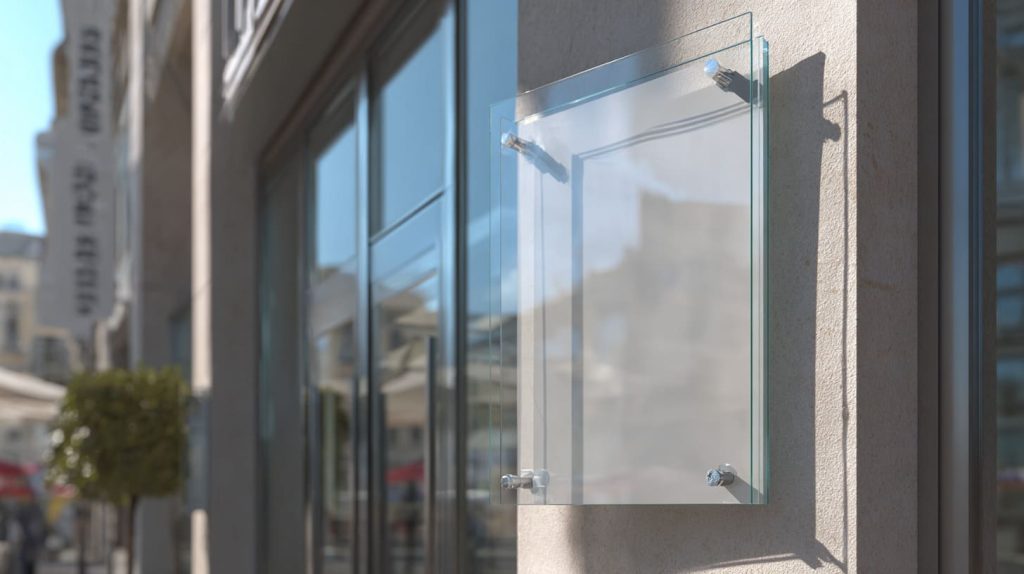
Some acrylic products are more exposed than others.
A small box used inside a drawer may have little UV risk. A clear sign panel facing sunlight every afternoon has much higher risk. A cosmetic organizer near a bathroom window may sit quietly for months before the buyer notices a color change.
UV risk is not only about the material. It is also about where the product lives.
I judge UV risk by asking where the product will sit on a normal day, not where it looks best in the product photo.
Outdoor signage and illuminated displays
Outdoor acrylic signage faces a hard life.
It sees sunlight.
It sees heat.
It sees rain.
It sees dust.
It may also see light from inside the sign.
When UV and heat work together, the material can age faster. If the sign is large, panel stability also matters. If the sign is illuminated, the material must handle both outside sunlight and internal heat from lighting.
This is why outdoor signage needs serious material discussion.
| Risk factor | Why it matters |
|---|---|
| Direct sunlight | Speeds up aging and yellowing risk |
| Heat buildup | May cause warping or stress |
| Large panel size | Shape stability becomes harder |
| LED lighting | Adds internal heat |
| Outdoor cleaning | Wrong chemicals may damage surface |
Outdoor signs are also public. If they age badly, everyone sees the problem. A yellowed display on a wall is not a private complaint. It is a public advertisement for a poor material choice.
That sounds harsh, but it is true.
Picture frames near windows
Acrylic picture frames often look safe because they are indoor products.
But “indoor” does not always mean low UV.
A picture frame near a sunny window may face strong light every day. The acrylic front panel may slowly become yellow or hazy. The photo or artwork behind it may also fade if there is not enough protection.
This matters for homes, offices, hotels, galleries, schools, cafés, and retail spaces.
| Frame use | UV risk | Practical concern |
|---|---|---|
| Bedroom wall away from window | Low | Standard acrylic may be fine |
| Office wall near window | Medium | Long-term clarity should be checked |
| Café window display | High | Sunlight and heat may age panel |
| Gallery-style display | Medium to high | Visual quality must stay stable |
| Certificate frame in reception area | Medium | Yellowing hurts professional look |
A frame is a quiet product. It does not move. But it is judged every day by eyes.
If the clear panel ages badly, the photo behind it pays the price.
Retail POP displays
Retail POP displays live in a strange world.
They may be temporary, but they must look perfect. They may only be used for a promotion season, but they often sit under strong store lighting or near storefront windows. They are touched by staff, moved by customers, and cleaned quickly.
This creates mixed risk.
If the display is used for only one month, standard acrylic may be enough. If it is used for six months near sunlight, the material choice becomes more important.
| Retail display type | Main UV concern | Decision point |
|---|---|---|
| Seasonal counter display | Usually lower | How long is the campaign? |
| Storefront display | Higher | Is there direct sunlight? |
| Cosmetic display | Medium | Clarity and premium look matter |
| Product rack near window | Higher | Does the brand expect long use? |
| Reusable display | High | Long-term aging matters more |
For rebranding customers, this is even more serious.
Their brand name may be on the display. If the display turns yellow or cloudy, customers may not blame the acrylic factory. They may blame the brand.
That is a heavy cost for a small material decision.
Cosmetic organizers and household products
Cosmetic organizers are often clear. Customers buy them because they make a space look clean.
But bathrooms and bedrooms can create UV risk in quiet ways.
A cosmetic organizer may sit beside a window. It may face sunlight every morning. It may also face humidity, heat, perfume, alcohol, cleaning sprays, and hand creams. These are not friendly conditions.
| Household product | Hidden risk |
|---|---|
| Cosmetic organizer | Sunlight, perfume, alcohol, humidity |
| Jewelry box | Window exposure and cleaning |
| Acrylic storage box | Heat and long-term yellowing |
| Bathroom shelf | Moisture and chemical exposure |
| Decorative tray | Sunlight and surface scratches |
This is where I often remind buyers that the “home environment” is not always gentle.
A beautiful clear organizer can become ugly if it ages unevenly. And when it sits next to white tiles or bright cosmetics, even a slight yellow tone becomes easier to see.
UV risk becomes more serious when the product’s value depends on clarity.
And once we understand which products are vulnerable, we need to talk about the real business risk. Because in B2B manufacturing, material failure is never only a material problem.
What Are the Business Risks of Ignoring UV Protection?
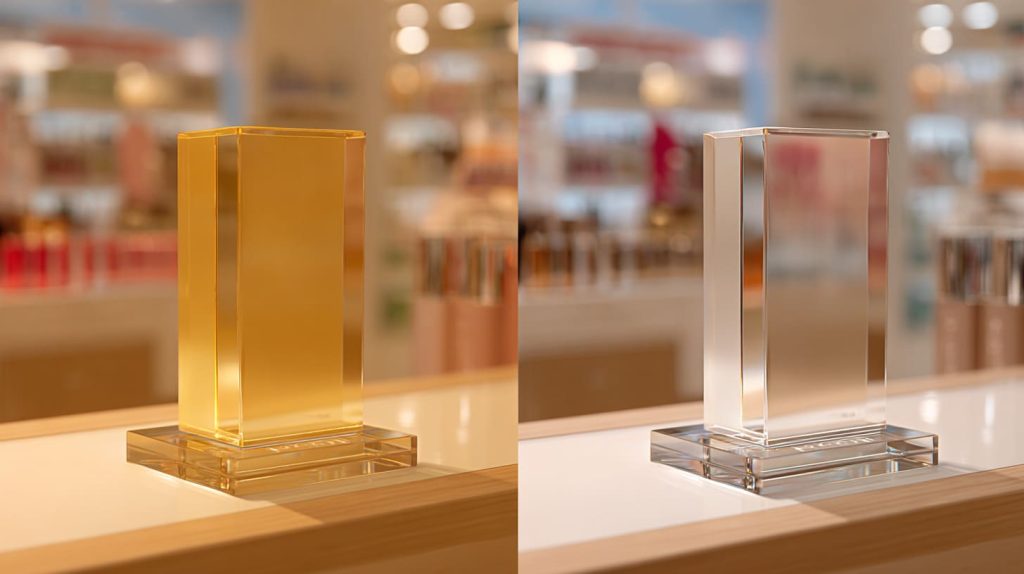
Acrylic aging is not only a technical issue.
It is a business issue.
A product can be physically usable but commercially damaged. That sounds strange, but it happens often. A display may still stand. A box may still close. A frame may still hold a picture. But if it looks yellow, cloudy, or old, the customer feels disappointed.
And disappointment has a cost.
When I think about UV protection, I do not only think about material performance; I think about who will receive the complaint, who will pay for the remake, and who will lose trust.
Increased customer complaints
Customer complaints rarely arrive with perfect technical details.
A customer may not say, “The acrylic experienced UV-related surface degradation.”
They say:
“It turned yellow.”
“It looks cheap now.”
“It was clear before.”
“This does not match the sample.”
“We cannot sell this.”
That is enough to create stress.
| Complaint type | What buyer hears | Business impact |
|---|---|---|
| Yellowing | Product aged too fast | Return or replacement pressure |
| Haze | Display lost clarity | Visual quality complaint |
| Cracking | Product feels unsafe | Trust damage |
| Warping | Product looks defective | Assembly or display issue |
| Color change | Brand color mismatch | Brand consistency problem |
The hardest complaints are the ones that appear after months. By then, the product may already be spread across different stores, homes, or regions. The problem is no longer in one carton. It is in the market.
That makes correction harder.
Product replacement and warranty costs
Replacement costs are rarely limited to the acrylic part.
There may be new production cost.
New packaging cost.
New shipping cost.
New inspection cost.
New communication cost.
Sometimes there is also lost time and lost trust.
A buyer may save money by using standard acrylic. But if the product fails too early, the saving can disappear quickly.
| Cost item | Why it hurts |
|---|---|
| Remake cost | New material and production are needed |
| Air shipment | Urgent replacement can be expensive |
| Labor cost | Staff must handle complaints |
| Packaging cost | Replacement needs proper packing |
| Lost sales | Product may be removed from display |
| Reputation cost | Hard to measure, but very real |
The material cost is easy to calculate before production.
The complaint cost is harder to calculate after failure.
That is why I often prefer a slightly more careful material choice when the product will face real sunlight. It may not be the cheapest quote. But sometimes the cheapest quote only looks cheap because it has not met the future yet.
Damage to brand image
Many of our buyers are not buying acrylic products only for function.
They are buying presentation.
Acrylic displays products. It holds cosmetics. It shows certificates. It protects photos. It organizes retail goods. It makes a brand look clean and professional.
If the acrylic ages badly, the brand image suffers.
This is especially true for buyers who resell, rebrand, or use acrylic products in retail environments. The end customer may never know which factory made the product. They only see the brand logo.
| Buyer type | Brand risk |
|---|---|
| Retail brand owner | Display quality affects product image |
| Distributor | Customer trust affects repeat orders |
| Custom order shop | Complaint affects service reputation |
| Corporate buyer | Poor display affects company image |
| Interior project buyer | Aging affects space appearance |
Acrylic is like a stage.
If the stage looks dirty, the product on the stage also looks worse.
That is why UV protection is not only about protecting acrylic. It is about protecting what the acrylic is meant to show.
Long-term relationship risks with suppliers
A bad UV problem can damage the relationship between buyer and factory.
Not because both sides are bad.
Often, the real reason is missing communication.
The buyer may assume the factory knows the product will be used near sunlight. The factory may assume the product is for normal indoor use. The quotation may say “clear acrylic,” but not specify UV-resistant grade. The sample may look good, so nobody discusses exposure.
Then the complaint comes.
And both sides feel wronged.
| Missing discussion | Possible result |
|---|---|
| Product location | Wrong material grade |
| Expected lifespan | Wrong durability target |
| Sunlight exposure | UV risk ignored |
| Cleaning method | Surface damage after use |
| Outdoor/indoor use | Wrong design and material choice |
This is why I like clear questions before production.
They may feel small, but they can save the relationship later.
A good supplier should not only make the drawing. A good supplier should also ask where the product will live. Because the environment is part of the product.
Now the practical question becomes clear: how can buyers check UV resistance before placing mass production orders?
How Can Buyers Properly Evaluate UV Resistance Before Production?
UV resistance should not be guessed.
It should be discussed, checked, and matched with the real application.
I do not mean every project needs expensive lab testing. That would be unrealistic. Many acrylic products are simple indoor items. But when the product will face sunlight or outdoor conditions, buyers should ask better questions before production.
A good question asked early is cheaper than a complaint answered late.
Before I recommend material, I try to separate “nice to have” from “must have,” because not every project needs the highest-grade material, but every project needs the right level of honesty about risk.
Ask about UV-resistant acrylic grades
The first step is simple.
Ask the supplier what acrylic grade they are quoting.
Not all “clear acrylic” means the same thing. Some acrylic is standard material. Some is more suitable for outdoor or window exposure. Some suppliers may use cast acrylic. Some may use extruded acrylic. Each has its own features, cost, and use cases.
| Question to ask | Why it matters |
|---|---|
| Is this standard acrylic or UV-resistant acrylic? | Material choice affects aging |
| Is it cast or extruded acrylic? | Processing and performance may differ |
| Is it suitable for outdoor use? | Indoor material may not survive outside |
| Can it handle window sunlight? | Window exposure is often underestimated |
| What lifespan do you expect? | Helps align buyer and supplier expectations |
This does not mean one material is always better.
It means the material must match the product’s job.
A simple indoor display may not need a premium UV-resistant sheet. But outdoor signage should not be treated like a small indoor box.
Request material certifications and technical data
Buyers often ask for photos first.
Photos are useful. But for UV risk, photos are not enough.
A photo shows today’s appearance. It does not prove long-term performance.
For higher-risk projects, buyers can request technical data, material certificates, or test information from the supplier. The level of documents depends on the project size and customer requirements.
| Document or data | What it helps confirm |
|---|---|
| Material specification sheet | Basic material properties |
| UV resistance information | Suitability for sunlight exposure |
| Outdoor durability notes | Expected use environment |
| Quality certification | Supplier quality control system |
| Material source information | Stability of raw material supply |
I know some buyers do not want to slow down the project with documents. I understand that. But for a serious outdoor or brand project, checking material data is not a delay. It is protection.
A buyer like Jacky already knows this from factory visits. The sample room can be beautiful. But the real control is often inside the material choice, process control, and inspection system.
Simulate real application environments
Real testing does not always need to be complicated.
The buyer can do simple exposure checks, especially for important projects. Place samples in the expected environment. Compare standard acrylic and UV-resistant acrylic. Watch for color change, haze, bending, and surface problems.
This is not perfect lab testing. But it can reveal obvious risks.
| Simple test | What to observe |
|---|---|
| Window exposure test | Yellowing, haze, heat effect |
| Outdoor shaded test | Surface and edge stability |
| Direct sun test | Warping or color change |
| Heat and humidity check | Bathroom or tropical market risk |
| Cleaning test | Chemical sensitivity |
The key is comparison.
One sample alone may not teach much. Two or three materials placed side by side can show differences more clearly.
I sometimes think of this like tasting tea. If you drink one cup, you may say it is fine. If you drink three cups side by side, you start noticing the real difference.
Discuss product lifespan expectations early
Not every acrylic product needs to last for years.
Some displays are used for one campaign. Some are used for one season. Some are used in permanent retail spaces. Some are used outdoors for long-term branding.
The expected lifespan changes the material decision.
| Expected use | Material thinking |
|---|---|
| 1-month promotion | Standard acrylic may be enough |
| 3-6 month retail display | Check lighting and sunlight |
| 1-year store use | UV risk should be discussed |
| Long-term outdoor use | UV-resistant material is important |
| Premium brand display | Appearance aging must be controlled |
This conversation should happen before quotation.
If the buyer only says “clear acrylic display,” the supplier may quote based on normal indoor use. If the buyer says “clear display near storefront window for 12 months,” the supplier can think differently.
That small sentence changes the whole risk picture.
After material evaluation, we should also look at design. Because material alone is not the only way to improve UV durability.
What Design Decisions Can Improve UV Durability?
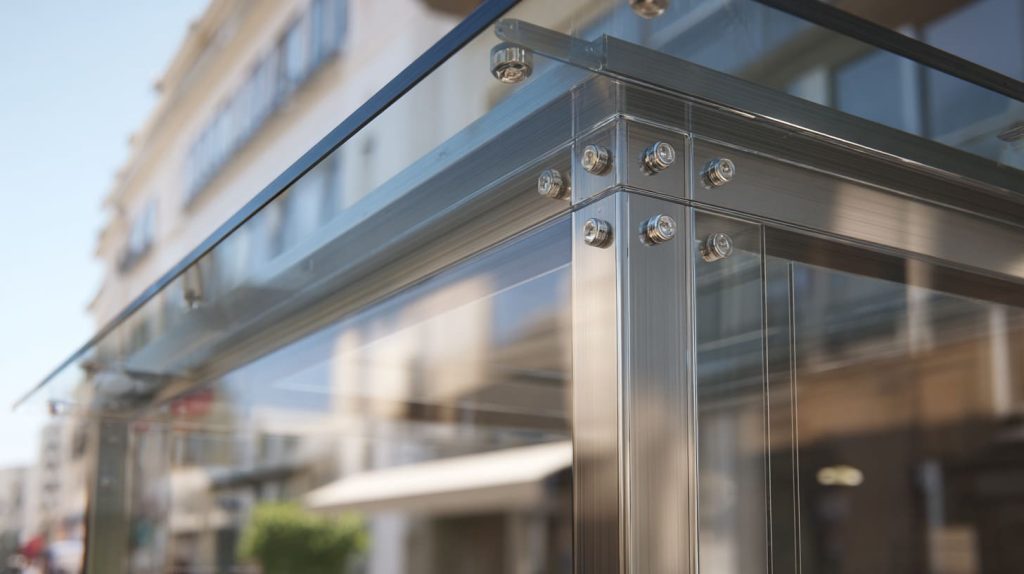
Material choice matters.
But design also matters.
A good material can still perform badly if the design traps heat, creates stress, uses poor support, or places the acrylic in direct sun without protection. A smart design can reduce risk and extend product life.
In custom acrylic work, I like design decisions that quietly reduce future trouble, even if the customer never notices them.
The detail I watch closely is whether the design asks acrylic to do too many jobs at the same time, because clear material, structural support, outdoor exposure, and premium appearance can pull the design in different directions.
Choosing the right acrylic thickness
Thickness affects strength, weight, price, stability, and appearance.
A thicker panel may resist bending better. It may feel more premium. It may also cost more and add weight. A thinner panel may save cost, but it may warp more easily under heat or stress.
UV exposure often works together with heat. So thickness becomes part of the discussion.
| Thickness decision | Benefit | Possible trade-off |
|---|---|---|
| Thinner acrylic | Lower cost and lighter weight | More bending risk |
| Medium thickness | Balanced for many products | Needs proper support |
| Thicker acrylic | Better structure and premium feel | Higher cost and weight |
| Oversized panels | Strong visual impact | More warping risk if unsupported |
For outdoor or window-facing products, I do not only ask, “What thickness looks good?” I ask, “Will this thickness stay stable after heat and sunlight?”
That is a more useful question.
Using protective coatings and treatments
Some projects can use coatings or treated materials to improve surface protection and UV resistance. The exact option depends on the acrylic type, supplier capability, budget, and final use.
Protective options may include UV-resistant acrylic sheets, surface coatings, anti-yellowing materials, or added films in some applications.
| Option | Main purpose | Best use case |
|---|---|---|
| UV-resistant acrylic | Better sunlight aging resistance | Outdoor or window exposure |
| UV coating | Extra surface protection | Specific display or signage uses |
| Anti-yellowing material | Maintain clarity longer | Premium clear products |
| Protective film during production | Prevent scratches before use | Handling and shipping stage |
| Proper cleaning guide | Reduce surface damage | Retail and household products |
Coating is not magic.
It must fit the application. It must also be compatible with fabrication, bending, polishing, printing, bonding, and cleaning. A coating that sounds good on paper may create other problems if it is not suitable for the process.
This is why supplier experience matters.
Reducing direct sunlight exposure through design
Sometimes the best UV protection is not only better material.
Sometimes it is smarter placement.
For signage, retail displays, or interior products, design can reduce direct sunlight exposure. A product can use a small shade, different installation angle, deeper frame, or partial cover. Even a slight change in placement may reduce long-term stress.
| Design choice | How it helps |
|---|---|
| Angled installation | Reduces direct sun hit |
| Deeper frame | Protects edges and panels |
| Metal top cover | Adds shade and structure |
| Back support | Reduces warping |
| Better ventilation | Lowers heat buildup |
This is often overlooked because buyers may focus on the front view only.
But products live in 3D space. Sunlight comes from a direction. Heat builds in a place. Dust collects on a surface. Workers clean from a certain angle.
A product drawing is flat. Real life is not.
Combining acrylic with other materials
Acrylic does not need to solve every problem alone.
For some outdoor or high-stress projects, combining acrylic with metal, aluminum profiles, stainless steel supports, or other materials can improve durability. Acrylic can provide clarity and appearance. Metal can provide structure and support.
This is common in signage, display cabinets, outdoor frames, and larger display products.
| Hybrid design | Why it helps |
|---|---|
| Acrylic panel + metal frame | Better structure |
| Acrylic cover + aluminum support | Less bending |
| Acrylic display + hidden bracket | Cleaner look with stronger support |
| Acrylic box + reinforced base | Better stability |
| Acrylic signage + backing board | Less stress on acrylic sheet |
The best design is not always the purest design.
Sometimes a small metal support behind the acrylic saves the whole product from bending. Sometimes a thicker frame protects the edges. Sometimes a hidden bracket makes the product less beautiful in the drawing, but much better in real use.
And real use always wins.
Now we should look at the supplier side. Because even good design needs a manufacturer who understands UV risk before cutting material.
How Do Professional Acrylic Manufacturers Handle UV Challenges?

A professional acrylic manufacturer should not only ask for drawings.
Drawings are important, but they do not tell the full story.
A drawing tells size, shape, hole position, thickness, and structure. It may show logo placement and assembly details. But it may not explain sunlight exposure, customer use, cleaning method, store location, or expected lifespan.
That missing information can decide success or failure.
From my side as a manufacturer, I feel responsible for asking application questions before I feel comfortable with the material choice.
Material selection based on application
The first thing is application.
Where will the product be used?
Indoor or outdoor?
Near a window or away from sunlight?
Temporary or long-term?
Cosmetic display or industrial display?
Low-cost project or premium brand project?
These questions are not small talk. They guide the material.
| Application | Material thinking |
|---|---|
| Indoor acrylic box | Standard high-clear acrylic may work |
| Storefront display | UV risk should be checked |
| Outdoor signage | UV-resistant material should be considered |
| Cosmetic organizer | Chemical and sunlight exposure both matter |
| Picture frame | Clarity and aging matter |
| Display cabinet | Structure and surface protection matter |
At Feilong Acrylic, custom work does not come from a catalog. It comes from client ideas, drawings, samples, and use cases. So the application discussion becomes part of the manufacturing process.
If the supplier only quotes the lowest material without understanding the use, the project may start fast but end badly.
Manufacturing consistency and quality control
UV resistance is not only about choosing one sheet.
It is also about stable sourcing and consistent production.
If one batch uses good material and the next batch uses lower-grade material, the buyer may face inconsistent aging. If polishing creates stress at the edges, cracking risk may increase. If bonding is poor, sunlight and heat may make weakness more visible over time.
| Manufacturing factor | Why it matters |
|---|---|
| Raw material consistency | Keeps performance stable |
| Cutting quality | Reduces stress and edge damage |
| Polishing control | Improves appearance and durability |
| Bonding process | Prevents weak joints |
| Inspection process | Finds defects before shipment |
| Packaging quality | Protects product before use |
Acrylic is honest in a cruel way.
It shows mistakes. It shows scratches. It shows haze. It shows poor bonding. It shows yellowing.
That is why production control matters from raw sheet to final packing.
Importance of communication between buyer and factory
Good communication prevents many UV problems.
But communication must be specific.
“Good quality acrylic” is not specific.
“Clear acrylic for outdoor sign near direct sunlight for two years” is specific.
That second sentence gives the factory a real target.
| Vague request | Better request |
|---|---|
| We need clear acrylic | We need clear acrylic for storefront window use |
| Good quality is needed | We need material that resists yellowing |
| It is for display | It will sit near sunlight for 8 hours daily |
| Please quote best price | Please quote standard and UV-resistant options |
| It is for retail | It must keep a clean look for at least 12 months |
I like buyers who explain the real use clearly.
It helps me protect them. It also helps avoid misunderstanding later. A good quotation should not only give price. It should also show assumptions.
If the assumption is indoor use, say it. If UV-resistant material is quoted, say it. If standard acrylic may not be suitable for outdoor exposure, say it.
Clear words save money.
Why experienced factories think beyond the sample
Experience teaches one painful lesson:
A perfect sample can still become a poor mass production decision.
This is why experienced factories think beyond the sample. They think about raw material, cutting tolerance, polishing, assembly, packaging, shipping, installation, cleaning, sunlight, and long-term appearance.
Acrylic products often fail in the details nobody wanted to discuss.
| Stage | Hidden UV-related question |
|---|---|
| Quotation | Is UV-resistant material needed? |
| Sampling | Is the sample tested in real conditions? |
| Production | Is material source stable? |
| Inspection | Is clarity and surface quality checked? |
| Packing | Will protective film stay safe? |
| Use | Will sunlight and cleaning damage it? |
Acrylic manufacturing is not only about making something clear.
It is about keeping it clear for the right amount of time.
And this brings us to the question buyers care about most: is UV protection worth the extra cost?
Is UV Protection Worth the Extra Cost?
The honest answer is this:
Sometimes yes.
Sometimes no.
I do not believe every acrylic product needs UV-resistant material. That would make projects more expensive than necessary. But I also do not believe buyers should ignore UV protection just to make the quote look better.
The right answer depends on use, risk, lifespan, brand position, and customer expectations.
My decision becomes simple when I compare the cost of better material with the cost of one serious complaint, because the second number is often much larger than people expect.
Comparing short-term savings vs long-term losses
Standard acrylic may save money in the beginning.
That saving is real. I do not deny it.
But the buyer should compare that saving with possible future costs. If the product is used indoors and replaced quickly, the saving may make sense. If the product is used outdoors or near sunlight for a long time, the saving may become a trap.
| Choice | Short-term result | Long-term risk |
|---|---|---|
| Standard acrylic | Lower cost | Yellowing or aging risk in sunlight |
| UV-resistant acrylic | Higher cost | Better protection for sunlight exposure |
| Cheap unknown material | Lowest quote | Unstable quality and complaints |
| Proper material match | Balanced cost | Better buyer confidence |
The lowest price can be attractive.
But the lowest price does not always include the future.
I have seen buyers worry about a small material price increase, then later face much larger remake or shipping pressure. That is not because they made a stupid decision. It is because the risk was not visible at the beginning.
When UV protection is absolutely necessary
Some projects should not treat UV protection as optional.
If the product will face direct sunlight, outdoor use, long-term window exposure, or premium brand display requirements, UV protection should be seriously considered.
| Situation | UV protection importance |
|---|---|
| Outdoor signage | Very high |
| Storefront display | High |
| Window-side frame | Medium to high |
| Long-term retail display | High |
| Premium cosmetic display | Medium to high |
| Temporary indoor display | Low to medium |
For outdoor commercial applications, I usually become stricter.
Outdoor products face too many variables. Sunlight, heat, rain, wind, cleaning, dust, and installation stress can all affect performance. If the product represents a brand, the risk becomes even higher.
Acrylic must look clean. That is part of its job.
Situations where standard acrylic may still work well
Standard acrylic is not bad.
It is useful for many indoor products. It can work very well for boxes, organizers, stands, displays, racks, cabinets, and decorative items used away from direct sunlight.
The mistake is not using standard acrylic.
The mistake is using it in the wrong place without discussion.
| Product use | Standard acrylic may work if... |
|---|---|
| Indoor display stand | It is away from direct sunlight |
| Acrylic box | It is used in normal room conditions |
| Cosmetic organizer | It is not exposed to strong sunlight or chemicals |
| Picture frame | It is not placed near a sunny window |
| Short-term POP display | The campaign period is short |
| Sample or prototype | Long-term aging is not the main goal |
This is why I prefer project-based decisions.
Acrylic material should not be selected by habit. It should be selected by application.
Finding the right balance between budget and durability
Good buying is not about choosing the most expensive option.
It is about choosing the option that fits the risk.
For B2B buyers, this balance matters. Jacky may need to control cost. He may also need to protect his company from complaints. He may know Chinese factories well, but he still needs clear information before approving mass production.
A useful decision framework can be simple:
| Question | If the answer is yes | Decision direction |
|---|---|---|
| Will the product face direct sunlight? | Yes | Consider UV-resistant material |
| Is the product used outdoors? | Yes | UV protection is important |
| Is the product for premium display? | Yes | Aging risk matters more |
| Is the use temporary? | Yes | Standard acrylic may be enough |
| Is the product near heat and humidity? | Yes | Check both material and design |
| Will customer complaints be costly? | Yes | Choose safer material |
The best decision is rarely the cheapest or most expensive.
It is the decision that survives real use.
And for acrylic products, real use is the final judge.
Conclusion
UV protection is often ignored because it does not shout at the beginning.
Acrylic samples look clear. The price looks better. The delivery plan looks smooth. The buyer feels the project is moving. The supplier starts production. Everyone feels comfortable.
Then time enters the room.
Sunlight touches the product every day. Heat builds up. The surface changes. The panel becomes yellow, hazy, brittle, or warped. The product still exists, but it no longer feels new. It no longer feels clean. It no longer supports the brand image it was supposed to protect.
That is why I take UV protection seriously.
I do not think every acrylic product needs special UV-resistant material. That would be too simple, and real manufacturing is never that simple. I think every acrylic product needs an honest discussion about its real environment.
Where will it be used?
How much sunlight will it face?
How long should it last?
Who will complain if it ages too soon?
What will the product represent when customers see it?
These questions may look small. But they can change the whole project.
I have learned that a good acrylic product is not only the one that looks beautiful in the sample room. It is the one that still feels right after shipping, installation, daily use, cleaning, and months of real exposure.
That is why I ask more questions before production. I ask about sunlight. I ask about outdoor use. I ask about store windows. I ask about expected lifespan. I ask about cost limits. I ask because I have seen how painful it becomes when nobody asks.
For buyers, especially experienced buyers like Jacky, my suggestion is simple:
Do not wait for yellowing to teach the lesson.
If your acrylic product will face sunlight, window exposure, outdoor use, or premium display requirements, discuss UV protection before sampling and before mass production. Ask for material options. Compare standard acrylic and UV-resistant acrylic. Match the material with the real use, not only the drawing.
At Feilong Acrylic, we focus on custom acrylic products for B2B projects. We do not sell from a catalog. We work from ideas, drawings, samples, and real application needs. If you are planning acrylic displays, boxes, frames, stands, racks, cabinets, organizers, or custom furniture parts, you can share the product use with us before production.
A clear product should stay clear for the right reason.
And the right reason begins with asking the right question early.