Skip to content
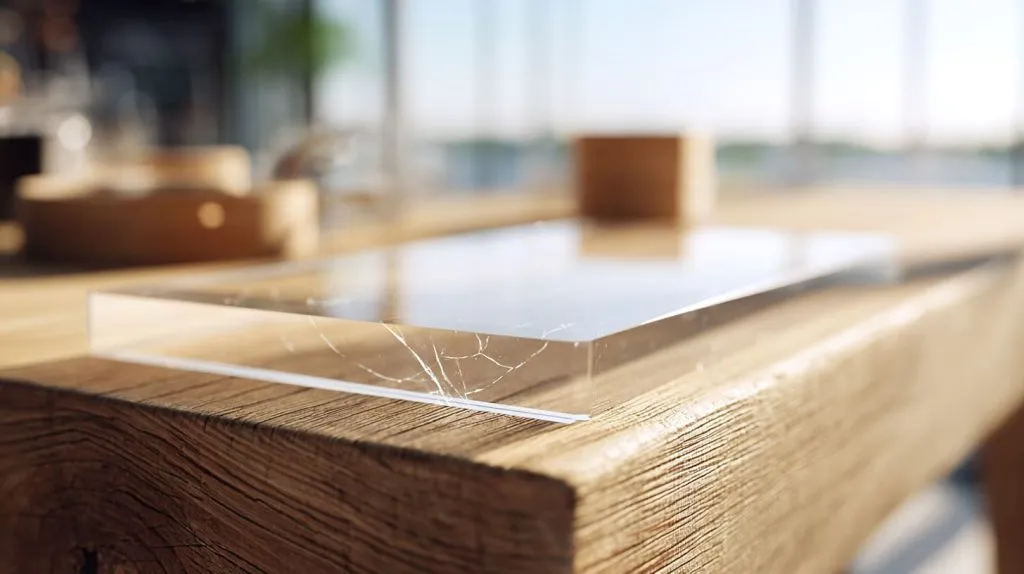
A POP display looks innocent on a screen. Clean lines. Clear plastic. A simple logo.
Then the real world touches it.
A carton gets dropped once. A store staff member wipes it fast with “whatever cleaner is nearby.” A customer taps the edge like it’s glass. And suddenly the display is not a “support tool” anymore. It is the product in people’s eyes.
I’ve had buyers send me the same CAD twice in one month. Same shape. Same size. Same “clear plastic” note.
The first sample cracked at a bend during packing. The second one survived shipping and survived the first week of store handling. The design did not change. The plastic did.
That is why I treat material choice like a business decision, not a lab decision.
Here are the pain points I see most often:
- Cracking in transport because the plastic is too brittle for the packaging reality.
- Yellowing or haze under store lights or near heat sources.
- Print or vinyl issues because the surface and ink system don’t match.
- Cost overruns because the “cheap sheet” becomes expensive after rework, scrap, and replacements.
So I want to answer one clear question, the way a buyer like Jacky would ask it:
Which plastics give the best balance of durability, customization, and visual impact for modern POP displays—without creating hidden risks in production?
I’ll keep this practical. I’ll compare the most common plastics I see for POP work—acrylic (PMMA), PETG, polycarbonate (PC), and PVC—and I’ll talk about what happens when the display meets real shelves, real cleaners, and real shipping.
If you’ve ever opened a box and found one corner cracked, you already know why the next section matters.
Why Material Choice Matters in POP Displays
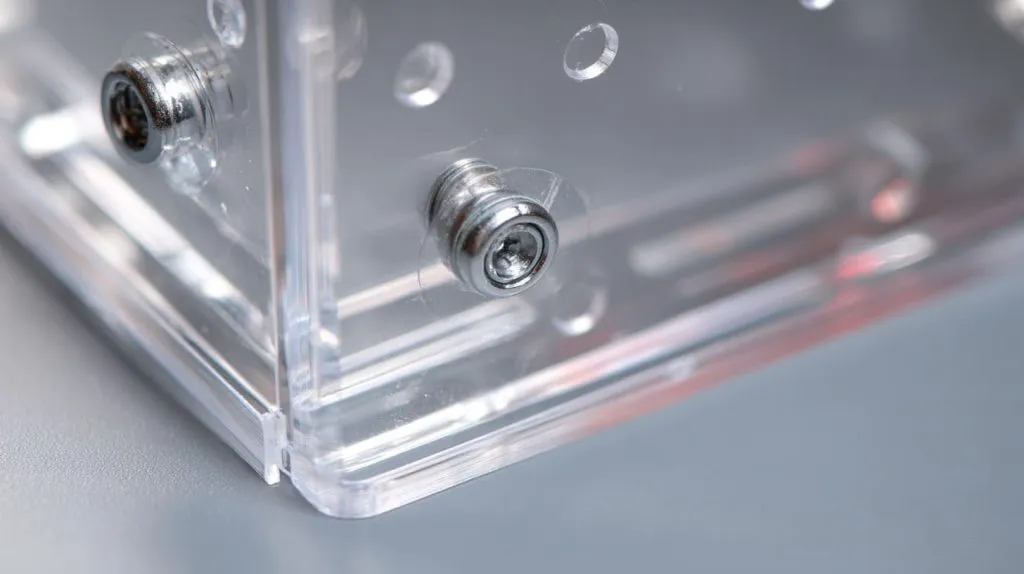
When someone says “it’s just a display,” I smile. Because I know what happens next: the display gets judged like a product.
Structural Integrity in High-Traffic Retail Environments
POP displays live in places that are rough in a quiet way.
No one punches them. They just get handled… all day.
Here’s where stress shows up most:
- Shelf-edge pressure: clips, tabs, and thin lips take constant load.
- Restocking: cartons slide, corners bump, staff move fast.
- Customer touch: people pull, tap, and lean without thinking.
I often ask one boring question that saves projects:
“Where does force concentrate?”
Not “is the sheet strong?” but where the stress gathers—corners, bends, screw holes, snap fits, and bonded joints.
A quick reality table I use when reviewing drawings:
| Stress Point | What Usually Happens | What I Look For |
|---|---|---|
| Bend line | Micro-cracks, whitening, edge splits | Bend radius, material choice, edge finish |
| Screw holes | Star cracks, creep, loose fit | Hole spacing, washers, thickness |
| Snap features | Breakage, fatigue | Material toughness, geometry |
| Bonded seams | Joint failure, hazing | Correct adhesive method for the plastic |
Visual Clarity and Brand Perception
Retail lighting is honest in a brutal way.
It shows every scratch and every cloudy edge.
Two displays can have the same shape, but look totally different because of:
- Clarity (how “glass-like” the part feels)
- Gloss (how premium it looks under LEDs)
- Edge finish (polished edges can look like jewelry; rough edges look cheap)
I’ve seen a “good” display lose the brand’s premium feel just because the edges looked tired under spotlights. The plastic was fine. The look was not.
Long-Term Cost and Replacement Cycles
This is the part many teams skip because it feels unsexy.
But it’s where ROI hides.
Hidden cost comes from:
- Scratch visibility (not just scratch rate)
- Shipping damage rate (returns and rework)
- Cleaning chemical damage (haze, micro-crazing, fading)
A simple way I explain it to buyers:
| Cost Type | What It Looks Like in Real Life |
|---|---|
| Cheap material cost | Low sheet price on day one |
| Expensive project cost | Replacements, delays, reprints, scrap, brand complaints |
If your display is going to be touched daily, the “best plastic” is the one that makes your failure rate boring.
Now let me get specific, because the first material is the one buyers ask for when they want the display to look expensive.
Acrylic (PMMA): The Premium Visual Standard
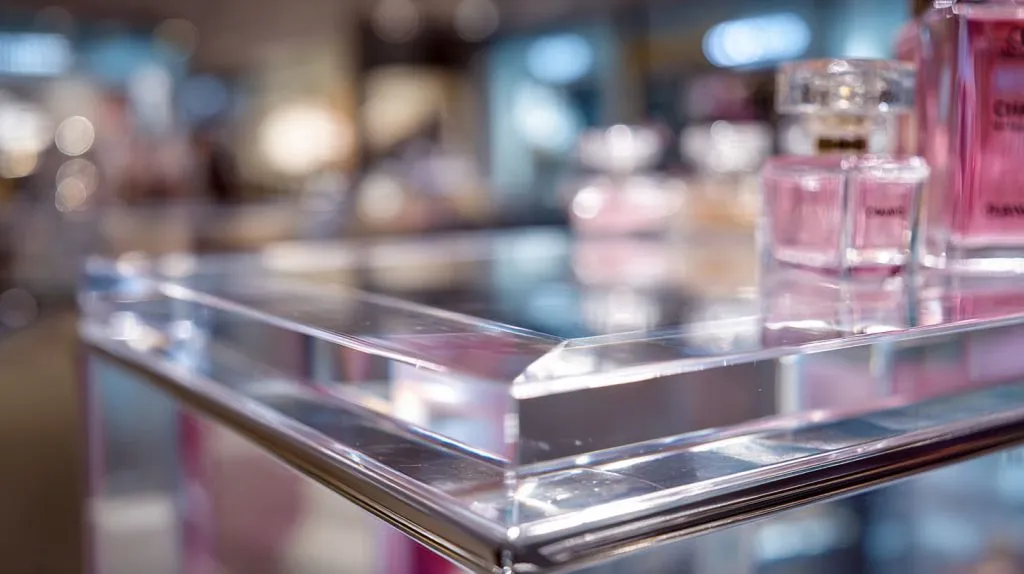
Acrylic is the material I reach for when the display must look like it belongs next to a premium product.
It has that clean “glass” vibe without the weight.
Optical Clarity and High-Gloss Finish
Acrylic can look almost unreal when it’s done right.
Clear. Bright. Crisp edges.
Why brands love it:
- Very high clarity and strong light transmission feel
- High gloss that reads as “premium”
- Polished edges that catch light like a showroom finish
If you sell cosmetics, skincare, or electronics accessories, acrylic often becomes the “default” because it makes the product look better beside it.
Here’s my quick visual rating:
| Visual Factor | Acrylic (PMMA) | What It Means |
|---|---|---|
| Clarity | ⭐⭐⭐⭐⭐ | Best “glass-like” look |
| Gloss | ⭐⭐⭐⭐⭐ | Strong premium signal |
| Edge beauty | ⭐⭐⭐⭐⭐ | Flame/polish can look stunning |
Fabrication Advantages
Acrylic is friendly in the shop when you treat it with respect.
Common wins:
- Laser cutting can be very clean and accurate
- Engraving looks sharp and premium
- UV printing can pop with good surface prep
- Bonding can be strong and visually clean when done correctly
In production, I like acrylic for:
- Sign holders
- Clear risers and platforms
- Side panels where the brand wants “invisible support”
Limitations to Consider
Acrylic’s weakness is not a mystery.
It is brittle under impact compared to PETG or PC.
The failure patterns I see:
- Edge cracking when a part is dropped on a corner
- Bend cracks when the design forces tight bends
- Crazing risk when the wrong cleaner or solvent touches it
This is where critical thinking helps: acrylic is not “bad.”
It is just honest. If the design has sharp corners and the packaging is thin, acrylic will tell you quickly.
A short “risk checklist” I use:
- Is the display shipped assembled?
- Are there thin tabs near holes?
- Are there tight bend lines?
- Will store staff clean it with alcohol or strong sanitizer?
If the answer is “yes” to several, acrylic can still work, but the design needs more care.
And that is the moment I usually bring up PETG, because PETG is the material that forgives mistakes a little more.
PETG: Impact-Resistant and Fabrication-Friendly

PETG is the plastic I recommend when the display must survive real shipping and real handling, but still look clean.
It is not as “jewel-like” as acrylic.
But it breaks less often. That matters.
Superior Impact Strength Compared to Acrylic
The difference shows up in one painful moment: when a carton drops.
PETG is more forgiving:
- Less edge cracking from impact
- Better toughness for high-touch displays
- Lower shipping damage risk in many cases
For buyers, this often means:
- Fewer replacements
- Less customer complaint noise
- Less “why did it crack?” emails
Here’s a simple durability comparison the way I explain it to Jacky:
| Scenario | Acrylic (PMMA) | PETG |
|---|---|---|
| Drop on corner | More likely to chip/crack | More likely to survive |
| Staff handling | Fine, but risky on thin edges | More tolerant |
| Tight features | Risky if sharp | Better toughness |
Thermoforming and Bending Flexibility
PETG is popular in POP because it plays well with forming:
- Vacuum forming is efficient
- Bending is more forgiving
- Fabrication speed can be faster for some shapes
When the display needs curves, wraps, or formed trays, PETG often feels like the “easy button.”
But I still push for good design:
- Avoid razor-thin lips
- Support long spans
- Respect hole distances and radii
PETG forgives, but it does not perform miracles.
Surface and Optical Trade-Offs
This is the honest trade:
- PETG can look clear, but it often has slightly lower gloss than premium acrylic.
- It can scratch more easily, depending on grade and use.
If your display must stay “perfect looking” for a long time, PETG needs:
- smarter surface handling
- better packing separation
- realistic expectations in the store
A fast decision table:
| Priority | Better Choice |
|---|---|
| Best “premium gloss” | Acrylic |
| Lower shipping crack risk | PETG |
| Heavy forming / complex bends | PETG |
| Most beautiful polished edge | Acrylic |
If PETG is the tough, practical friend, then polycarbonate is the bodyguard. Let’s talk about the “nearly unbreakable” option.
Polycarbonate (PC): Maximum Durability for Demanding Displays
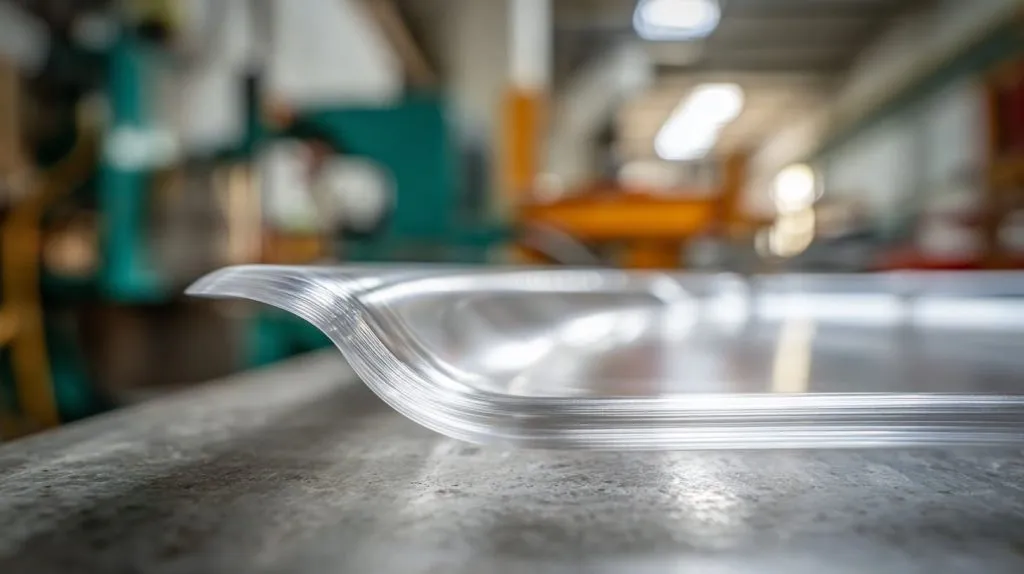
Polycarbonate is what I think of when the display must handle abuse, not just handling.
It is the material I bring up when:
- the environment is rough,
- the display is semi-permanent,
- or the cost of failure is high.
Extreme Impact Resistance
PC is famous for impact resistance for a reason.
It takes hits that would ruin acrylic.
I’ve seen PC used where customers touch hard and staff move fast:
- electronics stores
- hardware stores
- public-facing kiosks
- security covers for products
If you are sick of cracked corners, PC often solves that problem.
Heat and Flame Performance
This part matters more than people think.
Some POP displays sit near:
- light boxes
- warm shelves
- strong LED drivers
- heat from equipment nearby
PC tends to handle heat better than PETG and many PVC boards.
Also, in some sectors, fire ratings can become a requirement. That can push the choice toward PC grades designed for that.
Cost vs. Performance Analysis
Now the critical part: PC is usually more expensive.
So I ask a blunt question:
“What is the cost of one failure?”
If one broken display causes:
- a full store reset,
- a brand complaint,
- or a customer safety issue,
then PC can be cheaper in the total picture.
A quick ROI-style view:
| Factor | PC | What You Should Expect |
|---|---|---|
| Material cost | Higher | Budget needs planning |
| Breakage risk | Very low | Strong advantage |
| Visual clarity | Good | Often not as “glassy” as acrylic |
| Best use case | Heavy-duty | Where failure is unacceptable |
PC is not always the right choice.
But when you need durability above all, it earns its place.
Of course, not every project needs a bodyguard. Sometimes you need speed, cost control, and big graphics. That’s where PVC shows up.
PVC (Rigid & Foam Board): Cost-Effective Branding Solution
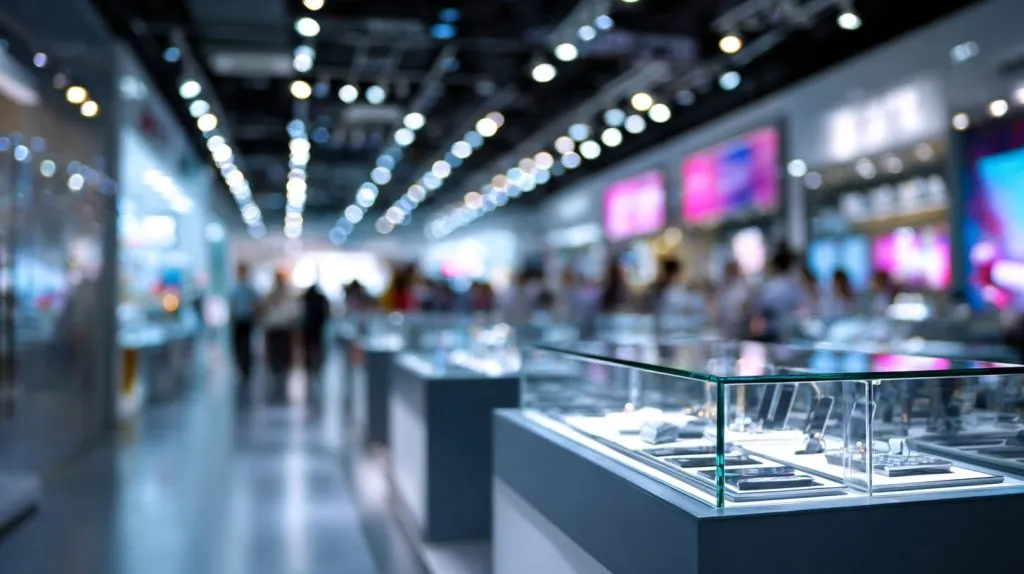
PVC—especially rigid sheet and foam board—is the workhorse for short-term campaigns and big signage.
It is not trying to be “luxury clear.”
It is trying to be fast, light, and affordable.
Lightweight and Budget-Friendly
When a brand wants:
- large printed panels,
- seasonal promotions,
- quick rollouts to many stores,
PVC can make the numbers work.
It is easy to:
- ship
- cut
- mount
- replace
That “easy” matters when the campaign is only 6–12 weeks.
Printing and Surface Compatibility
PVC boards can print well, especially with UV printing.
What I watch:
- surface flatness
- ink compatibility
- whether the client wants matte or gloss
This is often a “graphics first” material.
A useful micro-table:
| Need | PVC Board Fit |
|---|---|
| Large printed branding panels | Strong |
| Low weight | Strong |
| Premium clear look | Weak |
| Long-term structural parts | Weak |
Structural Limitations
PVC boards are not great when you need:
- load-bearing arms
- thin snap features
- premium edge clarity
Also, foam board can dent or compress.
If a shopper bumps it with a basket, the board may show it.
So I treat PVC as:
- excellent for signage
- okay for light fixtures
- not ideal for premium clear structures
Now that we’ve talked about each plastic, let’s put them on the same table. This is the part buyers love because it turns “feelings” into a decision.
Comparing the Top Plastics for POP Displays
I like comparison tables because they stop arguments.
Or at least they make the argument honest.
Performance Comparison Table (with Approximate Material Costs)
Here is a practical “buyer view” table with typical sheet pricing ranges (approximate, retail order):
| Plastic | Clarity | Impact Resistance | Scratch Visibility | Heat Tolerance | Cost Level (per m²) | Fabrication Complexity | |
|---|---|---|---|---|---|---|---|
| Acrylic (PMMA) | ⭐⭐⭐⭐⭐ | ⭐⭐ | ⭐⭐⭐⭐ (shows scratches) | ⭐⭐⭐ | ~$5–$10 | ⭐⭐⭐ | |
| PETG | ⭐⭐⭐⭐ | ⭐⭐⭐⭐ | ⭐⭐⭐ (can scratch) | ⭐⭐⭐ | ~$10–$15 | ⭐⭐⭐⭐ | |
| Polycarbonate (PC) | ⭐⭐⭐⭐ | ⭐⭐⭐⭐⭐ | ⭐⭐⭐ | ⭐⭐⭐⭐ | ~$50–$60 | ⭐⭐⭐⭐ | |
| PVC (rigid/foam) | ⭐⭐ | ⭐⭐ | ⭐⭐ | ⭐⭐ | ~$1–$3 | ⭐⭐ |
A note I always say out loud:
Scratch resistance and scratch visibility are not the same.
Some surfaces scratch, but you don’t notice. Others scratch and scream under LEDs.
Application-Based Recommendations
I don’t like “one winner” answers, so I match plastic to the job.
Cosmetic counters
- Usually: Acrylic for premium clarity
- Sometimes: PETG if breakage risk is high
Grocery aisle signage
- Often: PVC board for big graphics and fast swaps
- Sometimes: PETG for guards and dividers
Electronics retail
- Often: PC for theft-resistant and high-touch zones
- Sometimes: Acrylic for clean premium risers
Seasonal promotional displays
- Often: PVC board for cost control
- Sometimes: PETG for formed trays and curved guards
This is where critical thinking helps: the “best” plastic depends on what you are protecting—appearance, durability, or budget.
Okay, materials are only half the story. The other half is customization. Because a display can be tough, but still look cheap if branding execution is weak.
Customization Capabilities That Influence Material Selection
When a buyer says, “I need it eye-catching,” they usually mean:
- the print must be crisp,
- the logo must stay clean,
- the edges must look intentional,
- and assembly must feel solid.
Printing and Branding Techniques
Different plastics behave differently with ink and film.
Here’s the simplest way I explain it:
| Customization Method | Acrylic | PETG | PC | PVC Board |
|---|---|---|---|---|
| UV printing | Strong | Strong | Good (needs proper prep) | Strong |
| Screen printing | Strong | Strong | Strong | Strong |
| Vinyl application | Strong | Strong | Strong | Strong |
| Engraving | Excellent | Limited | Good | Limited |
What I watch in real production:
- Is the surface energy good for adhesion?
- Will the ink crack on a bend?
- Will cleaning chemicals attack the print?
Acrylic often looks best for engraving and “premium edge + logo” combinations.
PETG often wins when the part is formed and the print must survive bending.
CNC Machining and Laser Cutting Compatibility
Fabrication quality shows up as:
- clean edges,
- tight slots,
- consistent holes,
- and parts that assemble without forcing.
A quick fabrication notes list:
- Acrylic: laser edges can be beautiful, but design must avoid brittle stress points.
- PETG: often easy to cut and form, but edges may need finishing for premium look.
- PC: tough and stable, but can require more careful machining to keep edges clean.
- PVC: easy to cut for signage panels, not ideal for premium clear parts.
Assembly Methods
Assembly choice changes what “durable” means.
| Assembly Type | Best For | Watch Outs |
|---|---|---|
| Solvent bonding | Acrylic structures | Haze risk if rushed |
| Mechanical fasteners | PC and mixed materials | Stress around holes |
| Snap-fit design | PETG/PC with correct geometry | Fatigue and creep |
| Modular build | Campaign refresh | Loose tolerance if not controlled |
I’ve seen displays fail not because of the sheet, but because the joint was wrong.
So I always ask: “How will this be assembled at scale?”
And then, right when we feel confident, someone asks the next modern question: “What about sustainability and compliance?” Fair question. Let’s look at it without marketing fog.
Sustainability and Compliance Considerations
Sustainability is not one checkbox.
It is a mix of material choice, lifespan, and how often you replace the display.
Recyclability of Common Display Plastics
Here’s the honest view: recycling depends on local streams, collection, and contamination.
Still, it helps to understand the typical direction.
| Material | Recyclability Reality | Practical Note |
|---|---|---|
| Acrylic (PMMA) | Possible, but not always widely collected | Longer life helps sustainability |
| PETG | Often recyclable where PET streams accept it | Check local rules; sorting matters |
| PC | Recyclable, but less common in consumer streams | Often used in longer-life applications |
| PVC | More complicated and often restricted | Good for short campaigns, but disposal planning matters |
Critical thought:
If a “recyclable” display breaks in shipping and gets replaced twice, the project is not really sustainable.
Sometimes the greener choice is the one that doesn’t fail.
Certifications and Retail Requirements
For B2B buyers, compliance is often about:
- consistent quality,
- stable supply,
- and predictable output.
In my factory work, I see how much this matters when scaling:
- ISO9001 quality systems reduce variation.
- Material transparency and sourcing control reduce surprises.
- Eco-friendly material selection matters when brands ask for it.
I don’t treat certification as a badge. I treat it as a way to make results repeatable.
Now let’s bring everything back to the decision moment. Because most buyers don’t need more facts—they need a simple selection path that avoids regret.
How to Choose the Best Plastic for Your POP Project
When Jacky asks me “what plastic should I use,” I don’t start with a material name.
I start with three questions that narrow the choice fast.
Step 1: Define Display Lifespan
Is this display a short campaign, or a semi-permanent fixture?
| Lifespan Target | Common Material Direction |
|---|---|
| 1–3 months | PVC board, PETG |
| 3–12 months | PETG, acrylic (if handled carefully) |
| 12+ months | Acrylic (premium look) or PC (durability) |
Critical thought:
A “cheap” material becomes expensive when the display must still look good in month six.
Step 2: Assess Environmental Exposure
I look at what will attack the display:
- Heat near lights or equipment
- Cleaners used by store staff
- Touch frequency and handling style
A quick “environment map”:
| Environment Risk | What It Does | Better Candidates |
|---|---|---|
| Strong cleaning chemicals | Haze, crazing, print damage | PC, PETG (with right process) |
| Heat near lighting | Warping, surface change | PC |
| High-touch handling | Scratches, cracks | PETG, PC |
Step 3: Balance Budget with Brand Image
This is where buyers make the real call.
I like to frame it like this:
- Spend money on what customers notice
- Save money on what customers ignore
Examples:
- If customers stare through the panel: acrylic may be worth it.
- If the display is mostly graphics: PVC might be smarter.
- If breakage risk is high: PETG or PC often saves money later.
A simple decision shortcut:
| If your top risk is… | Start by considering… |
|---|---|
| “It must look premium” | Acrylic |
| “It must not crack in shipping” | PETG |
| “It must survive rough handling” | PC |
| “It must be cheap and fast for a campaign” | PVC board |
And one more honest note from production:
The best material choice is the one your supplier can produce consistently at your required volume.
A perfect material on paper is useless if lead time and yield are unstable.
Alright. We’ve walked through the plastics like a buyer, not like a textbook. Let me wrap it up cleanly and help you move to the next action.
Conclusion
There isn’t one “best plastic” for POP displays. There is only the best match for your retail reality.
Here’s the fair summary:
- Acrylic (PMMA) is the visual winner. It looks premium and clear, but it needs smart design to avoid brittle failures.
- PETG is the practical balance. It is tougher than acrylic and more forgiving in shipping and forming, but it may scratch and it can look slightly less glossy.
- Polycarbonate (PC) is the durability king. It is the safest choice when breakage is unacceptable, and it handles demanding environments better, but it usually costs more.
- PVC (rigid/foam board) is the cost-control tool. It shines for graphics and short campaigns, but it is not the right pick for premium clear structures.
My real takeaway is simple: choose based on the risk you cannot afford.
If you can’t afford cracks, prioritize toughness. If you can’t afford a cheap-looking display, prioritize optics. If you can’t afford delays, choose what you can produce consistently.
If you want, you can send me:
- your display drawing (even a rough one),
- the expected retail environment (high-touch, cleaners, heat),
- and target quantity and timeline,
and I can help you narrow the plastic choice quickly and spot design risks early.
At Feilong Acrylic (flacrylic.com), this is exactly the kind of decision we help buyers make before tooling and mass production—so the display looks right, ships safely, and stays stable in stores.