Skip to content
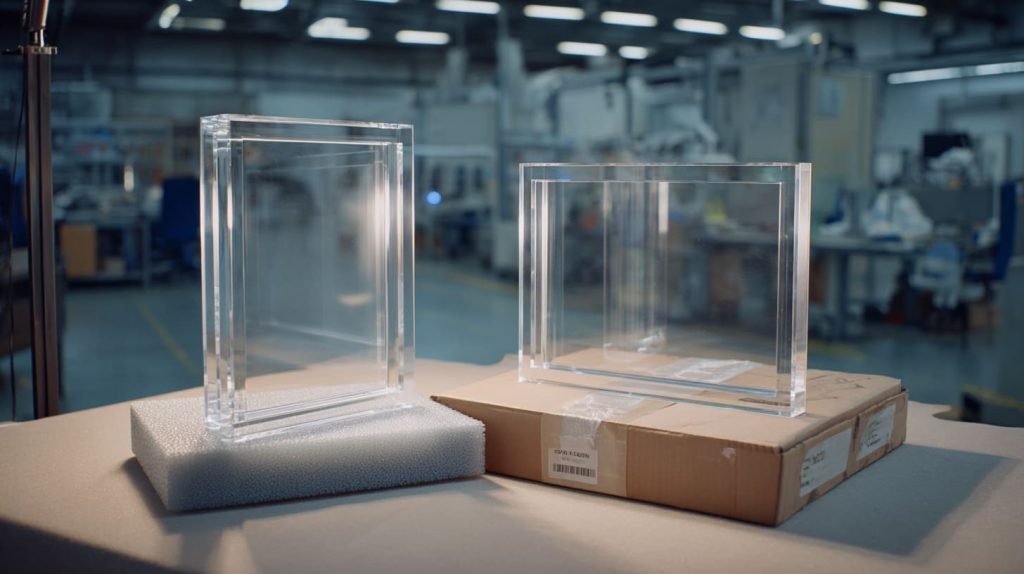
A frame looks like a quiet product.
It does not move.
It does not make sound.
It does not have wires, buttons, motors, or software.
It just sits there and holds a photo, a poster, a certificate, a product image, or a small piece of memory.
But in real work, I have never treated frames as “simple” products. Not after seeing cartons arrive with cracked glass. Not after seeing a retail display lose its clean look because the wrong front panel was selected. Not after seeing a buyer choose a material only because it looked nice in a sample room.
Acrylic frames and glass frames both have their place. I do not like saying one is always better than the other. That sounds clean, but real projects are not clean. Real projects have shipping risks, children touching corners, retail workers moving displays, buyers controlling cost, and customers judging the product in three seconds.
Acrylic frames are often better than glass frames for home and retail use when safety, weight, shipping, impact resistance, and customization matter. Glass frames still work well when scratch resistance, premium feel, and stable indoor display are the top priorities.
That is the honest answer.
Not the prettiest answer.
Not the shortest answer.
But the answer I trust after working with many custom acrylic projects.
The small detail I check early is not only how the frame looks under light, but what may happen before the final user even sees it. A frame can look perfect on a table and still fail during delivery, store handling, or daily home use.
So let us look at acrylic and glass frames in a practical way.
Not from a textbook.
From the table of a buyer, the packing line of a factory, and the wall of a real room.
What Are Acrylic Frames and Glass Frames?
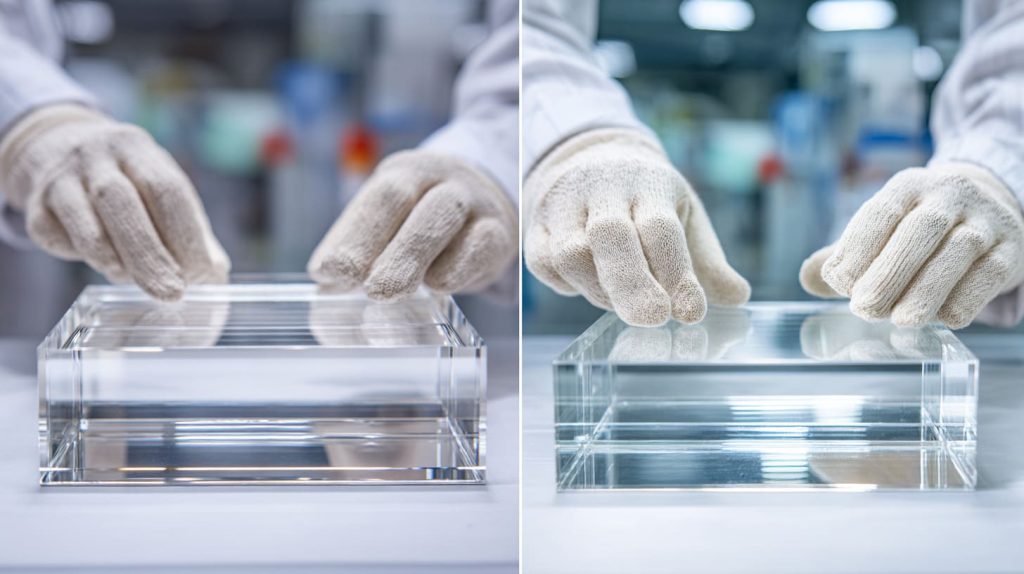
Before we compare acrylic and glass frames, I think we need to slow down for a moment.
Many buyers use the words “clear panel,” “plastic glass,” “plexiglass,” and “glass” very casually. I understand that. From a distance, both materials can look similar. Both can be transparent. Both can protect a photo or poster. Both can give the frame a clean front surface.
But once I touch the material, cut it, pack it, ship it, and hear customer feedback, the difference becomes very real.
What is an acrylic frame?
An acrylic frame uses acrylic sheet as the main clear material. Acrylic is also called PMMA or plexiglass in many markets.
It is clear.
It is light.
It is easier to shape than glass.
It is also much more impact-resistant.
For home use, acrylic frames often feel modern and clean. For retail use, acrylic frames are very common because stores need displays that can be moved, cleaned, shipped, and replaced without too much trouble.
I often see acrylic frames used for:
- Photo frames
- Certificate frames
- Menu displays
- Retail poster holders
- Countertop display frames
- Wall-mounted display panels
- Magnetic acrylic frames
- Custom logo display frames
Acrylic is not only a “glass replacement.” That is a small way to see it. In custom production, acrylic gives designers more freedom. It can be laser cut, CNC shaped, polished, drilled, bent, printed, glued, and made into many forms.
For a buyer like Jacky, this matters. He is not only buying a frame. He is buying a product that must fit a market, a package, a store shelf, and a customer expectation.
What is a glass frame?
A glass frame uses glass as the front protective panel. Glass is traditional. Many people grew up seeing glass picture frames in homes, offices, and galleries.
Glass has a hard surface. It resists scratches better than normal acrylic. It also feels heavier in the hand, and some customers connect that weight with “premium quality.”
That feeling is real.
When a customer picks up a small glass frame, the weight can give a strong first impression. The surface feels cool. The reflection feels familiar. The product may feel more classic.
But glass has one obvious weakness.
It breaks.
And when it breaks, it does not break politely.
It can create sharp pieces. It can damage the photo inside. It can cut the user. It can make the seller replace the product, refund the customer, or handle a complaint.
That is why I never compare glass and acrylic only by surface look. I compare them by the full journey.
Key structural differences
Acrylic and glass behave differently because their structures are different.
| Factor | Acrylic Frame | Glass Frame | Practical Meaning |
|---|---|---|---|
| Weight | Light | Heavy | Acrylic is easier to ship and hang |
| Impact resistance | High | Low | Acrylic is safer for active spaces |
| Scratch resistance | Medium | High | Glass stays clearer with rough cleaning |
| Custom shaping | Easy | More limited | Acrylic is better for OEM design |
| Breakage risk | Low | High | Glass needs stronger packing |
| Premium feeling | Modern and clean | Traditional and solid | Choice depends on market positioning |
| Large-size use | Easier | Riskier | Large glass panels are heavy and fragile |
The decision I make at this stage is usually not about which material is “better.” I first ask where the frame will live, how it will travel, and who will touch it. That answer usually tells me more than the material name.
A small photo frame for a quiet bedroom and a large retail poster frame near a store entrance do not live the same life.
They should not always use the same material either.
That is where the real comparison begins.
What Are the Key Differences Between Acrylic and Glass Frames?
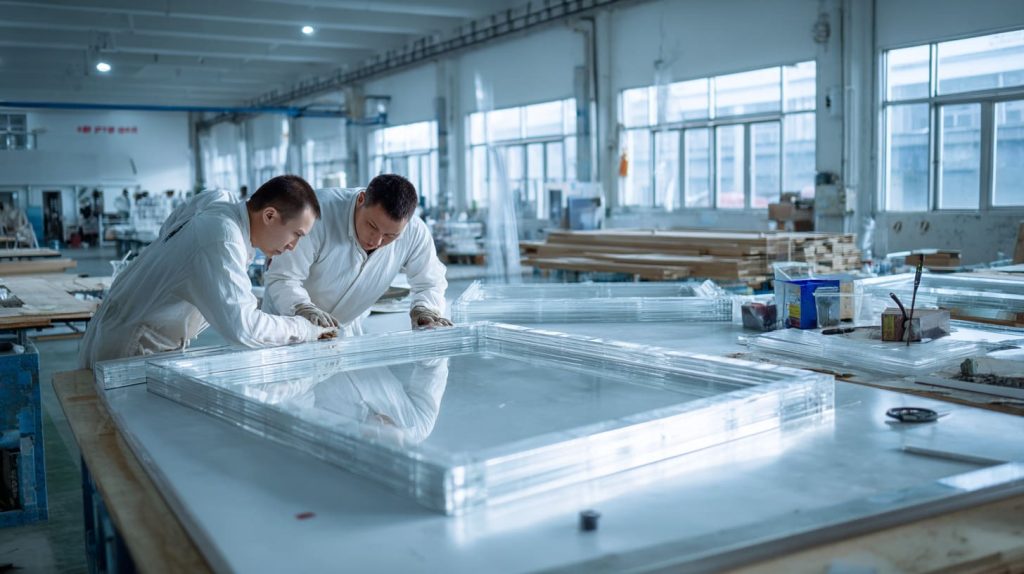
Acrylic and glass may look close when they are new and clean.
But products do not stay in that perfect sample condition forever.
They get packed.
They get shipped.
They get installed.
They get wiped with cloth.
They get touched by children.
They get moved by store staff in a hurry.
This is where the key differences start to matter.
Weight and handling
Acrylic is much lighter than glass. This sounds like a small point until the frame becomes large.
A small desktop frame may not make anyone worry. But a large wall frame, retail poster holder, or display panel can become a different story.
A heavy glass frame can create several problems:
- Higher shipping cost
- More difficult installation
- More pressure on wall hooks
- Higher risk during handling
- More dangerous breakage if it falls
Acrylic makes the frame easier to move and safer to install.
I have seen workers handle large acrylic panels with much less stress. They can move faster. They can adjust the frame position more easily. They do not feel like one wrong hand movement will turn the panel into broken pieces.
| Use Case | Acrylic Advantage | Glass Concern |
|---|---|---|
| Large wall photo frame | Easier to hang | Heavy and risky |
| Retail poster frame | Easy for staff to move | More breakage risk |
| Trade show display | Lighter for transport | Adds shipping burden |
| Children’s room frame | Safer if dropped | Can break into sharp pieces |
| Office wall display | Easier installation | Needs stronger mounting |
For real orders, I pay close attention to frame size because weight quietly changes the whole project. A material that feels fine in A4 size may become a headache in large custom sizes.
Durability and impact resistance
This is one of the biggest reasons buyers choose acrylic frames.
Acrylic is impact-resistant. It can bend slightly under force. It does not shatter like glass. That makes it useful for homes, schools, retail stores, hotels, offices, and public areas.
Glass is harder, but it is brittle. It may look strong until it receives sudden impact. Then it can crack or break.
Here is the simple difference:
| Situation | Acrylic Frame | Glass Frame |
|---|---|---|
| Dropped during unpacking | May scratch or dent | May break |
| Hit by shopping cart | More likely to survive | May crack |
| Child knocks it down | Safer result | Higher injury risk |
| Long-distance shipping | Lower breakage risk | Needs heavy protection |
| Retail staff moves it often | More forgiving | Higher handling risk |
I do not say acrylic cannot be damaged. Of course it can. It can scratch. It can crack under extreme force. It can bend if the design is poor.
But it gives the buyer more forgiveness.
And in business, forgiveness matters.
Because no one controls every hand that touches the product after it leaves the factory.
Scratch resistance
This is where glass wins.
Glass has a harder surface than standard acrylic. It resists small scratches better. If a customer wipes the frame with a rough cloth, glass may stay fine while acrylic may show marks.
This is one reason some buyers still prefer glass for premium home frames, gallery frames, and small photo frames that will not be handled often.
For acrylic frames, I usually suggest:
- Use a soft microfiber cloth
- Avoid dry wiping dusty surfaces
- Avoid rough paper towels
- Avoid alcohol or strong chemical cleaners unless material is approved
- Use anti-scratch acrylic if the project needs better surface protection
- Keep protective film on before final installation
| Cleaning Habit | Acrylic Result | Glass Result |
|---|---|---|
| Soft cloth and mild cleaner | Good | Good |
| Rough paper towel | May scratch | Usually fine |
| Dry wiping dust | Risky | Less risky |
| Frequent public cleaning | Needs care | More tolerant |
| Careless home use | May show marks | More stable |
The mistake I try to prevent is choosing acrylic for impact resistance and then cleaning it like glass. Acrylic can perform very well, but it asks for a different care habit.
That is not a weakness by itself.
It is a rule.
And rules are fine if the buyer knows them before placing the order.
Clarity and visual appearance
Both acrylic and glass can look very clear.
High-quality acrylic has excellent transparency. Good glass also looks clean and bright. For most home and retail users, the visual difference is not always obvious at first glance.
But there are small details.
Acrylic can sometimes show slight optical distortion if the sheet is low quality, too thin, or poorly processed. Glass stays flatter and more rigid, especially in small sizes.
For retail display, the difference depends on the product:
| Display Need | Better Choice | Reason |
|---|---|---|
| Large poster frame | Acrylic | Lighter and safer |
| Small premium photo frame | Glass or acrylic | Depends on market feeling |
| Countertop brand sign | Acrylic | Easy to customize |
| Gallery-style still display | Glass | Scratch resistance and flatness |
| Kids’ room wall frame | Acrylic | Safer if hit or dropped |
I once checked a batch of display frames where the sample looked nice, but the acrylic sheet was too thin for the size. Under bright store lighting, the panel had a slight wave. It was not terrible. But it was enough to make the display feel cheaper.
That day reminded me of a simple truth.
The material name is not enough.
Thickness, grade, processing, and frame structure also decide the final look.
Acrylic and glass do not only compete on beauty. They compete on real working conditions. And safety is usually the next question buyers ask after they understand the difference.
Which Is Safer for Home Use?

Home is not always gentle.
Children run.
Pets jump.
Doors slam.
Frames fall during cleaning.
People move furniture and forget the wall frame is behind them.
A frame may look calm on the wall, but home life has its own small accidents.
This is why acrylic often makes more sense for home use, especially in active spaces.
Safety for families and children
Acrylic frames are safer because they do not shatter like glass.
If an acrylic frame falls, the panel may scratch or crack in a serious case. But it is much less likely to create sharp broken pieces across the floor.
Glass frames are different. When glass breaks, the problem becomes urgent. Someone must clean it carefully. Children must stay away. Pets must be kept out. The photo or artwork may also be damaged.
That risk may sound small until it happens once.
| Home Area | Acrylic Frame | Glass Frame |
|---|---|---|
| Child’s bedroom | Strong choice | Higher risk |
| Hallway | Strong choice | Can break if knocked |
| Living room | Good choice | Good if stable |
| Stair wall | Safer | Riskier if it falls |
| Home office | Good choice | Good if not touched often |
When I think about home safety, I do not only think about the frame on day one. I think about a tired parent cleaning the room quickly, or a child hitting the wall by accident. That is where acrylic gives me more peace of mind.
Use in high-traffic areas
Some home areas are quiet.
Other areas are not.
A hallway frame gets passed many times a day. A frame near stairs may be touched by bags, shoulders, or cleaning tools. A frame in a child’s playroom may face balls, toys, and hands.
In these spaces, acrylic usually wins.
It is not because acrylic is perfect. It is because acrylic handles normal accidents better.
High-traffic spaces usually need:
- Lower breakage risk
- Lower injury risk
- Lighter weight
- Easier installation
- More forgiving material behavior
Glass can still work in home areas where the frame is small, well-mounted, and rarely touched. For example, a small family photo frame on a stable shelf can be fine with glass.
But if the frame is large or placed in a busy area, I lean toward acrylic.
Long-term maintenance considerations
Safety is not the only home question.
Maintenance matters too.
Acrylic needs soft cleaning. Glass can handle more careless cleaning. This is the trade-off.
| Maintenance Factor | Acrylic Frame | Glass Frame |
|---|---|---|
| Breakage risk | Low | High |
| Scratch risk | Higher | Lower |
| Cleaning habit | Needs soft cloth | More tolerant |
| Replacement risk | Lower from impact | Higher from breakage |
| Daily safety | Better | Depends on location |
I often tell customers to think about the user’s habits, not only the product’s features.
If the end user cleans carefully, acrylic works beautifully. If the user wipes everything with rough tissue, acrylic may collect small scratches over time.
A simple care card can help.
For example:
- “Clean with soft cloth only”
- “Do not use rough paper towels”
- “Keep away from strong solvents”
- “Remove dust gently before wiping”
This is a small thing. But small things protect the product experience.
Home buyers often judge safety with emotion. Retail buyers judge safety with cost, returns, and brand image. So let us move from the home wall to the store floor.
Which Is Better for Retail and Commercial Display?

Retail display has no patience.
A store display must look clean. It must survive handling. It must be easy to install. It must arrive without damage. It must not create trouble for staff.
Acrylic frames often fit this world better than glass frames.
Shipping and logistics impact
Shipping is where many glass frame projects become painful.
Glass needs stronger packing. Stronger packing means more material, more labor, more carton space, and more shipping weight. Even with good packing, glass still has breakage risk.
Acrylic reduces this risk.
For B2B buyers, this can change the total project cost.
| Cost Area | Acrylic Frame | Glass Frame |
|---|---|---|
| Breakage during shipping | Lower risk | Higher risk |
| Packaging material | Usually less demanding | Needs stronger protection |
| Carton weight | Lighter | Heavier |
| Replacement cost | Lower risk | Can be frequent |
| Customer complaints | Lower from breakage | Higher if glass cracks |
One thing I watch closely in retail orders is not only the unit price, but the “after-shipping price.” A cheaper glass frame can become expensive when replacement, repacking, and customer complaints enter the room.
This is a very real problem.
A buyer may save a little on material. Then he loses more later because 3% or 5% of frames arrive damaged.
For small retail orders, that may already hurt.
For bulk orders, it can become a full headache.
Display performance in stores
Retail stores need products that look good under lighting.
Acrylic performs well here, especially for:
- Poster frames
- Menu frames
- Price display holders
- Brand story boards
- Product information panels
- Countertop signs
- Wall display frames
- Window display frames
Acrylic gives a clean, modern look. It is also easier to make into frameless or magnetic designs.
Glass can look premium, but it is usually better for smaller and more controlled displays. For example, a luxury photo frame on a shelf may benefit from the solid feel of glass.
But a large wall display in a busy store?
I would be careful with glass.
| Retail Display Type | Better Choice | Why |
|---|---|---|
| Large poster frame | Acrylic | Light and safer |
| Counter display frame | Acrylic | Easy to move and customize |
| Luxury small photo frame | Glass or acrylic | Depends on brand feel |
| Hanging signage | Acrylic | Lower weight |
| Public information board | Acrylic | Safer in high-traffic areas |
| High-end gallery corner | Glass | Better scratch resistance |
Retail staff also matter.
They may change posters often. They may clean displays quickly. They may move frames during promotions. A display material must survive real store behavior, not just look good in a product photo.
Customization flexibility
This is where acrylic becomes very useful for B2B projects.
Acrylic can be shaped and customized in many ways. It can support special sizes, polished edges, printed logos, magnetic structures, holes, stands, bending, and layered designs.
This is important for buyers who do not want a standard catalog frame.
At Feilong Acrylic, custom work is a normal part of our daily production. We often receive drawings, rough ideas, photos, or samples. Then we turn them into workable acrylic products.
Acrylic supports many custom needs:
| Custom Need | Acrylic Frame | Glass Frame |
|---|---|---|
| Special shape | Easier | Harder |
| Drilled holes | Easier | Risky |
| Logo printing | Easier | Possible but less flexible |
| Magnetic design | Common | Less common |
| Edge polishing | Clean result | Limited style |
| Layered structure | Easy | Harder |
| Bulk OEM order | Strong fit | More packing risk |
For retail use, customization is not decoration only.
It can affect:
- Brand image
- Shelf fit
- Display angle
- User interaction
- Assembly speed
- Packing method
- Replacement parts
A beautiful frame that cannot be produced steadily is not a good retail product.
I care about repeatability here. A sample can be handmade slowly, but a retail order needs stable quality across hundreds or thousands of pieces.
Retail buyers often ask about unit price first. I understand that. But the better question is usually long-term value.
How Do Cost and Long-Term Value Compare?

Cost is a tricky word.
Some buyers mean material cost.
Some mean unit price.
Some mean landed cost.
Some mean total loss after complaints, returns, and replacements.
These are not the same thing.
When we compare acrylic frames and glass frames, we should not only ask, “Which one is cheaper?”
We should ask, “Which one creates fewer problems after purchase?”
Material cost comparison
Glass can be cheaper than acrylic in some standard sizes and simple designs. That is one reason glass remains common in many photo frames.
Acrylic may cost more per sheet, especially if the buyer needs good clarity, thicker material, anti-scratch coating, anti-glare surface, or custom processing.
But material cost is only one part of the story.
| Cost Factor | Acrylic Frame | Glass Frame |
|---|---|---|
| Basic material cost | Often higher | Often lower |
| Processing flexibility | Strong | More limited |
| Packaging cost | Usually lower risk | Often higher |
| Shipping weight | Lower | Higher |
| Breakage loss | Lower | Higher |
| Replacement risk | Lower | Higher |
The cost trap I try to avoid is comparing only the first quotation line. A low unit price can hide a high project cost if the material creates damage, delays, or complaints later.
This is especially true for export orders.
A frame may travel through:
- Factory packing
- Warehouse loading
- Container transport
- Customs handling
- Local warehouse
- Retail distribution
- Final customer delivery
Every step is a chance for glass to break.
Acrylic has risks too, but breakage is usually not the main one.
Hidden costs in real projects
Hidden costs are the costs buyers do not see clearly at the start.
They appear later.
Sometimes quietly.
Sometimes very loudly.
For frames, hidden costs can include:
- Broken panels after shipping
- Extra foam or corner protection
- Heavier cartons
- More warehouse damage
- Customer complaints
- Refunds or replacements
- Delayed retail launch
- Bad reviews
- Staff time spent solving issues
| Hidden Cost | Why It Matters |
|---|---|
| Breakage | Direct product loss |
| Replacement shipping | Often more expensive than the part |
| Customer complaint | Hurts brand trust |
| Extra packaging | Adds labor and material cost |
| Heavy cartons | Increases freight cost |
| Installation risk | Can create safety issues |
| Store handling damage | Affects display quality |
I once saw a buyer focus hard on saving a small amount per frame. The logic looked smart on paper. But after shipping damage appeared, the saving disappeared like ice in hot tea.
That is not a rare story.
It happens because buyers sometimes treat frames as simple products.
They are not always simple once volume and shipping enter the picture.
ROI for B2B buyers
For B2B buyers, ROI does not only mean “profit.”
It means smoother operation.
Acrylic frames can offer better long-term value when:
- The product ships internationally
- The frame size is large
- The product is handled often
- The display is used in public spaces
- The buyer needs custom design
- The seller wants fewer breakage claims
Glass can offer good value when:
- The frame is small
- The display is stable
- Scratch resistance matters most
- The product stays in one controlled place
- The brand wants a heavier traditional feel
| Buyer Priority | Acrylic Frame | Glass Frame |
|---|---|---|
| Fewer shipping issues | Strong | Weak |
| Lower material cost | Medium | Strong |
| Custom design | Strong | Medium |
| Premium small-frame feel | Medium | Strong |
| Safety | Strong | Weak |
| Scratch resistance | Medium | Strong |
| Large display use | Strong | Weak |
I do not push acrylic just because we make acrylic products. That would be lazy thinking. I recommend acrylic when the full project risk points toward acrylic.
This is also why environment matters. A frame in a quiet bedroom and a frame in a busy retail store are not facing the same life.
How Do Acrylic and Glass Perform in Different Environments?
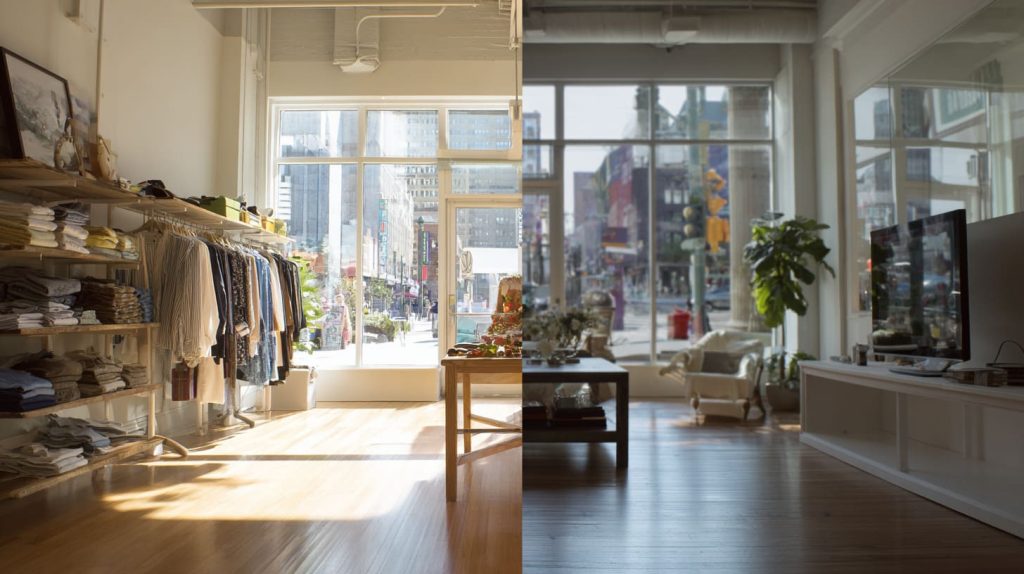
The same frame can perform well in one place and poorly in another.
That may sound unfair, but materials do not care about our expectations. They only react to the environment.
Temperature.
Sunlight.
Humidity.
Cleaning habits.
Human traffic.
Installation method.
All of these things matter.
Indoor home environments
For normal indoor home use, both acrylic and glass can work well.
If the frame is small, installed safely, and rarely touched, glass can be a good choice. It gives a classic feel and better scratch resistance.
Acrylic is also a strong choice, especially when the frame is larger or placed in an active area.
| Home Environment | Acrylic Frame | Glass Frame |
|---|---|---|
| Quiet bedroom | Good | Good |
| Kids’ room | Better | Riskier |
| Hallway | Better | Riskier |
| Living room wall | Good | Good if secure |
| Rental apartment | Good | Heavier to install |
| Large family photo wall | Better | Heavy and fragile |
The detail I care about at home is not only where the frame hangs, but how people live around it. A “safe wall” on paper may still be a busy wall in real life.
For example, a hallway wall beside a shoe cabinet may look safe. But every day, bags, elbows, and cleaning tools pass near it. That changes the material choice.
Retail and commercial environments
Retail environments are more demanding.
Frames may face:
- Frequent cleaning
- Customer touching
- Staff handling
- Display changes
- Bright lighting
- Tight installation spaces
- Shipping between branches
- Seasonal promotion changes
Acrylic usually performs better in this kind of active environment.
It is lighter. It is safer. It is easier to customize. It is less likely to break during movement.
Glass can still work in controlled retail environments. For example, a luxury store may use glass for a small, fixed display frame where customers do not touch it.
But in general retail use, acrylic is more practical.
| Commercial Environment | Better Material | Reason |
|---|---|---|
| Supermarket display | Acrylic | High traffic |
| Cosmetic counter | Acrylic | Custom clean display |
| Hotel lobby sign | Acrylic | Safe and elegant |
| Restaurant menu frame | Acrylic | Easy to replace and clean |
| Luxury small display | Glass or acrylic | Depends on brand image |
| Museum-style display | Glass | Scratch resistance and flatness |
Retail display is not only about beauty. It is about staying beautiful after many hands and many days.
That is a harder test.
UV resistance and aging
Acrylic and glass also age differently.
Standard acrylic can yellow over time if it has poor material quality or long-term UV exposure. Good UV-resistant acrylic performs much better. This is why material grade matters.
Glass is more stable under UV, but it is still heavy and fragile.
For indoor use, yellowing is usually not a major issue if good-grade acrylic is selected. For window displays or areas with strong sunlight, buyers should ask about UV-resistant acrylic.
| Factor | Acrylic Frame | Glass Frame |
|---|---|---|
| Indoor aging | Good with quality material | Very stable |
| Strong sunlight | Needs UV-resistant grade | Stable |
| Weight over time | Easy on mounting | More load on wall |
| Breakage from impact | Lower risk | Higher risk |
| Surface scratches | Needs care | Better resistance |
This is where cheap acrylic can damage the reputation of good acrylic.
A buyer may see a low-cost acrylic frame yellow or scratch badly, then think all acrylic is poor. But the real issue may be sheet grade, thickness, coating, or cleaning method.
Materials have levels.
A low-grade acrylic frame and a high-grade acrylic frame are not the same product.
Now we can turn this into a more practical buying decision. When should acrylic be the first choice?
When Should You Choose Acrylic Frames?
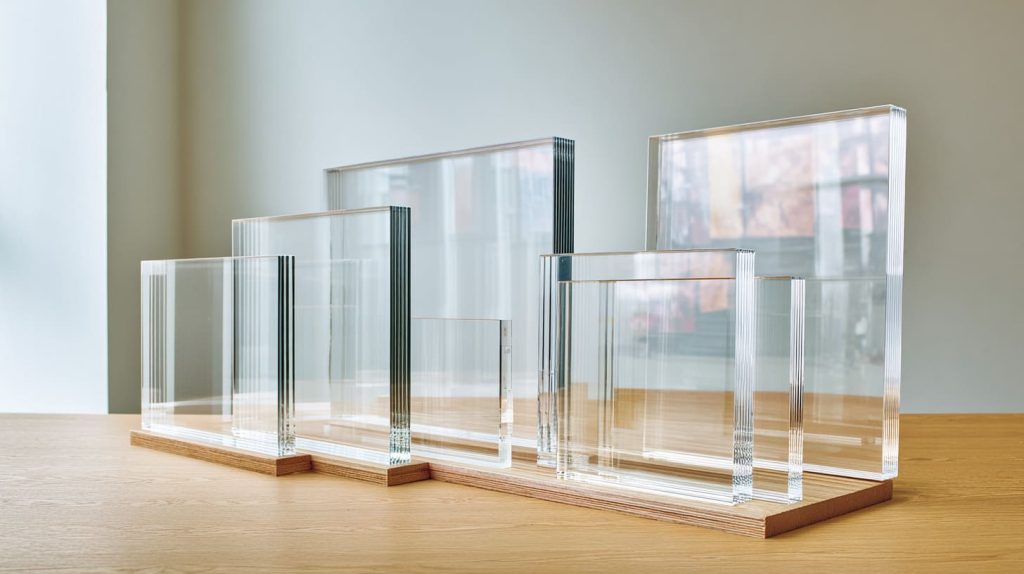
I choose acrylic frames when the project needs more safety, lower weight, better shipping performance, or custom design freedom.
That covers many home and retail uses.
Acrylic is not perfect. I never tell buyers that. But it solves many real problems that glass creates.
Ideal scenarios
Acrylic frames are a strong choice for large frames and wall displays.
Large glass frames can be heavy and risky. Acrylic makes installation easier. It also reduces breakage during handling.
Acrylic is also good for projects that require shipping.
This is very important for online sellers, retailers, wholesalers, and importers. A frame that breaks before it reaches the customer is not a product anymore. It becomes a problem in a carton.
Acrylic is also better for safety-sensitive environments.
These include:
- Children’s rooms
- Schools
- Retail stores
- Hospitals
- Hotels
- Public hallways
- Trade shows
- Restaurants
- Offices
- Rental spaces
| Best Acrylic Use Case | Why Acrylic Works Well |
|---|---|
| Large photo frame | Light and safer |
| Wall display frame | Easier to install |
| Retail poster holder | Lower breakage risk |
| Kids’ room frame | Safer if dropped |
| Trade show frame | Easier to transport |
| Custom brand display | Easy to shape and print |
| Online retail frame | Better shipping survival |
The point where I usually choose acrylic is when one broken glass panel can create more trouble than the material saving is worth. That is a very practical line in real buying.
For example, if a buyer sells frames online, glass may create too many shipping complaints. Acrylic may cost more at first, but it protects the business better.
B2B customization needs
Acrylic frames are especially useful for B2B custom orders.
A buyer may need:
- A custom size
- A special thickness
- A printed logo
- A magnetic front panel
- A wall-mounted structure
- A freestanding frame
- A polished edge
- A special color
- A mixed-material design
- A retail-ready package
Acrylic supports these needs well.
At Feilong Acrylic, this is the type of work we handle often. A customer may not have a perfect drawing at the start. Sometimes he has a photo, a sample, or only a rough idea. We help turn that into a real product structure.
| Custom Requirement | Acrylic Advantage |
|---|---|
| Logo printing | Easy to add brand details |
| Special shape | Easier cutting and processing |
| Magnetic frame | Common acrylic design |
| Thick clear block style | Strong visual effect |
| Wall mounting holes | Easier to drill |
| Small-batch sample before bulk | Practical for custom testing |
| OEM production | Good repeatability with proper setup |
But customization also needs discipline.
Acrylic gives freedom, but too much freedom can become messy. If the drawing is not clear, the thickness is wrong, or the packing is ignored, the project can still fail.
For custom frame orders, I usually ask about:
- Final use place
- Frame size
- Panel thickness
- Quantity
- Logo or printing needs
- Hanging or standing method
- Cleaning environment
- Packing method
- Shipping destination
These questions may look basic.
But basic questions save expensive mistakes.
Still, acrylic is not the answer for every situation. There are times when glass makes more sense.
When Should You Choose Glass Frames?

Glass frames still have a place.
I do not believe in replacing every glass frame with acrylic. That would be too simple. It would also be wrong.
Glass has real strengths. The surface is hard. The feel is classic. The weight can feel premium. The clarity can be very stable in small formats.
Ideal scenarios
Glass frames are a good choice when scratch resistance is very important.
For example, a small frame on a desk may be cleaned often. If the user wipes it without care, glass will usually handle that better than acrylic.
Glass also works well for premium small-format displays. The weight can help the product feel more expensive in the hand.
Ideal glass frame situations include:
- Small photo frames
- Desk frames
- Premium gift frames
- Gallery-style display
- Low-touch wall frames
- Controlled indoor display
- Projects where surface hardness matters most
| Best Glass Use Case | Why Glass Works Well |
|---|---|
| Small desktop photo frame | Premium weight and feel |
| Gallery frame | Better scratch resistance |
| Low-touch wall frame | Stable and clear |
| Premium gift frame | Traditional customer expectation |
| Controlled indoor display | Lower breakage risk |
| Scratch-sensitive use | Harder surface |
The moment I become more open to glass is when the frame is small, stable, and unlikely to travel through rough handling. In that case, the scratch advantage may matter more than impact resistance.
This is why a buyer should not make a material decision based only on trend.
Modern does not always mean better.
Traditional does not always mean outdated.
The right material depends on the job.
Situations with minimal handling
Glass is better when handling is low.
For example, a framed artwork in a quiet gallery may not be touched often. A small photo frame on a shelf may stay in one place for years. A hotel room frame may be mounted securely and cleaned by trained staff.
In these cases, glass can work well.
But if the same frame is shipped to thousands of online customers, glass becomes riskier.
| Situation | Glass Risk Level | Comment |
|---|---|---|
| Fixed gallery wall | Low | Good if handled carefully |
| Small desk frame | Medium | Safe if stable |
| Kids’ room | High | Breakage risk |
| Online shipping | High | Needs strong packing |
| Retail high-traffic wall | High | Public impact risk |
| Large wall frame | High | Heavy and fragile |
Glass is like a formal leather shoe.
It can look excellent in the right place.
But you do not wear it to run through mud.
Acrylic is more like a clean, practical sneaker. It may not have the same classic feeling, but it handles movement better.
This is why the final buying decision should not be emotional only. It needs a simple project checklist.
How to Choose the Right Frame for Your Project?
Choosing between acrylic and glass frames becomes easier when we stop asking, “Which material is better?”
That question is too wide.
I prefer to ask, “Which material is safer for this project, easier to ship, easier to maintain, and better for the target customer?”
That question gives a clearer answer.
Key decision factors
Here are the key points I usually check.
| Question | Why It Matters | Acrylic Tends to Fit When | Glass Tends to Fit When |
|---|---|---|---|
| What is the frame size? | Large frames increase weight and risk | Size is medium or large | Size is small |
| Where will it be used? | Environment affects safety | Busy or public area | Quiet and controlled area |
| Who will touch it? | User behavior changes risk | Children, staff, customers | Careful adults or trained staff |
| How will it ship? | Transport can cause damage | Long-distance or e-commerce shipping | Local delivery or strong packing |
| How often will it be cleaned? | Cleaning affects surface life | Soft cleaning is possible | Rough cleaning may happen |
| Is custom design needed? | Processing changes cost | Special shape or logo needed | Standard frame is enough |
| What is the brand position? | Material feel affects perception | Modern and practical | Classic and premium |
| What is the real budget? | Total cost is not unit price only | Lower damage risk matters | Lowest material cost matters |
A buyer who only checks appearance is making the decision with one eye closed. I try to open the other eye by looking at shipping, use behavior, maintenance, and complaint risk.
This may sound careful.
It should be.
Frame projects can look small, but a bad material choice can create repeated problems.
Questions buyers should ask suppliers
A good supplier should not only say, “Yes, we can make it.”
That is not enough.
The buyer should ask practical questions before confirming the order.
Material questions
- What acrylic grade will be used?
- Is it standard acrylic or UV-resistant acrylic?
- What thickness do you suggest for this frame size?
- Will the panel bend or wave in large size?
- Is anti-scratch acrylic available?
- Is anti-glare surface needed?
- Can you provide a sample?
Design questions
- How will the frame stand or hang?
- Are the screw holes strong enough?
- Will the magnets hold firmly?
- Are the edges polished?
- Is the frame easy to open for photo replacement?
- Will the design scratch the printed photo inside?
Packaging questions
- How will each frame be protected?
- Will the acrylic surface have protective film?
- Is there corner protection?
- What is the carton drop risk?
- Is the packing suitable for export?
- Can the product survive warehouse handling?
Bulk order questions
- Can the sample quality be repeated in mass production?
- What is the tolerance?
- How will surface scratches be controlled?
- How will printing quality be checked?
- What is the lead time?
- What happens if damage is found after delivery?
| Supplier Check | Why I Care |
|---|---|
| Material grade | Prevents yellowing, poor clarity, and weak panels |
| Thickness suggestion | Prevents bending and cheap appearance |
| Edge finishing | Affects safety and visual quality |
| Surface protection | Prevents scratches before delivery |
| Packing method | Reduces shipping complaints |
| Sample review | Confirms real product feel |
| QC process | Supports stable bulk production |
For acrylic frames, I also pay attention to protective film. A frame can leave the factory clean, but if workers remove the film too early, small scratches may appear before packing.
That kind of detail is easy to ignore.
But customers notice.
They may not know why the product feels wrong. They just feel it.
So the supplier’s process matters as much as the material.
Conclusion
I think acrylic frames are usually better than glass frames for many home and retail uses.
Not because acrylic is perfect.
It is not.
Acrylic can scratch more easily than glass. It needs better cleaning habits. It also needs the right grade, thickness, and production control. Cheap acrylic can make a good design look bad.
But I still choose acrylic in many real projects because it solves the problems that usually hurt buyers the most.
It is lighter.
It is safer.
It is easier to ship.
It is easier to customize.
It is more forgiving in homes, stores, and public spaces.
Glass frames still make sense when the frame is small, stable, premium, and not handled often. Glass has better scratch resistance. It has a classic feel. It can look beautiful in the right environment.
But my experience has taught me one thing.
A frame should not be judged only by how it looks under perfect light.
It should be judged by its whole life.
How will it be packed?
How far will it travel?
Who will touch it?
Where will it hang?
How often will it be cleaned?
What happens if it falls?
These questions are not dramatic. They are practical.
And practical questions often save money.
At Feilong Acrylic, we work with custom acrylic products every day, from display frames and boxes to stands, racks, cabinets, blocks, and organizers. I have learned that a good acrylic frame is not only a clear panel. It is a small design decision that protects the buyer from breakage, shipping risk, and poor user experience.
If you are planning a custom acrylic frame project for home, retail, display, or bulk OEM use, I would suggest starting with the real application first.
Send the size.
Send the usage place.
Send the quantity.
Send the packing need.
Send the logo or design idea.
Then the material choice becomes much clearer.
Because the best frame is not always the one that looks best in a sample photo.
It is the one that still looks right after shipping, installation, handling, cleaning, and real daily use.