Skip to content
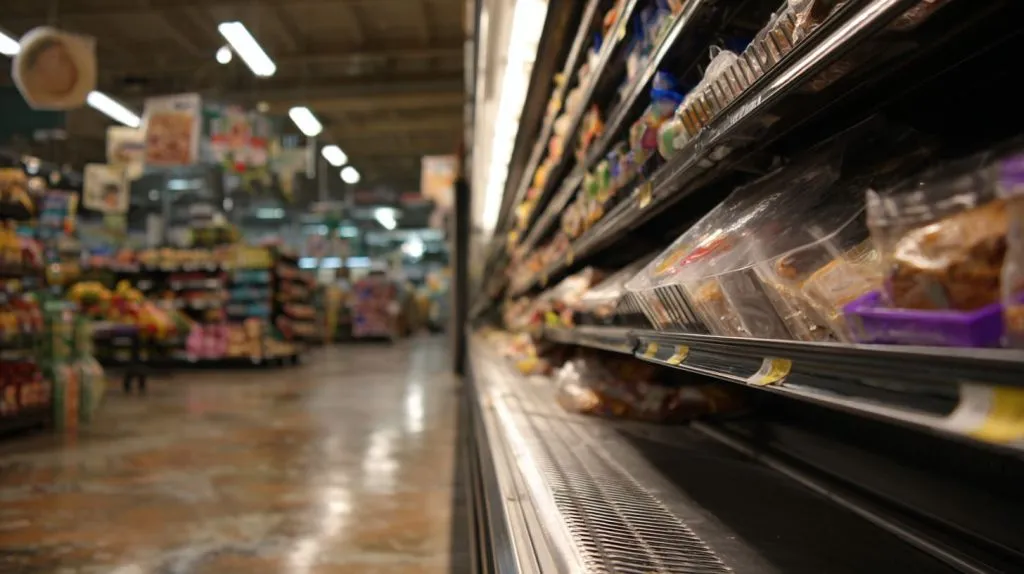
A grocery store display looks “simple” until something goes wrong.
A shelf divider snaps during restocking. A clear guard turns cloudy after a few weeks of sanitizer. A sign holder warps near the deli warm lights. And then the buyer email lands in my inbox with that familiar tone: “Vincent, we need this to last. What plastic should we use?”
I like this question because it sounds small, but it decides everything. Durability decides how many replacements happen. Hygiene decides how the surface looks after daily cleaning. Cost decides whether the rollout happens in 20 stores or 200. And branding decides whether the display looks like a premium product or a temporary workaround.
There’s also a quiet gap people miss: retail-grade vs. B2B custom requirements.
- Retail-grade often means “good enough for this season.”
- B2B custom displays often mean “repeatable, scalable, consistent, and safe for long use.”
So in this article, I’m going to break down the top plastic materials used in grocery store displays, how they behave in the real world, and how I choose the right one when an OEM buyer wants both looks and reliability.
A display is not just a shape. It’s a material decision with consequences.
Why Plastic Is Widely Used in Grocery Store Displays
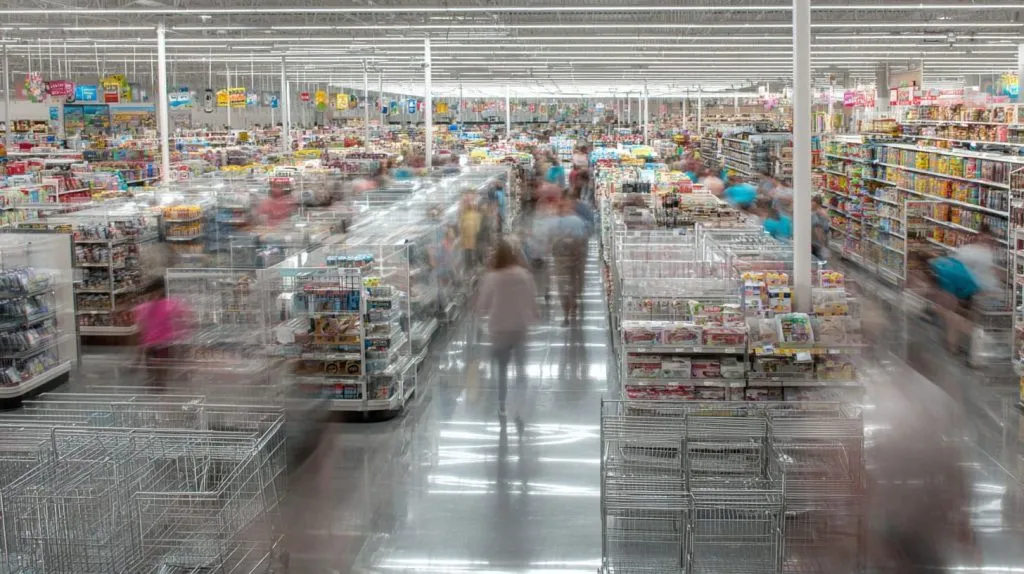
When I compare plastic to glass or metal for grocery displays, I don’t start with “cheap” or “premium.” I start with one simple idea: stores are busy places. People bump things. Staff move fixtures fast. Cleaning happens every day. And displays need to survive all of it without creating new problems.
Lightweight Yet Strong for High-Traffic Environments
Plastic wins the daily battle because it is light, but still strong enough for most retail tasks.
- A staff member can install it alone.
- A merchandiser can reposition it quickly.
- A store manager doesn’t panic when something drops.
And honestly, plastic reduces injury risk compared to glass. That matters when you have customers and staff moving around all day.
Here’s the practical view I use:
| Material Type | Handling Risk | Typical Store Reaction |
|---|---|---|
| Glass | High | “Too risky near customers.” |
| Metal | Medium | “Strong, but heavy and can dent products.” |
| Plastic | Low | “Fast, safe, flexible.” |
The critical thinking point: lightweight is not always good. Too light can mean tipping. So I always think about base weight and design balance, not just sheet thickness.
Cost Efficiency for Bulk Retail Rollouts
Grocery chains live on scale. A display that costs $2 more might sound fine—until you multiply it by 5,000 units.
Plastic often offers:
- Lower raw material cost (not always, but often)
- Easier processing (cutting, bending, forming)
- Faster cycle times for molded parts
But I also watch out for the trap: “cheap today, expensive later.”
If a plastic cracks early, the replacement cost and downtime can eat the savings.
Design Flexibility and Branding Potential
This is the part that makes buyers smile.
Plastic can be:
- Cut
- Bent
- Thermoformed
- Printed
- Polished
- Textured
And you can shape it into something that feels like a brand decision, not a generic fixture.
If you’re selling premium snacks or cosmetics inside a grocery store, the display has to match that mood. Plastic gives you that control.
Bridge to the next section (keep reading):
Now comes the part that surprises many buyers: “clear plastic” is not one material. Acrylic, PETG, and PC can look similar in photos, but behave totally differently in stores.
Acrylic (PMMA): The Premium Choice for Clear Displays
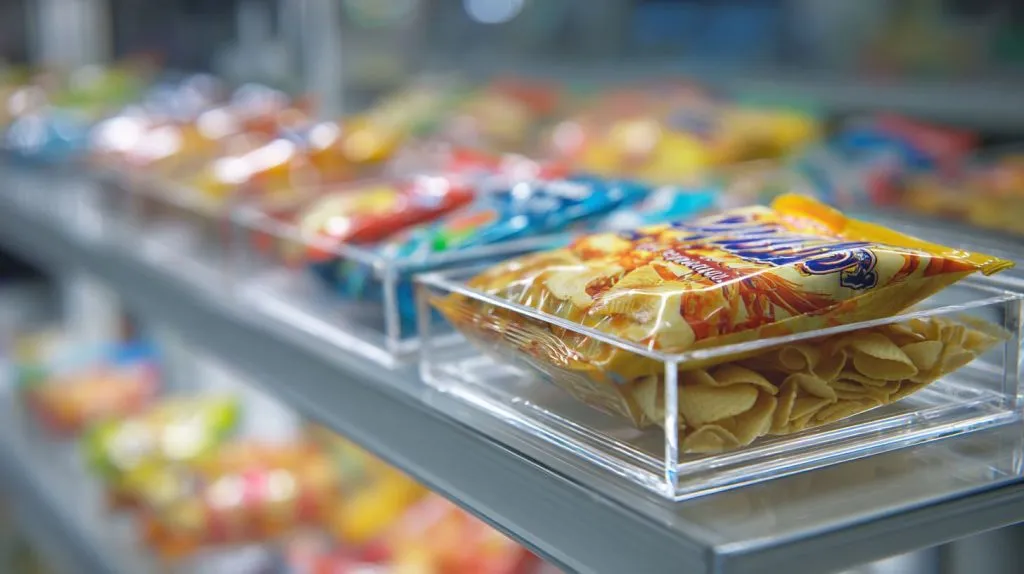
Acrylic is the material that makes people stop and stare. It has that clean, glass-like look that feels “finished.” In my factory work at Feilong Acrylic, acrylic is the default choice when the buyer cares about visual clarity and presentation.
But I also tell Jacky-type buyers a blunt truth: acrylic rewards good design and punishes lazy design. It looks premium, but it is not forgiving.
What Is Acrylic and Why It’s Popular in Retail
Acrylic (PMMA) is a transparent plastic known for:
- High clarity
- Strong surface gloss
- Good UV stability (so it stays clear longer in light)
In a grocery environment, clarity is not “nice.” It is strategy. Clear displays reduce visual clutter. They make products feel more “organized” without shouting.
Critical thinking: acrylic looks like glass, so buyers expect glass behavior. But acrylic is still plastic. It can scratch. It can crack if you push it the wrong way.
Typical Applications in Grocery Stores
I see acrylic used for:
- Cosmetic organizers near checkout
- Product risers for premium snacks
- Shelf dividers for neatly faced goods
- Bakery and deli covers (when the design is correct)
Acrylic shines when customers are close to the display and judging quality fast.
Advantages and Limitations
Here’s how I explain it in plain terms:
| Acrylic (PMMA) | Why Buyers Love It | Where It Can Hurt You |
|---|---|---|
| Clarity | Looks like glass | Scratches can show easily |
| Premium feel | Great for branding | Can crack under sharp impact |
| UV stability | Stays clear longer | Not ideal for rough handling |
| Clean edges | Polishes beautifully | Needs correct thickness/design |
A small story from real production thinking
A buyer once insisted on thin acrylic shelf dividers to save cost. The samples looked perfect. Then the store staff started restocking fast. The dividers snapped at the notch points. The design was “clean,” but the stress points were loud.
So I learned to ask one boring question every time: Where will the force hit?
Not “what looks nice,” but “what gets abused daily.”
Bridge to the next section:
If acrylic is the “premium glass look,” PETG is the “clear but tougher cousin.” And in grocery stores, toughness often wins quietly over beauty.
PET and PETG: Impact-Resistant and Food-Safe Options
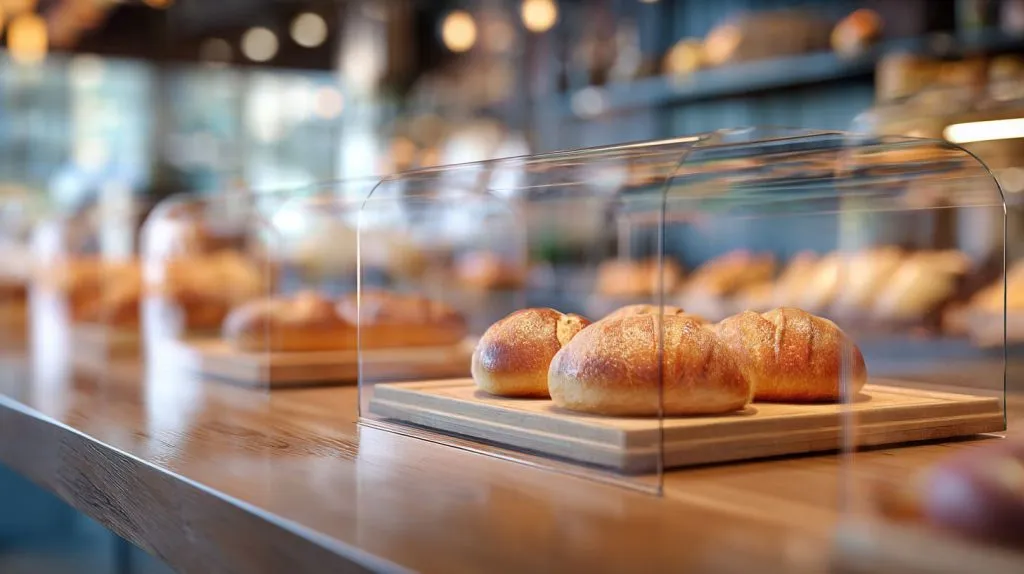
PET and PETG are the materials I reach for when the buyer says:
“I still want it clear, but I don’t want cracked parts.”
That sentence shows up a lot in grocery displays because stores are rougher than people admit.
What Is PET/PETG?
PET is a polyester plastic. PETG is a modified version that is easier to form and usually tougher in many display uses.
In simple words:
- PET: strong, widely used, often rigid
- PETG: clearer forming, better impact behavior in many display designs, more forgiving
Critical thinking: PET and PETG get grouped together too casually. They are related, but not the same. If the display needs bending and shaping, PETG often makes the project smoother.
Where PETG Performs Best in Grocery Displays
I often see PETG used for:
- Food trays and containers
- Protective guards (including clear panels)
- Hanging holders for promotions
- Areas where impacts happen often (carts, baskets, stocking)
PETG works well when you want “clear” but also want fewer surprises in daily handling.
Key Benefits for Grocery Environments
Here’s a simple comparison I use in early discussions:
| Feature | Acrylic (PMMA) | PETG |
|---|---|---|
| Clarity | Very high | High |
| Impact resistance | Medium | Higher |
| Thermoforming ease | Medium | High |
| Scratch resistance | Medium | Medium |
| Cost | Medium to higher | Medium |
Cleaning reality check (this matters more than people think)
Grocery stores clean a lot. And cleaning does not mean “gentle.”
So I ask: What chemicals will touch this surface every day?
Because a clear sheet can turn into a foggy sheet if the wrong cleaner is used.
A practical approach is to test common cleaners on small samples before mass production. It sounds slow, but it saves a rollout.
Bridge to the next section:
Sometimes PETG still isn’t enough—like checkout lanes where carts collide, or entry displays where people bump in. That’s where polycarbonate steps in like a bodyguard.
Polycarbonate (PC): High-Impact Performance Material
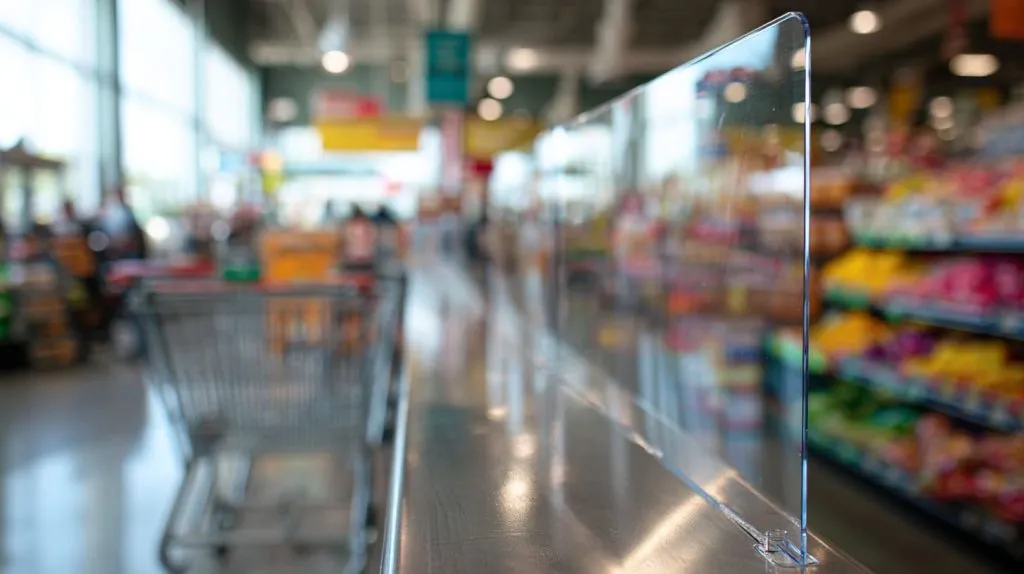
Polycarbonate is the material I suggest when the buyer says:
“This display will get hit. A lot.”
PC is not always the prettiest to work with, and it can cost more. But it is a survival-focused choice.
What Makes Polycarbonate Different?
Polycarbonate is known for:
- Very high impact resistance
- Higher heat tolerance than acrylic in many real applications
- Strong performance when the environment is rough
Critical thinking: people assume “strongest is best.” Not always. PC can scratch too. And sometimes PC clarity is not the same “glass” mood as acrylic. So I use PC when function is the priority.
Common Grocery Applications
I see PC used in:
- Checkout lane guards and shields
- Entry displays where carts and baskets bump
- Protective panels near high-touch zones
- Places where safety matters more than showroom looks
When to Choose PC Over Acrylic
Here are the triggers I watch for:
- Impact risk: carts, baskets, crowded corners
- Vandalism risk: public-facing zones with repeated abuse
- Heat exposure: near warm lights or equipment
- Long lifespan expectation: the display must last for years
A simple decision table helps a lot:
| If your display has… | Acrylic | PETG | Polycarbonate |
|---|---|---|---|
| Premium clarity needs | ✅✅✅ | ✅✅ | ✅✅ |
| Frequent impacts | ⚠️ | ✅✅ | ✅✅✅ |
| Complex forming | ⚠️ | ✅✅✅ | ✅✅ |
| Highest safety margin | ⚠️ | ✅✅ | ✅✅✅ |
Bridge to the next section:
Not every display is meant to live for years. Some are born for a 2-week promotion. That’s when budget materials like PVC start to make sense—if you accept the trade-offs.
PVC (Rigid and Foam Board): Budget-Friendly Display Material
PVC is a common “get it done” material in retail signage and temporary displays. I respect it for what it is: a cost and speed tool.
But I also stay honest: PVC rarely gives the same premium mood as acrylic.
Understanding PVC Variants
There are two common forms in displays:
- Rigid PVC sheet: stronger, more durable than foam board
- PVC foam board: lighter, often used for short-term signage
Critical thinking: foam board looks great on day one. Then it meets humidity, handling, and time. If your display is near produce misting or refrigerated zones, you need to think twice.
Typical Grocery Store Uses
PVC is often used for:
- Temporary promotional signage
- Shelf talkers and price boards
- Backing boards for printed graphics
It’s also common when the store wants fast replacement and doesn’t care about long-term finish.
Cost vs. Durability Considerations
Here’s a plain, buyer-friendly summary:
| PVC Type | Best For | Risk to Watch |
|---|---|---|
| Rigid PVC | longer promos, sign panels | looks less premium |
| PVC foam board | short promos, lightweight signs | dents, edge damage, humidity |
I tell buyers: PVC is not “bad.” It is simply honest about its purpose.
If the purpose is short-term marketing, PVC fits.
Bridge to the next section:
If PVC is the “promo sign” material, polystyrene is the “cheap and fast component” material. It shows up everywhere, but you need to know where it breaks.
Polystyrene (PS): Lightweight and Economical Option
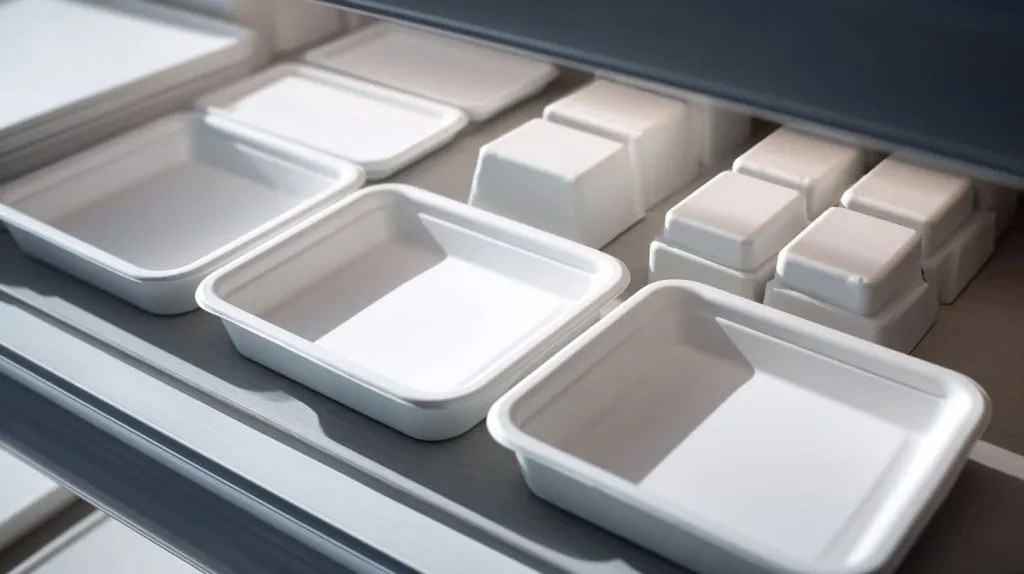
Polystyrene is one of those materials that quietly fills the world. It’s light, cheap, and easy to process. That’s why it shows up in many display components.
But PS has a personality: it behaves well when treated gently, and it complains fast when abused.
What Is Polystyrene?
PS is a lightweight plastic that is often used in:
- Injection-molded parts
- Low-cost packaging and trays
- Display pieces that do not carry big loads
Critical thinking: many buyers only see PS as a cost decision. I see it as a risk decision. If the part is thin and gets hit, PS can crack.
Best Uses in Grocery Displays
PS is common for:
- Disposable trays
- Low-cost dividers
- Small display components that are not structural
Pros and Cons
Here is the short truth:
| Polystyrene (PS) | Pros | Cons |
|---|---|---|
| Cost | very low | can fail early |
| Weight | very light | can feel “cheap” |
| Processing | easy to mold | lower impact strength |
If the display is temporary and low-stress, PS can be fine.
If the display lives in a rough zone, PS becomes a complaint generator.
Bridge to the next section:
Now let’s talk about the “working plastics.” HDPE and PP don’t always look fancy, but they survive cleaning, moisture, and daily abuse like champs.
HDPE and PP: Functional Plastics for Utility Displays
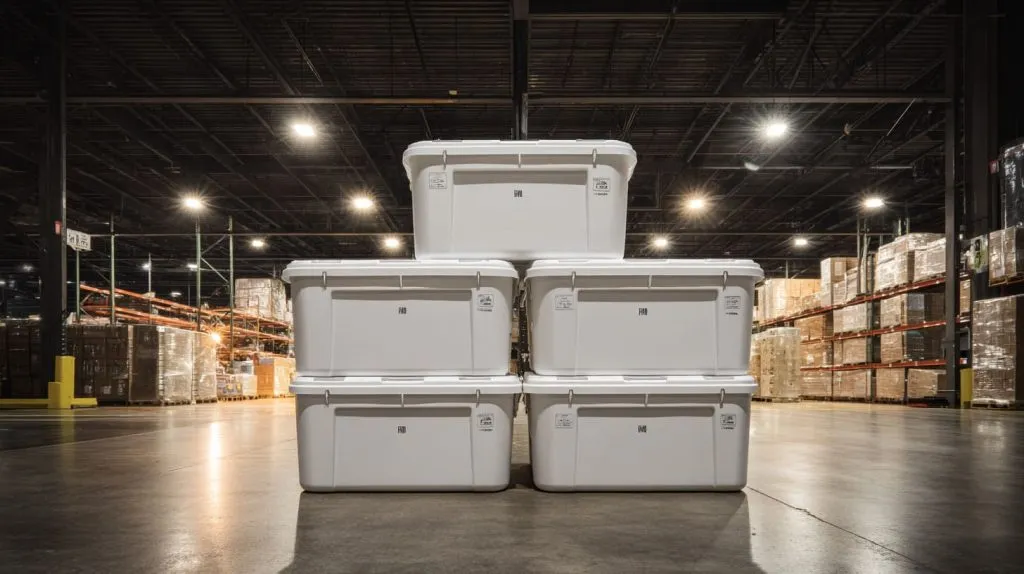
HDPE and PP are not the stars of the showroom. They’re the quiet workers in the backroom and in utility setups. I like them because they are practical and stable, especially around moisture and cleaning.
Overview of HDPE and Polypropylene (PP)
In simple terms:
- HDPE: tough, moisture-resistant, good chemical resistance
- PP: similar “workhorse” energy, often great for bins and containers
Critical thinking: these plastics are not about “beauty.” They are about “survival.” If a buyer expects crystal clarity, these are not the right tools. But if the buyer expects daily washing and long life, they are strong candidates.
Where They Are Used in Grocery Stores
I see HDPE and PP used for:
- Storage bins
- Backroom organization systems
- Bulk product containers
- Utility trays in staff-only areas
Why They Matter in Food Retail
Food retail is wet, messy, and repetitive. That’s reality.
So a material that resists:
- moisture
- many cleaners
- repeated handling
…becomes valuable fast.
A simple comparison I often share:
| Material | Best Use Mood | Weak Spot |
|---|---|---|
| HDPE | bins, moisture-heavy areas | not clear, less premium look |
| PP | containers, utility parts | not for “premium clear” displays |
Bridge to the next section:
By now, you can see a pattern: every plastic is a trade. So the real skill is choosing the right trade for the right location. Let me show you how I decide it quickly.
How to Choose the Right Plastic for Grocery Store Displays
When Jacky asks me, “What’s the best plastic?” I usually smile and answer:
“The best for where and for how long?”
Because there is no universal winner. There is only the right fit.
Consider the Display Location
Location decides abuse.
Ask simple questions:
- Is it near checkout where carts hit?
- Is it near produce misting where moisture is constant?
- Is it near deli heat where temperatures rise?
- Is it a quiet shelf area with low impact?
A quick location map helps:
| Store Zone | Common Stress | Safer Material Picks |
|---|---|---|
| Checkout lane | impact, scratches | PC, PETG |
| Produce area | moisture, cleaning | PETG, HDPE/PP (utility) |
| Deli/bakery | heat, grease, cleaning | PC, PETG |
| Cosmetic display | premium look | Acrylic, PETG |
Critical thinking: people over-focus on material, and ignore geometry. A thick acrylic part with good corner design can outlast a thin PC part with bad stress points. Design and material work as a pair.
Evaluate Load and Structural Requirements
I always ask:
- What weight sits on it?
- Will someone lean on it?
- Will staff pull it like a handle?
Then I pick thickness and structure around that.
A simple load mindset:
- Light load: sign holders, shelf talkers (PVC, PS, thin acrylic)
- Medium load: shelf dividers, risers (acrylic, PETG)
- High load or impact: guards, barriers (PC, thicker PETG)
Balance Aesthetics and Budget
This is the part where buyers can be too optimistic.
- Acrylic looks premium, but can crack if abused.
- PC survives abuse, but may not have that “luxury glass” look.
- PVC and PS save money, but may feel temporary.
So I frame it like this:
| Goal | My Material Bias |
|---|---|
| premium brand look | acrylic first, PETG second |
| reduce breakage complaints | PETG or PC |
| short promo campaigns | PVC or PS |
| utility/backroom durability | HDPE or PP |
Bridge to the next section:
Once material is chosen, the next headache is consistency: printing, finishing, and repeat production. That’s where OEM thinking matters most—and where many projects quietly drift off budget.
Customization and OEM Considerations for B2B Buyers

This is where my factory brain turns on.
In B2B, the display is not one unit. It’s a system:
- multiple stores
- multiple batches
- multiple reorders
- and the same brand expectations every time
So the real question becomes: Can we keep the quality consistent at scale?
Material Selection Based on Project Scale
For small trials, buyers sometimes pick the prettiest option. Then the rollout arrives and the cost feels heavy.
I suggest a staged approach:
- Prototype with the material that best represents the final look and function
- Test it in real store conditions
- Optimize thickness, edges, and forming method
- Lock a repeatable spec before large rollout
Critical thinking: if the buyer skips testing, the store becomes the test lab. That is expensive testing.
Surface Finishing and Printing Options
Printing and finishing can make the same material feel “cheap” or “solid.”
Here are common choices I see in custom grocery displays:
- UV printing (fast, flexible, great for complex graphics)
- Screen printing (strong color blocks, good for large runs)
- Engraving (premium detail, good for logos)
- Polishing (edge quality makes acrylic look expensive)
A simple selection table:
| Method | Best For | Watch Out For |
|---|---|---|
| UV printing | short runs, detailed graphics | surface scratch risk if mishandled |
| Screen printing | large runs, solid colors | setup cost and color limits |
| Engraving | premium branding | extra processing time |
| Polishing | acrylic clarity and edges | must control quality carefully |
Manufacturing Capabilities and Quality Control
In Feilong Acrylic, when we run B2B custom displays, the hidden work is not “making one nice sample.” The hidden work is making 1,000 units look like the same product.
That usually means:
- CNC cutting for consistent shape
- Laser cutting for clean details (when suitable)
- Controlled bending/thermoforming process
- Clear QC checkpoints for surface, edges, and print alignment
And I never ignore lead time and MOQ because they affect planning. Many buyers want “fast,” but fast only works when specs are stable.
Bridge to the conclusion:
So after all this, what’s the clean takeaway? It’s not “use acrylic” or “use PETG.” It’s learning how to match the plastic to the real store life. Let me wrap that up in a simple, honest way.
Conclusion
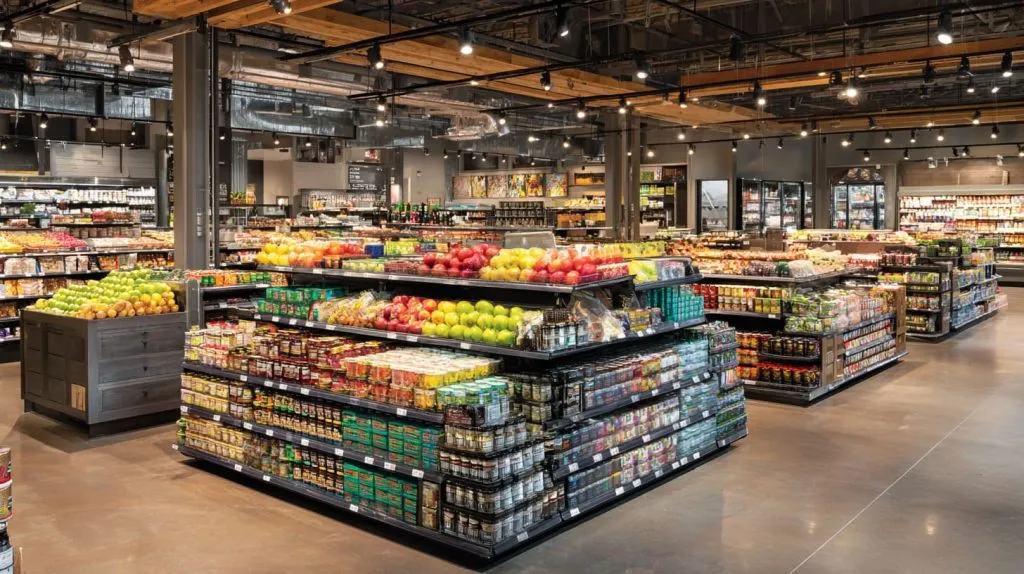
When I look at grocery store displays, I don’t see “plastic parts.” I see a daily environment that tests materials over and over: impacts, cleaning, moisture, heat, and customer handling.
Here’s the objective summary I keep in my head:
- Acrylic (PMMA) is the premium clarity choice when presentation matters most, but it needs smart design to avoid cracking.
- PETG is the practical clear choice when you want fewer breakage headaches and easier forming.
- Polycarbonate (PC) is the heavy-duty choice for high-impact zones and safety-focused parts.
- PVC (rigid/foam) fits short-term signage and budget campaigns, as long as you accept a less premium feel.
- Polystyrene (PS) can work for low-stress, low-cost components, but it is not a long-life hero.
- HDPE and PP are the workhorse plastics for bins, backroom, and utility uses where moisture and cleaning are constant.
If you’re planning a new display project, my best advice is simple: choose material based on the store zone, the expected lifespan, and the cleaning reality—not just the photo.
If you want, you can tell me:
- the display type (divider, riser, guard, sign holder, bin)
- where it will sit in the store
- the expected lifespan and cleaning routine
And I can help you narrow down the right plastic and thickness before you spend money on tooling or large rollout orders.