Skip to content

Most mornings at Feilong Acrylic start with the same small ritual. I open my inbox, download a drawing, and see one short line in the material box: “Acrylic sheet.” Nothing else. No type, no thickness tolerance, no finish. Just that one word trying to carry the weight of an entire project.
On my side of the world, that single word is never “just” a material callout. It is really a bundle of choices about clarity, strength, cost, risk, and process. Acrylic can act like glass, like plastic, or like something in between, depending on how we specify it and how we process it on the factory floor.
I write this guide for people like Jacky — product and mold designers, buyers with real experience, who already know that PMMA is not magic but also not “cheap plastic”. You probably have your own scars from cracked parts, warped displays, and projects that looked perfect in 3D but failed in real life.
From my perspective in a China factory, acrylic only works well when the drawing, the buyer, and the workshop all share the same picture in their mind; when they don’t, even the best material can fail in quiet, expensive ways.
In this article, I want to walk through acrylic sheets the way we actually use them in projects: what they are, what they can do, where they break, and where they shine. If you stay with me, I think you will start to see acrylic less as “a clear board” and more as a toolbox of different behaviors you can choose from.
1. What Are Acrylic Sheets?

When someone writes “acrylic” on a drawing, I never assume we are talking about the same thing until we clarify the details, because that word covers too many behaviors for serious work.
1.1 Definition and Terminology
At the simplest level, an acrylic sheet is PMMA – polymethyl methacrylate. It is a transparent thermoplastic that we heat, form, cut, glue, and polish into displays, organizers, and covers.
But in real projects, I almost never hear the word PMMA. I hear:
- Acrylic
- Plexiglass
- Perspex
- Lucite
- Acrylite
These names come from brands or regions, but they all sit in the same general material family.
When I talk with buyers, I pay attention to the words they use, because wording often hints at their experience:
- Buyers who say “plexiglass” often think of acrylic as a pure glass alternative.
- Buyers who say “plastic sheet” sometimes underestimate clarity and stiffness needs.
- Buyers who say “PMMA, cast grade” usually have run into stress cracking or tolerance issues before.
How Acrylic Compares to Glass and Other Plastics
A simple way to frame acrylic for a project is to compare it with its usual competitors:
| Property | Acrylic Sheet | Glass | Polycarbonate | PS Sheet (Polystyrene) |
|---|---|---|---|---|
| Clarity | Very high | Very high | High (slight tint) | Medium |
| Impact resistance | Higher than glass | Low (brittle) | Very high | Low–medium |
| Weight | ~50% of glass | Heavy | Similar to acrylic | Light |
| Scratch resistance | Moderate | High | Low | Low |
| Cost | Medium | Medium–high | High | Low |
| Ease of fabrication | Good | Poor | Moderate | Moderate |
You can see why acrylic lives in the middle: lighter and safer than glass, easier to fabricate than polycarbonate, but still with a more “premium” look than many other plastics.
For a cosmetic display, museum cover, or small furniture piece, that balance often matters more than any single property.
1.2 How Acrylic Sheets Are Made
In the factory, the first big split is not color or finish. It is cast acrylic vs extruded acrylic. They look similar on a photo, but they behave differently when you cut, bend, or polish them.
Cast vs. Extruded Acrylic – The Big Picture
| Aspect | Cast Acrylic | Extruded Acrylic |
|---|---|---|
| Manufacturing | Liquid monomer cast in molds | Melted pellets pushed through a die |
| Thickness tolerance | Less consistent | Very consistent |
| Optical quality | Very good, good for polishing | Very good, may show flow lines |
| Cost | Higher | Lower |
| Machining | Better for CNC and laser | Softer, more “gummy” when machining |
| Stress behavior | Lower internal stress | More internal stress |
Cast acrylic is like a well-baked cake: each sheet has its own tiny personality, but the structure is strong and stable. Extruded acrylic is like pasta from a machine: very consistent in thickness, faster to make, more cost-effective at volume.
For high-end cosmetic displays, polished blocks, and thick structural parts, I usually push for cast acrylic, even when the buyer first wants to chase price.
1.3 Material Composition and Properties
Chemically, PMMA has a rigid backbone that gives it:
- High optical clarity (good light transmission)
- Decent stiffness for many structural uses
- Clean fracture behavior (it cracks rather than folds like soft plastics)
When I see a design that relies on “flexible bending” without heat, I know acrylic is already the wrong material. It can bend when heated and formed, but it is not a natural flex-hinge material.
From a designer’s view, it helps to think of acrylic like this:
- It behaves stiffer than many plastics, but softer and more forgiving than glass.
- It wants smooth transitions, generous radii, and controlled loads.
- It does not like sharp inside corners, local stress, or point loads near holes.
Acrylic is not mysterious. It is simply honest. If we respect its structure, it rewards us with clarity and stability. If we push it the wrong way, it shows every mistake on the surface.
2. Key Properties of Acrylic Sheets
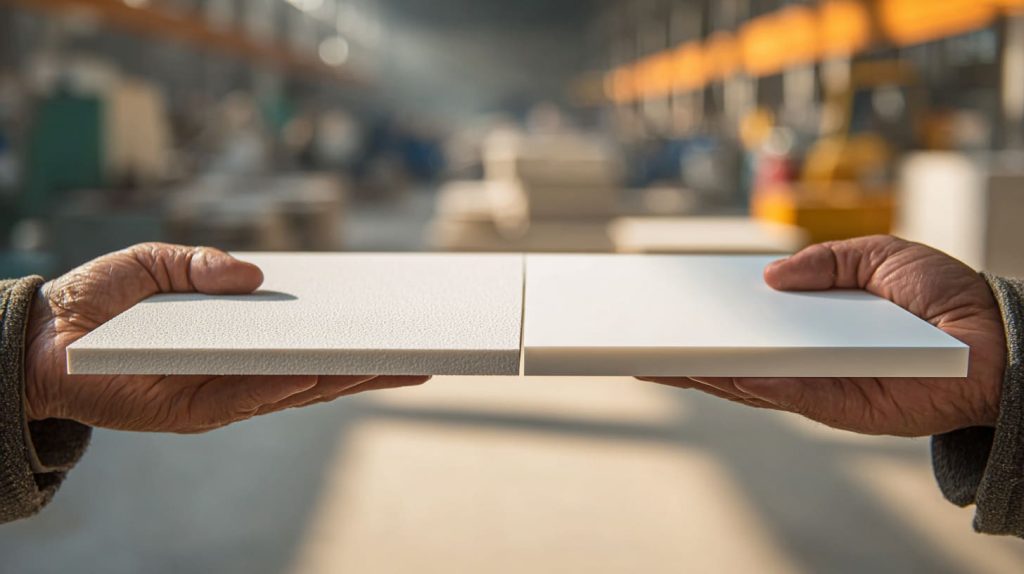
Whenever I judge if acrylic is suitable for a project, I stop looking at marketing words and look at five things only: clarity, impact, weight, weather, and how it behaves under heat and chemicals.
2.1 Optical Clarity and Transparency
Many buyers come to acrylic first because of how it looks. A good grade of clear acrylic can pass over 90% of visible light. For most display work, that is more than enough.
Key points I watch:
- Are we hiding LEDs or showing product details?
- Is glare a problem, or is “mirror shine” the goal?
- Will the sheet sit close to light sources or far away?
Managing Clarity in Real Projects
If the client wants a “floating” luxury cosmetic display, I keep the following in mind:
- Cast acrylic for front faces and thicker sections.
- Reasonable thickness (not too thin, or it looks cheap; not too thick, or it feels heavy and distorts).
- Edge finishing plan from day one (flame, polish, or matte).
For light diffusers or backlit panels, I often suggest frosted or diffusing acrylic instead of clear, even when the designer first sends a clear panel. That small change can save them from hot spots and uneven lighting later.
2.2 Strength and Impact Resistance
Acrylic is stronger than glass in impact, but it is not unbreakable. It is more like a well-behaved glass substitute that still needs respect.
Common misunderstandings I see:
- People think acrylic will “never break” — not true.
- People think any crack is only from material quality — also not true.
- Many cracks start from bad design details, not from the sheet itself.
Typical Failure Patterns
- Cracks starting from sharp inside corners.
- Fractures around over-tightened screws.
- Crazing (fine cracks) near aggressive cleaners or solvents.
A simple rule we use in the workshop:
- Avoid zero-radius internal corners. Add a radius wherever possible.
- Use proper holes and spacers if screws pass through acrylic.
- Never design acrylic panels to take hammer-type impact loads unless you accept the risk.
2.3 Weight and Ease of Handling
One reason architects and brand owners like acrylic is simple: weight.
Acrylic is about half the weight of glass, which affects:
- Shipping cost
- Installation effort
- Mounting method
For wall-mounted displays in retail stores or hanging panels above people’s heads, this weight difference can be the difference between “easy install” and “specialist team required”.
I pay attention to this especially for international shipments. Lighter panels mean fewer problems with freight and handling. It also gives you more room to spend on finishing instead of pure logistics.
2.4 Weatherability and UV Resistance
Not all acrylic is equal outdoors. Good grades handle UV very well; cheaper or non-UV grades can yellow or lose clarity over time.
When someone wants to use acrylic:
- Outside a store
- On a building façade
- As part of a garden or balcony structure
…I always ask about:
- Sun hours per day
- Expected lifetime
- Color stability expectations
If the client expects a luxury look for more than five years in direct sun, I push hard for UV-stable, high-quality material and a proper frame design. The extra cost up front usually saves a lot of complaints later.
2.5 Chemical and Thermal Properties
Acrylic is sensitive to some solvents and to localized heat.
Key thermal points:
- It softens with heat and can be formed at elevated temperatures.
- It does not like sudden extreme temperature swings.
- It expands more than glass when heated.
Key chemical points:
- Many strong solvents can cause stress cracking.
- Some aggressive cleaners can damage edges and glued joints.
When we run a project for a lab cover or industrial housing, I like to see a list of chemicals present in the environment. If that list is missing, we treat the design with extra margin or consider alternative materials.
For displays and household items, the main risk is often cleaning staff using the same strong glass cleaner on everything. A simple note in the manual recommending soft cloth and mild soap can extend the life of acrylic surprisingly well.
To keep it simple: acrylic is stable when treated like a quality material, and fragile when treated like disposable packaging.
3. Types of Acrylic Sheets

The moment I know a project truly depends on how the acrylic looks and feels, I move from “acrylic” to “which exact type of acrylic sheet” because the wrong combination of process and finish can ruin even a great design.
3.1 By Manufacturing Process
We already touched on cast vs extruded, but let’s state it clearly from a design angle.
Cast Acrylic – Where It Shines
Cast acrylic is ideal when you need:
- High-end visual quality
- Thicker sections without too much internal stress
- Polished blocks, engraved awards, solid stands
It behaves better under:
- CNC machining
- Laser cutting
- Polishing
Extruded Acrylic – Where It Wins
Extruded acrylic works well when:
- You need consistent thickness across large areas.
- You care about cost in high-volume projects.
- You work with simple cuts and bends, not heavy machining.
A quick decision matrix I often share with buyers:
| Project Type | Recommended Base | Reason |
|---|---|---|
| Premium cosmetic display | Cast | Better edges, nicer polish |
| Simple brochure holder | Extruded | Cost-effective, thin sheets |
| Thick light box frame | Cast | Less internal stress |
| Large flat protective screen | Extruded | Consistent thickness, easier sourcing |
3.2 By Appearance and Finish
After process, appearance is the next big filter.
Common options:
- Clear acrylic – for cases, covers, displays.
- Colored acrylic – for brand accents, panels, signage.
- Frosted or matte acrylic – for privacy and soft light.
- Textured acrylic – for grip or visual effects.
- Mirror acrylic – glass-like reflection but lighter and safer.
Choosing Finishes for Real Products
For a retail cosmetic shelf, a typical combination might be:
- Clear acrylic for front panels.
- Frosted acrylic as a soft light diffuser.
- Colored acrylic in brand colors as accent strips.
- Mirror acrylic in the back to give a “fuller” look.
A simple comparison table for finishes:
| Finish Type | Look & Feel | Typical Use Cases |
|---|---|---|
| Clear | High clarity, glossy | Covers, display windows, organizers |
| Frosted | Soft, diffused, low glare | Light diffusers, privacy panels |
| Matte | Low reflection | Surfaces where fingerprints are a worry |
| Textured | Patterned, tactile | Anti-slip shelves, decorative panels |
| Mirror | Reflective, bold | Signage, back panels, décor features |
3.3 Specialty Acrylic Types
There are also specialty grades that matter for certain buyers:
- UV-filtering acrylic for artwork and museum cases.
- UV-transmitting acrylic for plant growth or special lighting.
- Anti-glare acrylic for display covers.
- Impact-modified acrylic for higher toughness.
For museum-grade covers or display cases, I often recommend optical- or museum-grade acrylic even before the buyer asks, because:
- It reduces color shift.
- It keeps artwork or product safe from UV.
- It usually has better surface quality.
When a project crosses from “retail” into “preservation” or “high-value items,” upgrading the acrylic grade from normal to specialty often costs less than the value of what you protect.
If this section feels like a menu, that is exactly the point; once you see all the flavors of acrylic, it becomes easier to match the right one to each job.
4. Sizes, Thicknesses, and Format Options

Whenever I receive a drawing with “t = 5mm (or similar)” floating in the corner, I treat that as a polite invitation to talk about thickness again, because vague notes about size often hide real-world problems with weight, stiffness, and cost.
4.1 Standard Sheet Dimensions
Most acrylic sheets come in fairly standard panel sizes, and we cut down from there.
Common stock formats (varies by region and supplier):
| Region | Typical Sheet Sizes (mm) |
|---|---|
| North America | 1220 × 2440, 1524 × 3048 |
| Europe/Asia | 1220 × 2440, 2050 × 3050 |
From a factory view, nesting is critical. If your components fit badly on a master sheet, you may:
- Waste material
- Increase cost per piece
- Create unnecessary seams or joints
I sometimes redraw nesting layouts to help buyers reduce waste. A small change in part dimensions can sometimes increase yield dramatically.
4.2 Thickness Choices and Selection Guidelines
Typical thickness ranges we use in custom acrylic work:
| Application Type | Common Thickness Range |
|---|---|
| Small lids, dividers | 2–3 mm |
| Cosmetic organizers, trays | 3–4 mm |
| Retail display shelves | 4–6 mm |
| Medium boxes, covers | 4–8 mm |
| Structural panels, furniture | 8–15 mm or more |
When you choose thickness, you balance:
- Stiffness vs weight
- Look vs cost
- Safety margin vs shipping and handling
If a shelf is long and carries heavy products, I sometimes recommend a thicker acrylic or an added metal support, even if the original drawing says “5mm is okay”. That suggestion is not about selling more material; it is about avoiding sagging, cracking, and complaints after installation.
4.3 Non-Sheet Formats
Acrylic does not live only as flat sheets. We also use:
- Rods – for spacers, supports, design accents.
- Tubes – for poster holders, columns, décor.
- Blocks – for engraved awards, solid bases.
From a design angle, mixing sheets with rods or tubes opens more interesting options:
- Rods can become invisible supports under a clear shelf.
- Tubes can carry LED light or graphics inside.
- Blocks can act as heavy bases for tall, narrow displays.
When we work with brand designers, I often see them move from “flat panel thinking” to “3D acrylic structures” once they realize how many shapes are possible.
At this point, acrylic stops being a simple sheet and starts to feel like a construction system.
5. How Acrylic Sheets Are Used

From a distance, acrylic looks like one material; close up, it shows up in skylights, cosmetic organizers, machine guards, furniture details, and lab covers, and each use has different failure modes that I try to think about before we cut the first sheet.
5.1 Architecture and Construction
In architecture, we see acrylic used for:
- Skylights and roof panels
- Balustrade infills (in controlled conditions)
- Interior partitions and light walls
- Facade elements and signage panels
Designers like the way acrylic:
- Transmits natural light.
- Reduces weight compared to glass.
- Allows creative shapes and colors.
But acrylic also brings questions:
- How will it move with temperature?
- Can people reach it and scratch it?
- Will cleaning staff treat it gently?
A small real-world example: we once produced acrylic panels for a light wall in a hotel. The design team wanted deep glossy black outside and soft diffused light from behind. We ended up combining colored acrylic with diffuser sheets, and we spent time discussing access panels for maintenance. The wall looked simple in photos but required many decisions behind it.
5.2 Retail, Display, and Signage
This is where my factory lives most of the time.
Typical uses:
- Point-of-sale displays
- Cosmetic organizers
- Product risers and stands
- Logo panels and brand signage
Why acrylic works well here:
- It can look premium with the right thickness and polish.
- It can carry brand colors with high consistency.
- It is easy to cut, glue, and assemble into custom shapes.
A common trade-off:
- Thicker acrylic = more “luxury” feel but also more weight and cost.
- Thinner acrylic = cheaper and lighter but can look flimsy if not supported.
A quick view from my side:
| Retail Feature | Acrylic Advantage |
|---|---|
| Shelf edge clarity | Clean product view |
| Branding inserts | Easy to mount graphics behind clear sheet |
| Re-layout of store | Lightweight, easy to move and change |
| Lighting integration | Works well with LEDs and light boxes |
5.3 Protective and Safety Applications
You have probably seen acrylic in:
- Sneeze guards
- Machine guards
- Desk partitions
- Reception barriers
Here, the focus moves from “beautiful” to safe and practical.
Key questions I ask:
- What kind of impact might the panel see?
- Are there sharp tools or high-energy moving parts nearby?
- Does the panel need to meet any standards?
Sometimes, after talking through these points, I suggest polycarbonate or thicker acrylic for certain areas, even if the original request is “just acrylic.” That conversation is about making sure we do not pretend that every sheet can be a safety shield.
5.4 DIY, Furniture, and Decorative Use
For small furniture parts and home décor, acrylic gives a very modern, clean style:
- Side tables and shelf fronts
- Chair backs and legs (with proper design)
- Wall art and frames
- Light features and decorative boxes
Home users often fall in love with the “glass look without the weight” but forget about scratches and cleaning. When we work with furniture brands, we talk honestly about:
- Using matte or textured surfaces where hands touch often.
- Protecting top surfaces with glass or overlay panels.
- Choosing colors and thicknesses that age well.
Acrylic furniture looks best when designers think about daily life, not just catalog photos.
5.5 Industrial and Scientific Applications
In more technical areas, acrylic becomes:
- Instrument covers
- Tank windows and level indicators
- Lab equipment housings
- Optical test plates or guards
Technical buyers care less about “wow effect” and more about:
- Chemical compatibility
- Cleaning routines
- Long-term stability under light and heat
When we supply these parts, the drawing often includes radii, hole sizes, and tolerances that are much more precise than retail work. That suits acrylic quite well, as long as we choose the right grade and process.
Designers who move between retail and industrial projects quickly see that the same sheet material can play very different roles, depending on how we shape it.
6. Fabrication and Working with Acrylic

Whenever I see a perfect 3D render with 90° sharp internal corners on thick acrylic, I mentally add a red flag, because the drawing looks powerful but the sheet will not forgive that geometry once tools and heat arrive.
6.1 Cutting and Shaping
We usually cut acrylic by:
- Laser cutting
- CNC routing
- Saw cutting
- Scoring and snapping (for thin panels)
Each method has its own signature:
| Method | Edge Quality | Precision | Typical Use |
|---|---|---|---|
| Laser | Very clean, glossy | High | Displays, detailed shapes |
| CNC routing | Clean, machinable | High | Thick parts, pockets, countersinks |
| Saw cutting | Functional, needs finish | Medium | Large panels, rough sizing |
| Score & snap | Rougher, simple | Low–medium | Quick cuts on thin sheets |
For visible edges on high-end displays, we prefer laser or CNC plus polishing. For hidden structural panels, saw cutting can be fine.
A small design tip: when you want a very clear edge line on a display, specify cast acrylic + laser cut + polished edge explicitly. That alignment saves many emails later.
6.2 Drilling, Bending, and Forming
Acrylic allows:
- Drilling and countersinking
- Cold bending in special cases (limited)
- Heat bending and thermoforming
Key points for drilled holes:
- Leave space from the edge (no holes too close to a corner).
- Use proper drill bits and speeds.
- Allow for expansion if screws are tight.
For bending:
- Line-bending creates clean angles for stands and holders.
- Oven forming allows complex curves and shapes.
I sometimes receive drawings where an acrylic panel is expected to flex many times like a hinge without any metal part. In those cases, I usually recommend a different design, because acrylic is best at holding shape, not acting as a living hinge.
6.3 Polishing and Surface Finishing
Acrylic edges can go from rough and milky to crystal clear if we treat them well.
Common finishing options:
- Flame polishing – fast, high gloss, good for visible edges.
- Buffing and mechanical polishing – more control, good for thick pieces.
- Sanding to matte – for soft, non-gloss edges.
For certain high-end displays or awards, we polish edges until they look like solid glass blocks. That finish changes how people perceive the entire product; the same geometry with rough edges feels cheap, with polished edges feels like a premium piece.
A simple rule: when edges are part of the visual design, never treat them as an afterthought in the drawing.
6.4 Bonding and Assembly
We typically assemble acrylic with:
- Solvent cements that “weld” surfaces.
- Two-part adhesives for thicker or stressed joints.
- Mechanical fasteners (screws, standoffs) where needed.
Each approach has trade-offs:
| Joint Type | Look | Strength | Notes |
|---|---|---|---|
| Solvent-welded | Seamless, clear | Good if designed well | Needs clean, precise joints |
| Two-part adhesive | Slightly visible | High | Better for larger loads |
| Mechanical fasteners | Visible hardware | Very high | Good for maintenance, disassembly |
We see many failures where the joint area is too small or the load direction is wrong. If a shelf or bracket relies on a tiny bonded area to hold heavy products, I usually suggest a small redesign: add gussets, lengthen the joint, or combine bonding with mechanical support.
Good assembly design is really about letting the material do what it is naturally good at, not forcing it to behave like metal.
7. Acrylic Sheets vs. Other Materials

When I help a buyer choose between acrylic, glass, polycarbonate, or other plastics, I try to ignore my own factory bias and look at how the product will actually live in the real world, because the “best” material on paper can be the wrong one for how people use it.
7.1 Acrylic vs. Glass
Acrylic vs glass is the classic comparison.
- Acrylic is lighter and more impact-resistant.
- Glass is harder and more scratch-resistant.
- Acrylic is easier to cut, shape, and glue.
- Glass resists many chemicals better and feels more “traditional”.
A quick side-by-side:
| Factor | Acrylic | Glass |
|---|---|---|
| Weight | About half of glass | Heavy |
| Impact | More resistant | Brittle, breaks into shards |
| Scratch | Easier to scratch | More scratch resistant |
| Fabrication | Easy to cut and shape | Limited shaping |
| Look | Very clear, warm feel | Very clear, “hard” feel |
For stores, exhibitions, and household items, I lean toward acrylic because:
- It is safer if something drops.
- It gives more freedom in shapes.
- It is easier to ship and handle.
For very large static windows or fire-critical areas, glass can still be the better or required choice.
7.2 Acrylic vs. Polycarbonate
Polycarbonate sits in another corner of the map:
- Very high impact resistance.
- Higher cost.
- More sensitive to scratching.
- Different chemical resistance profile.
I see polycarbonate used for:
- Heavy-duty machine guards.
- Vandal-resistant panels.
- High-impact barriers.
A simplified comparison:
| Factor | Acrylic | Polycarbonate |
|---|---|---|
| Impact resistance | High | Very high |
| Scratch resistance | Better than PC | Worse than acrylic |
| Cost | Medium | Higher |
| Clarity | Very high | High (slight tint often) |
| UV stability | Good with UV grades | Needs UV-stabilized types |
When a buyer wants “unbreakable clear plastic,” we talk about polycarbonate. When they want “luxury clear display with polished edges”, we stay with acrylic. Mixing them in the same project can work, but they have different surface feels, so I usually do not mix them in direct side-by-side locations.
7.3 Acrylic vs. PS and Other Sheet Plastics
Cheaper plastics like polystyrene (PS) or PVC-based sheets sometimes compete in low-cost applications.
They can make sense when:
- The product is temporary.
- The environment is controlled.
- Visual requirements are modest.
But they often fall short when:
- The client expects long-term clarity.
- The product faces regular cleaning and handling.
- The brand image must feel premium.
A quick comparison table:
| Material | Main Advantage | Main Weakness |
|---|---|---|
| Acrylic | Clarity + appearance | Scratches, solvent sensitivity |
| Polycarbonate | Impact strength | Scratches, cost |
| PS Sheet | Low cost | Brittle, lower clarity |
| PVC Sheet | Chemical resistance | Heavier, aesthetic limits |
For B2B brand work, especially in cosmetics, retail, and furniture parts, I rarely recommend PS over acrylic unless the budget is extremely tight and the product lifetime is short.
The choice between these materials is less about a winner and more about matching real-world use to material personality.
Conclusion

When I look at a drawing that only says “acrylic sheet,” I do not see a simple material label. I see a series of quiet decisions that will decide whether the display cracks at the screw hole, whether the shelf sags under product weight, whether the light box glows evenly, or whether the client calls back in two years still happy.
I choose to work this deeply with acrylic because I have watched it fail for the wrong reasons and succeed for the right ones. When projects go wrong, it is rarely because “acrylic is bad.” It is usually because someone treated it like generic plastic or thin glass without respecting its nature. When projects go right, it is because designer, buyer, and factory all aligned on type, thickness, finish, and process with clear eyes.
My belief is simple: acrylic is not a compromise; it is a material with its own character. If we listen to that character — its need for radius, its love of polished edges, its sensitivity to solvent and stress, its strength in light and shape — we can build products that feel premium, stay stable, and still make sense in real budgets.
If you are working on a new acrylic display, box, organizer, or furniture part and you want a factory partner who thinks in this way, you are welcome to reach out to me and my team at Feilong Acrylic. Share your drawings, your doubts, and your constraints. I am happy to walk through material choice, thickness, and fabrication with you, so that “acrylic sheet” in your next drawing is not a vague label, but a clear decision that supports your design and your client for years.