Skip to content

A sheet sample on a meeting table can create a very misleading kind of confidence. One buyer presses on it with a thumb, hears a solid little tap, and says, “Let’s use the tougher one.” I understand that instinct. I really do. Tougher sounds safer. Safer sounds smarter. But I have spent enough time around custom acrylic products to know that material choice does not work like that in real life.
I have seen polycarbonate win technical comparisons and still lose the project.
That sounds strange at first. After all, polycarbonate is famous for impact strength. It handles abuse better. It bends more before it fails. It survives environments that would make acrylic crack or chip. So it is easy to think the decision is finished right there. But real projects are not built on one property alone. They are built on a whole stack of needs: look, cost, finish, user behavior, cleaning, branding, fabrication, shipping, and the simple question of whether the extra toughness will ever matter.
That is where the confusion starts.
Acrylic and polycarbonate often look close enough to make buyers feel they are choosing between a good option and a better option. In truth, they are often choosing between a more suitable material and a less suitable one. That is a very different decision. One material is not the hero of every story.
A while ago, I discussed a countertop display project with a buyer who had plenty of sourcing experience. He was not careless. He was actually very thoughtful. He asked for polycarbonate because the display would travel, get unpacked, and be handled by retail staff. On paper, that sounded reasonable. But once I looked at the actual use, the display was going into a clean beauty retail setting, sitting indoors, holding light products, and living most of its life under store lighting. The real priority was not impact survival. The real priority was a crisp visual finish, clean edges, strong branding effect, and sensible cost for bulk production. That project did not need the toughest material. It needed the right one.
My own test is simple: I do not let a material win just because one spec looks impressive; I want to know which property will actually matter after the product leaves the factory.
So in this article, I want to break this down in a practical way. I want to look at cost, clarity, toughness, durability, and application fit without turning the topic into a dry material science lecture. Because that is not how buyers like Jacky work. They do not buy theory. They buy outcomes.
And once you start judging these materials by outcome, not by fear, the whole picture changes.
That is also where the debate gets more interesting, because before choosing between polycarbonate and acrylic, we have to be honest about what these two plastics really are.
What Are Polycarbonate and Acrylic, Really?
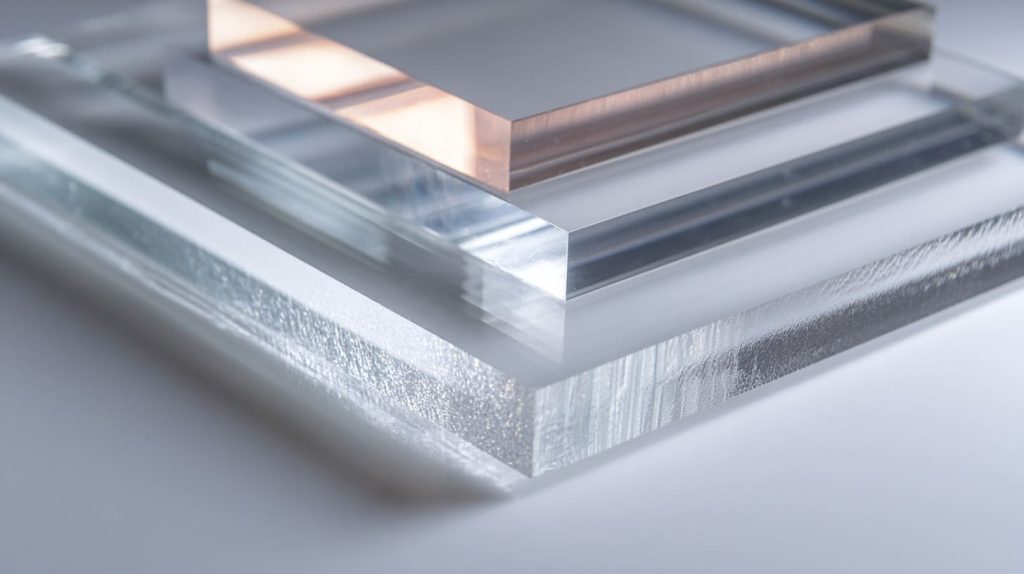
At first glance, polycarbonate and acrylic can look like cousins. Both can be clear. Both are used in displays, covers, guards, boxes, and fabricated parts. Both can show up on the same sourcing list. That is why many people treat them like near substitutes.
I do not.
When I look at them in a real project, I see two different personalities. One is built for toughness. The other is built for visual performance. That difference affects almost everything that comes after.
Basic material definitions
Polycarbonate, often called PC, is an engineering plastic. I usually think of it as the material people choose when they expect impact, stress, or harsher working conditions. It is strong, flexible, and much harder to break than acrylic.
Acrylic, often called PMMA, is more of an optical plastic in the way many buyers use it. It is loved for clarity, brightness, smooth appearance, and a premium-looking finish. It is also common in custom displays because it processes well and presents products beautifully.
That difference sounds simple, but it creates very different results.
| Property | Polycarbonate (PC) | Acrylic (PMMA) |
|---|---|---|
| Main identity | Engineering plastic | Optical/display plastic |
| Impact strength | Very high | Moderate to low |
| Surface feel | Softer | Harder |
| Visual sharpness | Good | Excellent |
| Scratch resistance | Lower | Better |
| Cost | Higher | Lower |
| Common use | Safety covers, guards, industrial parts | Displays, signs, organizers, retail fixtures |
One problem I often see is this: buyers hear “engineering-grade” and assume that means “higher-end” in every case. That is not how I judge it. Engineering-grade only means the material was designed to solve a different set of problems.
Key material properties comparison
Now let me put the practical comparison on the table, because this is where people often rush.
Transparency, impact resistance, weight, and rigidity
Acrylic usually wins when pure visual clarity matters. It has that clean, glass-like look that works very well in cosmetic displays, branded retail stands, brochure holders, and polished presentation pieces. The edges can also look beautiful after proper finishing.
Polycarbonate is clear too, but it often does not give me the same sharp and premium visual effect for display-focused work. It is more about performance than beauty.
Impact resistance is where polycarbonate pulls far ahead. This is the part everyone remembers, and for good reason. If a part may be hit, flexed, dropped, or stressed, PC is in another league. Acrylic is more brittle. It can crack. It can chip. It can fail suddenly if the design or use is wrong.
Still, rigidity is a funny detail here. Acrylic feels stiffer. Some buyers mistake that stiffness for “better quality.” It is not better quality. It is just a different behavior.
Heat resistance and chemical resistance
Polycarbonate usually handles heat better than acrylic. That makes it more useful in electronics housings, protective covers near heat sources, and industrial applications where temperature can rise.
Chemical resistance needs more care. Neither material is magically safe from every cleaner, solvent, or chemical. That is why I always check the real exposure. A display in a skincare shop may face alcohol-based cleaners. A machine cover may face oils or industrial chemicals. Those are very different situations.
This is the part that often gets missed: a material sheet can look perfect in a sample room and still become the wrong choice once real cleaning habits enter the picture.
Why buyers often mix them up
The confusion is not foolish. It is actually very understandable.
Both materials can be:
- Clear
- Fabricated into boxes, panels, stands, and covers
- Cut, bent, and assembled
- Used in retail and industrial-looking products
So the mix-up starts from appearance.
Then it gets worse because many online articles compare them in a simple winner-loser style. One article says polycarbonate is stronger. Another says acrylic is clearer. Another says one is better outdoors. Another says one costs less. All of that may be true in part, but it does not tell a buyer what to do on a specific project.
I think that is where a lot of material mistakes are born. People compare plastics in isolation, but products live in context.
Here is how I usually break the confusion:
| Question | If the answer is “yes,” I lean toward... |
|---|---|
| Will the part face impact or physical abuse? | Polycarbonate |
| Is the part mainly for visual display or branding? | Acrylic |
| Is surface beauty more important than impact survival? | Acrylic |
| Is the part near heat or technical equipment? | Polycarbonate |
| Is the project cost-sensitive in bulk production? | Acrylic |
| Will the user judge the product by how premium it looks? | Acrylic |
What matters to me is not which plastic sounds stronger in a meeting, but which one still feels right after I imagine the product being used for six months by real people.
That brings us to the part where polycarbonate earns its reputation honestly, because there are jobs where acrylic simply cannot compete on safety or toughness.
Where Polycarbonate Clearly Outperforms Acrylic
I do not like oversimplifying this comparison, but I also do not like pretending the two materials are equal. They are not. There are cases where polycarbonate is the clear winner, and trying to force acrylic into those jobs is asking for trouble.
This is not a close call when impact, heat, or repeated stress are real parts of the job.
Impact resistance and safety applications
Polycarbonate is much tougher under impact. That is its headline advantage, and in the right job, that advantage matters a lot. If a panel may be struck, dropped, kicked, bumped by equipment, or hit by moving parts, polycarbonate makes much more sense.
Acrylic can look fine right up until the moment it is not. It can crack from a hard hit. It can chip at edges. It can fail in a way that feels sudden. Polycarbonate behaves differently. It absorbs more punishment before it gives up.
Where this matters most
I usually see polycarbonate make sense in:
- Machine guards
- Safety shields
- Protective covers
- Equipment windows
- Industrial enclosures near moving components
- Public-facing installations with high abuse risk
| Application | Acrylic risk | Polycarbonate advantage |
|---|---|---|
| Machine guard | Cracking under impact | High impact resistance |
| Protective cover | Edge chipping | Better durability |
| Workshop shield | Sudden breakage | More forgiving under stress |
| Technical enclosure window | Lower safety margin | Stronger under accidental force |
A buyer once asked me about a clear cover for equipment used in a rough working area. The first version had acrylic in the drawing. It looked neat. It kept cost down. But the real environment included tools, rushed operators, and the kind of daily contact that never shows up in a neat quotation sheet. That was not the place to save money with acrylic. That was the place to avoid a failure call later.
The mistake here is not choosing acrylic. The mistake is choosing it because the drawing looked calm.
Heat and flame resistance
Polycarbonate also performs better when heat enters the picture. I do not mean extreme temperatures in every case. I mean real-world situations where electronics, lighting, motors, or enclosed systems create more heat than buyers first expect.
Acrylic can work well in many indoor environments. But when heat goes up, its comfort zone narrows. Polycarbonate usually gives more room.
Good fit for technical environments
Polycarbonate often makes more sense for:
- Electronics housings
- Protective covers near internal heat sources
- Parts near lighting systems
- Industrial components with temperature variation
Here is a simple comparison:
| Condition | Acrylic | Polycarbonate |
|---|---|---|
| Mild indoor room temperature | Usually fine | Usually fine |
| Warm equipment area | Needs careful review | Safer choice |
| Repeated heat exposure | More risk | Better suited |
| Technical housing with temperature rise | Limited margin | Stronger margin |
A lot of people only think about impact when they hear “polycarbonate.” I think that is too narrow. Heat matters too. A display stand on a beauty counter is one thing. A clear shield around working equipment is another thing completely.
Flexibility and durability under stress
This is another area where polycarbonate quietly wins. It handles stress better over time. It bends more. It is less likely to fail sharply from a load or movement that acrylic cannot tolerate.
That matters in products that get assembled and disassembled, transported often, or exposed to repeated handling. Acrylic can still work in many of those jobs, but the design has to respect its limits. Polycarbonate gives more forgiveness.
Dynamic use vs stable display use
I often separate projects into two groups:
- Stable display use: product sits in place, limited handling, visual role first
- Dynamic or stressed use: product is moved, touched, flexed, installed, or exposed to force
Polycarbonate belongs more naturally in the second group.
This is where I become cautious: when I see snap-fit ideas, moving parts, repeated assembly, or stress around screw points, I stop assuming acrylic will be “good enough” without deeper checking.
That extra forgiveness can save a project.
Still, the fact that polycarbonate wins these performance battles does not mean it should automatically win the order. That is where many decisions go sideways. Because once the project shifts from safety and abuse resistance to beauty, branding, and visual sharpness, acrylic starts to look much smarter.
Where Acrylic Is Actually the Better Choice
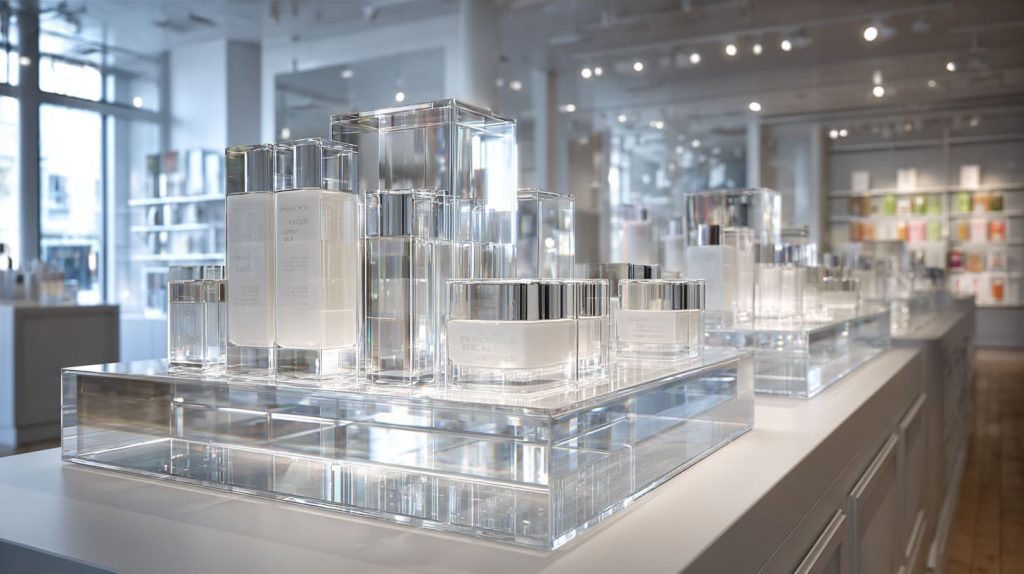
This is the part I wish more buyers would slow down and think about.
I have seen people choose polycarbonate because they were afraid of breakage, then end up disappointed by the look, the finish, or the cost. They solved a problem that barely existed and created new ones that mattered more. That happens more often than many suppliers admit.
Acrylic is not the weak cousin in this comparison. In the right application, it is the stronger decision.
Optical clarity and surface quality
Acrylic usually gives a cleaner visual result. That matters a lot in displays. When the whole purpose of a product is to present cosmetics, skincare, jewelry, branding, printed graphics, or premium packaging, the material is doing more than just existing. It is shaping the way the customer sees value.
Acrylic helps with that.
Its clarity is often sharper. Its edges can look brighter and more refined after polishing. The whole product can feel more elegant, especially under store lighting.
Why appearance is not a shallow concern
Some people treat appearance like a soft issue. I do not. In retail, appearance is part of performance.
A display that looks cheaper does not just look cheaper. It can make the product on it look cheaper too.
| Visual factor | Acrylic | Polycarbonate |
|---|---|---|
| Light transmission feel | Excellent | Good |
| Edge finishing effect | Very attractive | Less crisp |
| Premium retail look | Strong | Moderate |
| Suitability for brand display | High | Lower in many cases |
That is why acrylic dominates so many beauty, cosmetic, and point-of-sale display applications. It simply speaks the right visual language.
Scratch resistance and aesthetics
Polycarbonate is tough against impact, but it usually scratches more easily. This is where many buyers get surprised. They choose the “stronger” material, then watch it pick up surface marks in handling, packaging, installation, or regular use.
Acrylic often has the better surface for presentation work. It keeps that polished, finished look more naturally in many display settings.
Why this matters in the real world
Think about how many times a retail display gets:
- Wiped down
- Touched by store staff
- Moved during setup
- Rubbed against packaging
- Cleaned with cloths or paper towels
Those small actions add up.
I pay close attention to surface appearance when the buyer’s success depends on how clean and premium the finished product looks under bright lighting, because minor scratches that seem harmless in the factory can become very visible in a store.
For cosmetic displays, branded countertop units, brochure holders, and sign panels, that surface quality is not a side issue. It is one of the main reasons the product exists.
Cost efficiency for large-volume projects
Acrylic is often more cost-effective, and not only in raw material cost. It is also frequently the more practical choice in processing and finishing for many display products. That matters a lot in bulk production.
When buyers compare materials, they sometimes look only at “Can it survive more?” I also ask, “What is the project paying for?”
If a retail display sits indoors, supports lightweight products, and is replaced on a marketing cycle anyway, then paying extra for polycarbonate toughness may not bring any return at all.
Where acrylic usually makes more business sense
Acrylic often wins in:
- Cosmetic display stands
- Retail countertop displays
- POP and POS displays
- Brand blocks and risers
- Literature holders
- Presentation boxes
- Store signage
| Project type | Better choice in many cases | Why |
|---|---|---|
| Skincare retail display | Acrylic | Better look and cost |
| Cosmetic organizer | Acrylic | Clarity and finish |
| Brand signage panel | Acrylic | Visual sharpness |
| Protective machine guard | Polycarbonate | Safety first |
| Equipment cover | Polycarbonate | Impact and heat |
I have had buyers ask for polycarbonate on an indoor beauty display, and once we finished discussing cost, finish, and actual use, they quietly moved back to acrylic. Not because acrylic was “good enough.” Because acrylic was better for the job.
And that is the point many comparisons miss: the wrong strong material is still the wrong material.
That takes us straight into the heart of the article, because this is where polycarbonate can stop being the smart choice and start becoming an expensive distraction.
When Polycarbonate Becomes the Wrong Choice
I do not think polycarbonate becomes the wrong choice because it is a bad material. It becomes the wrong choice when it answers the wrong question.
That may sound small, but it changes everything.
A buyer says, “I want the tougher one.” I hear, “I am worried about failure.” That is fair. But failure can come from more than breakage. A project can fail because it looks dull. It can fail because the cost gets too high. It can fail because the finish scratches too easily. It can fail because the customer expected elegance and got industrial energy instead.
So yes, polycarbonate can absolutely be the wrong choice.
Over-engineering the project
This happens when the material is chosen for extreme conditions that the product will never face. I see this often in indoor retail displays.
A skincare stand on a countertop is not a machine guard. A brochure holder in a showroom is not a workshop shield. A cosmetic organizer in a department store is not preparing for factory abuse.
Still, once a buyer becomes nervous about cracking, they may jump straight to polycarbonate.
That is usually where the project gets overbuilt.
What over-engineering looks like in practice
- Paying for impact resistance that the product will never need
- Accepting a softer, more scratch-prone surface in a display job
- Adding cost with no real gain in customer experience
- Moving away from the best visual material because of imagined risk
I become skeptical when the material spec sounds tougher than the actual use case, because that often means the project is being driven by anxiety, not by product logic.
Higher cost without real benefit
This is one of the biggest reasons polycarbonate can be the wrong choice. Buyers do not only pay for raw material. They pay for the whole chain.
That includes:
- Material cost
- Fabrication cost
- Finishing choices
- Yield and waste
- Shipping effect
- Possible rework
- Project margin
If the application does not need polycarbonate’s extra performance, then that extra spend becomes dead weight.
A simple way to think about cost
| Cost area | Acrylic | Polycarbonate |
|---|---|---|
| Raw material | Lower | Higher |
| Display-oriented finishing value | Strong | Often weaker |
| Return on extra spend in indoor display use | High | Often low |
| Value in safety-heavy use | Lower | High |
I once saw a buyer push for the highest-performing material on a premium retail display, but after we reviewed the numbers, the extra cost was not protecting the brand; it was quietly eating the budget that should have gone into finish, print quality, and packaging.
That is why I never treat “more durable” as the same thing as “better value.”
Surface issues in display applications
This point deserves more attention than it usually gets.
Polycarbonate may survive impact better, but it often does not keep the same visual quality under handling. It can scratch more easily. It can lose that clean premium look faster in certain display settings. That becomes a real problem when the product is meant to attract customers, not resist tools.
Why the finish matters more than some buyers expect
In beauty retail, people notice details:
- Surface marks
- Cloudy appearance
- Edge quality
- Cleanliness under strong lighting
- Overall polish
Acrylic often supports that environment better.
| Display concern | Acrylic | Polycarbonate |
|---|---|---|
| Premium surface look | Better | Less ideal |
| Scratch visibility | Lower risk in many cases | Higher risk |
| Visual sharpness under store lighting | Strong | Weaker |
| Brand presentation value | High | Moderate |
This is where many strong-material decisions quietly go wrong: the buyer avoids one kind of failure and accidentally walks into another one that customers can actually see.
Once that happens, the smart move is no longer to ask, “Which material is stronger?” The better question is, “Which material fits the life this product will actually live?”
And the answer changes depending on the application, which is why a side-by-side real-world comparison matters more than a simple property chart.
Real-World Application Comparison
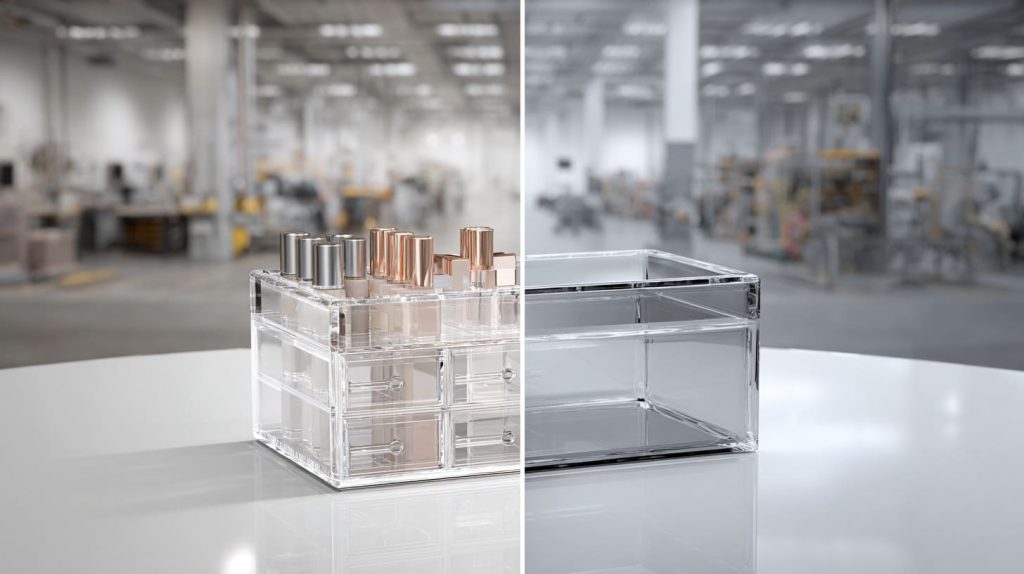
I like material debates much more when they leave the lab and enter the real world. That is where vague opinions start to fall apart. A material that looks excellent in a property table may suddenly feel awkward in an actual product. And a material some people dismiss as “less tough” may turn out to be the better commercial decision.
Let me break this down by use case, because that is how I really judge it.
Retail displays and cosmetic organizers
This is one of the clearest areas where acrylic usually leads. Retail displays need to look bright, clean, and premium. Cosmetic organizers need visual clarity. Beauty counters rely on sharp presentation. Acrylic fits that world naturally.
Polycarbonate can still be used, of course. But in many of these projects, it gives away too much in finish and cost while solving a durability issue that is not central to the job.
Why acrylic dominates here
- Better display clarity
- Better polished look
- Better fit for brand presentation
- Often lower cost for larger runs
- Better match for indoor, lower-impact use
| Retail use | Preferred material | Main reason |
|---|---|---|
| Cosmetic display stand | Acrylic | Visual finish |
| Skincare countertop unit | Acrylic | Branding and clarity |
| Product riser | Acrylic | Clean appearance |
| Organizer box | Acrylic | Premium display feel |
A display in a skincare store is judged first by the eye, not by its ability to survive a workshop accident.
Industrial enclosures and safety covers
Now the balance changes.
This is where polycarbonate often steps forward with a very strong case. If the product needs to survive hits, movement, technical conditions, or safety-related use, PC starts to justify its higher cost.
Where I would not casually replace polycarbonate with acrylic
- Safety covers near machinery
- Technical guards
- Equipment windows in rough environments
- Covers exposed to repeated handling or impact
- Parts close to heat-generating systems
| Industrial use | Preferred material | Main reason |
|---|---|---|
| Machine safety guard | Polycarbonate | Impact resistance |
| Technical equipment cover | Polycarbonate | Durability |
| Clear protective shield | Polycarbonate | Safer under stress |
| Workshop viewing panel | Polycarbonate | Better abuse tolerance |
The part I watch carefully here is not appearance first. It is failure behavior. That is a completely different priority.
Signage and branding panels
This category sits in the middle, and that is why it needs thought.
Some signage jobs are pure visual branding. Those often suit acrylic very well. Other signage jobs live in rougher public environments, face heavier contact, or have greater risk of abuse. Those may push the decision toward polycarbonate.
The trade-off here is very real
Acrylic gives:
- Better optical presentation
- Cleaner edge beauty
- Stronger premium feel
Polycarbonate gives:
- Better impact survival
- More safety margin in rough use
- More forgiveness in public or semi-industrial settings
This is where things often slip: if a sign is meant to impress clients in a showroom, I do not like sacrificing visual sharpness just to calm a fear that may never become real.
Outdoor vs indoor use cases
Outdoor use needs extra care. Neither material should be chosen lazily for outdoor work. Sunlight, weather, temperature shifts, and long-term appearance all matter.
Acrylic often has good weathering and can perform well outdoors in many sign and display situations. Polycarbonate may need more care depending on grade and coating because long-term UV exposure can affect performance and appearance if the material is not correctly specified.
Questions I ask before approving outdoor material
- How long is the product expected to stay outside?
- Is visual clarity still a priority after months of exposure?
- Will there be impact risk from public use?
- Is there a coating or grade requirement?
- What kind of cleaning will happen?
| Condition | Acrylic | Polycarbonate |
|---|---|---|
| Indoor retail | Excellent fit | Often unnecessary |
| Indoor technical use | Possible, case by case | Strong fit |
| Outdoor signage | Good, case by case | Needs proper specification |
| Rough public-facing protection | Limited | Stronger fit |
So yes, application changes everything. And once buyers see that clearly, cost becomes much easier to discuss. Because the real question is not “Which one costs more?” It is “What am I buying that cost for?”
Cost Breakdown: Material vs Total Project Cost
A lot of material discussions become too narrow when people only ask about sheet price. I understand why. It is simple. It is easy to compare. It gives a fast answer in a purchasing meeting. But that shortcut can also hide the real cost story.
I never judge material cost by the sheet alone. I judge it by what the project has to spend in order to achieve the right result.
That includes material, processing, finish, quality risk, replacement risk, and whether the final product helps or hurts the customer’s impression.
Raw material price comparison
In many markets, polycarbonate costs more than acrylic. Exact numbers move with region, quantity, grade, and supply situation, so I do not like pretending there is one universal number that stays fixed forever. Still, the general direction is usually clear: PC is the more expensive material.
That matters more when:
- The order volume is large
- The display is cost-sensitive
- The product margin is tight
- The material thickness is high
- The buyer is already managing packaging and freight pressure
What higher raw cost really means
A higher sheet price does not just raise the material line. It affects the whole project price structure, especially in bulk orders.
| Cost factor | Acrylic | Polycarbonate |
|---|---|---|
| Sheet cost trend | Lower | Higher |
| Budget pressure in bulk | Easier to manage | Heavier |
| Fit for price-sensitive display projects | Better | Weaker |
When a buyer says, “The cost difference per piece is not huge,” I often agree at first. Then I multiply it across the order, packaging, rejections, and margin expectations. Suddenly it is not small anymore.
Processing and machining differences
Material cost is only one layer. Processing matters too.
Acrylic is widely used in display fabrication for a reason. It cuts, bonds, polishes, and presents well in many common display structures. That does not mean it is effortless. Good acrylic work still needs skill. But in many custom display factories, acrylic fits the normal flow very naturally.
Polycarbonate can also be fabricated well, but it does not always deliver the same value in finishing for display-oriented jobs.
Fabrication questions that affect the budget
- Does the project need flame-polished edges?
- Will the product rely on visual edge beauty?
- Is the structure simple or complex?
- Are there bends, joints, or formed parts?
- Will the material mark easily during production or packing?
| Fabrication topic | Acrylic | Polycarbonate |
|---|---|---|
| Display edge presentation | Strong | Less attractive |
| Fit for polished retail pieces | Strong | Weaker |
| Processing value in presentation products | High | Lower in many cases |
I tend to look at processing value, not just processing possibility. A material can be processable and still not be the smartest choice for the job.
Long-term cost considerations
This part gets overlooked all the time.
A buyer may save a product from cracking by choosing polycarbonate, but lose money later if the surface scratches faster, the display looks tired early, or the customer feels the product does not look premium enough. On the other hand, choosing acrylic in a harsh setting can lead to replacement cost, complaints, or safety risk.
So the long-term cost is not one-directional.
Long-term thinking checklist
- Will the product age well visually?
- Will it face abuse or mainly sit still?
- Is replacement likely?
- Is surface appearance important after months of use?
- Does the product live in a technical or display environment?
Here is the trade-off in plain words:
| Scenario | Smarter long-term choice |
|---|---|
| Indoor beauty display with light use | Acrylic |
| Equipment shield with impact risk | Polycarbonate |
| Premium sign panel in controlled indoor space | Acrylic |
| Technical cover near heat and handling | Polycarbonate |
The detail I never ignore is this: a project can become expensive either because the material fails physically or because it fails commercially.
That is why the next step matters so much. Once cost and application are both on the table, the decision becomes less emotional and much more practical.
How to Choose the Right Material (A Practical Framework)

I think many material mistakes happen because buyers try to answer the whole question in one jump. They ask, “Which is better?” But that is too big and too vague. A better question is built step by step.
When I help judge a project, I usually break it down into a simple framework. Not because the issue is simple, but because simple questions often reveal the truth faster than technical noise.
Step 1: Define the real working environment
This has to come first. Not the imagined environment. The real one.
Ask:
- Is it indoor or outdoor?
- Will people handle it every day?
- Is there impact risk?
- Is there heat?
- Is there chemical exposure?
- Does it sit still or move often?
Why this first step changes everything
Acrylic can be perfect in one environment and completely wrong in another. So can polycarbonate.
I always start by imagining where the product will actually live, because I have seen too many good-looking drawings hide rough handling, hot equipment, or cleaning habits that completely change the material decision.
| Environment question | If yes, consider... |
|---|---|
| Public handling or abuse | Polycarbonate |
| Indoor visual display | Acrylic |
| High heat nearby | Polycarbonate |
| Premium branding space | Acrylic |
| Routine impact or stress | Polycarbonate |
Step 2: Identify the priority
Every product has a main job. Buyers get into trouble when they try to make every property the hero.
What matters most here?
- Strength?
- Clarity?
- Cost?
- Surface beauty?
- Long-term presentation?
- Technical safety?
If you do not rank these, the discussion stays muddy.
A simple priority table
| Priority | Best fit in many cases |
|---|---|
| Impact survival | Polycarbonate |
| Visual clarity | Acrylic |
| Premium display finish | Acrylic |
| Higher heat tolerance | Polycarbonate |
| Bulk project cost control | Acrylic |
A material choice becomes much easier once I force myself to name the first priority honestly instead of pretending every feature matters equally.
Step 3: Avoid emotional decision-making
This may be the hardest step, because fear sounds rational in purchasing.
A buyer thinks:
- “What if it breaks?”
- “What if the customer complains?”
- “What if I regret not choosing the stronger one?”
I understand that mindset. But “safer” is often a feeling, not a fact.
The real issue is this: safe from what?
Emotional material decisions often sound like this
- “Let’s use polycarbonate just in case.”
- “I want the strongest material.”
- “It feels risky to use acrylic.”
- “I do not want to take chances.”
Those sentences are understandable. They are also incomplete.
| Fear-based thought | Better follow-up question |
|---|---|
| I want the stronger material | Stronger against what? |
| I do not want breakage | How likely is impact really? |
| I want to be safe | Safe in use, or safe in my mind? |
| I do not want complaints | Complaints about breakage, or about appearance? |
Step 4: Work with your manufacturer early
This step saves time, money, and arguments.
A good manufacturer should not just quote what you ask for. They should challenge the choice when needed. That is especially true in custom work. If the supplier sees the drawing, the application, the target market, and the finish expectation early, they can flag material mismatches before they become production issues.
What to discuss early
- Actual use environment
- Expected lifetime
- Surface finish expectations
- Display vs protection priority
- Budget pressure
- Packaging and shipping concerns
- Prototype needs
I trust a material choice much more when the buyer and factory discuss how the product will be used before locking the sheet spec, because that is usually where the hidden risks show up.
A practical framework like this does not sound dramatic. But it prevents very dramatic mistakes.
And once you see how easy it is for emotion to creep into material choice, the common buyer mistakes become painfully familiar.
Common Mistakes Buyers Make
I do not say “mistakes” to sound harsh. Most of these are very human decisions. They come from caution, pressure, deadlines, and the natural desire to avoid problems. I have made judgment calls under pressure too. Everyone in custom manufacturing has.
But some patterns show up again and again.
And once you recognize them, they become much easier to avoid.
Choosing polycarbonate “just in case”
This is probably the most common one. A buyer knows polycarbonate is tougher. That part is true. Then the mind quietly adds a second idea: if it is tougher, then it must be the safer business choice.
That second step is where trouble begins.
Because “just in case” can become a very expensive phrase.
Why this mistake feels reasonable
- Nobody wants breakage complaints
- Tougher sounds more professional
- Buyers want to avoid regret
- Suppliers do not always challenge the idea
Still, “just in case” often means “I have not fully defined the risk.”
I get cautious the moment a material is chosen as emotional insurance rather than as a response to a clearly defined use condition.
Ignoring surface finish requirements
This mistake is less dramatic, but I see it hurt projects often. Buyers focus on strength, thickness, and structure, but forget that the end user will judge the product with their eyes first.
That is especially dangerous in:
- Cosmetics
- Beauty retail
- Premium packaging displays
- Brand signage
- Countertop product presentation
Questions that should be asked earlier
- Will the display sit under bright lighting?
- Will customers stand close to it?
- Does the finish need to feel premium?
- Will scratches become obvious quickly?
| Finish question | Why it matters |
|---|---|
| Edge quality | Affects premium feel |
| Surface marks | Affects visual trust |
| Clarity | Affects product presentation |
| Material brightness | Affects retail impression |
A technically stronger material can still damage the brand effect if the surface look does not support the customer experience.
Not considering user interaction
Products are not frozen in renderings. People touch them. Clean them. Move them. Pack them. Drop them. Lean on them. Wipe them with the wrong cloth. Use harsh cleaners. Rush through setup.
That human layer changes material performance in a very real way.
Things buyers often forget to model mentally
- Daily wiping by staff
- Fingerprints and smudges
- Friction during shipping
- Light scratches from setup
- Repeated product restocking
- Accidental knocks during normal use
I often learn more from imagining how careless a rushed store employee might be than from reading a clean material property table.
Skipping prototype validation
This one can cost a lot later.
A project may look fine in a drawing and still feel wrong in the hand. That is true for both acrylic and polycarbonate. A prototype can reveal:
- Visual quality
- Surface behavior
- Assembly issues
- Stability
- Cleaning response
- Edge finish effect
- Customer perception
Why prototypes still matter for experienced buyers
Even experienced sourcing people can get surprised by material feel. A sample closes the gap between theory and use.
| What a prototype helps confirm | Why it matters |
|---|---|
| Surface appearance | Visual approval |
| Material feel | Buyer confidence |
| Structure stability | Real use check |
| Finish quality | Retail suitability |
| Handling marks | Durability reality |
I do not like betting a full production order on material assumptions when a prototype can expose the truth much faster and much more cheaply.
And that really brings us to the core of the whole discussion. Because after all these comparisons, the lesson is not that acrylic is better or polycarbonate is better. The lesson is that material choice only becomes smart when it is tied to real use.
Conclusion

I do not believe the strongest material is automatically the smartest one. I have seen too many projects prove the opposite.
That is why I think the real job is not to chase the most impressive spec. The real job is to match the material to the life the product will actually live. That is the difference between a safe-looking choice and a correct one.
Polycarbonate and acrylic are not enemies. They are tools. Each one solves a different kind of problem. Polycarbonate is the better answer when the project truly needs impact strength, heat resistance, and more forgiveness under stress. Acrylic is the better answer when clarity, surface beauty, cost control, and brand presentation matter more.
I came to this view because I have watched projects drift off course when people tried to buy peace of mind instead of buying fitness for purpose. A display is not better because it can survive a harder hit. It is better when it performs well in the exact setting it was made for. That is the standard I trust.
The detail I keep coming back to is very simple: the wrong strong material can still weaken a project by hurting the look, the budget, or the commercial result.
So when I make this judgment, I am not asking only, “Which sheet is tougher?” I am asking:
- What will the user see first?
- What will the product face every day?
- What kind of failure is actually most likely?
- Where does the project make money or lose value?
That is why I often choose acrylic for retail and branded display work, even when polycarbonate sounds more reassuring at first. Not because I ignore durability. Because I refuse to let one property bully the whole decision.
If you are planning a custom display, organizer, sign, or acrylic product and you are stuck between acrylic and polycarbonate, I would strongly suggest starting with the real application, not the headline spec. That is where the right answer usually appears.
And if you want a second set of eyes on your project, I think that is a smart move. A good factory should help you challenge the material choice early, before cost, finish, and performance start pulling against each other. That is how I prefer to work, and in my view, that is how better custom products get made.