Skip to content

A tray looks quiet. Almost invisible. But after more than a decade working with retail buyers and designers, I’ve learned one thing the hard way: when trays are wrong, the shelf feels nervous; when trays are right, everything calms down.
I’ve seen this in many stores. Cosmetics lined up but never quite straight. Products slowly drifting out of place after each customer touch. Staff adjusting things again and again. The issue is rarely the product. It’s often the tray under it.
This article is written for people like Jacky. Buyers and designers who already know acrylic. You don’t need definitions for beginners. You need judgment. You need to know what works, what fails, and why small tray decisions quietly shape buying behavior.
What Are Acrylic Trays for Retail Stores?

Definition and basic structure
When I say “acrylic retail tray,” I mean a rigid, transparent or semi-transparent holder designed to control space, not just hold items. That difference matters.
A typical acrylic tray has:
- A flat base
- Raised edges or walls
- Controlled dimensions
- Finished edges meant for open handling
Here are the basics buyers usually discuss first:
| Element | Common Options | Why It Matters |
|---|---|---|
| Shape | Rectangle, square, round | Fits shelf logic |
| Thickness | 3mm–8mm | Affects stiffness |
| Edge style | Straight, chamfered | Safety and feel |
Thickness is often underestimated. Too thin, and the tray flexes. Too thick, and cost rises fast.
Acrylic trays vs other tray materials
I get this question often, usually tied to budget.
| Material | Strength | Clarity | Retail Feel | Risk |
|---|---|---|---|---|
| Acrylic | Medium–High | Excellent | Clean, premium | Scratches |
| PS / PET | Low–Medium | Good | Disposable | Warping |
| Metal | High | None | Industrial | Heavy |
| Glass | High | Excellent | Luxury | Breakage |
Acrylic sits in the middle. That’s why it’s everywhere.
Before moving on, here’s a quiet truth I’ve learned: most tray failures don’t come from material choice, but from wrong expectations. And that leads us to types.
Main Types of Acrylic Trays Used in Retail

Flat display trays
Flat trays are simple. And because they look simple, they are often abused.
They work best when:
- Products are uniform
- Staff restock often
- The goal is visual order, not separation
| Best for | Risk |
|---|---|
| Gift items | Sliding |
| Bottles | Fingerprints |
Compartment and divided trays
I personally like divided trays for busy counters. They reduce chaos.
But there is a trade-off.
| Advantage | Limitation |
|---|---|
| Clear placement | Fixed layout |
| Faster restocking | Less flexible |
If SKUs change often, fixed compartments become a problem.
Tiered and stepped trays
Tiered trays solve one issue well: visibility.
They work best on:
- Deep shelves
- Counters with eye-level gaps
But they increase tooling and assembly cost. Buyers often forget that.
Custom-shaped and brand-specific trays
Custom shapes look great. They also lock you in.
I’ve seen brands regret this when packaging changes.
| Custom Feature | Long-Term Impact |
|---|---|
| Logo cutout | Brand clarity |
| Unique shape | Low reuse |
Once shape is fixed, flexibility drops.
That brings us to how these trays actually get used in stores.
Common Uses of Acrylic Trays in Retail Stores
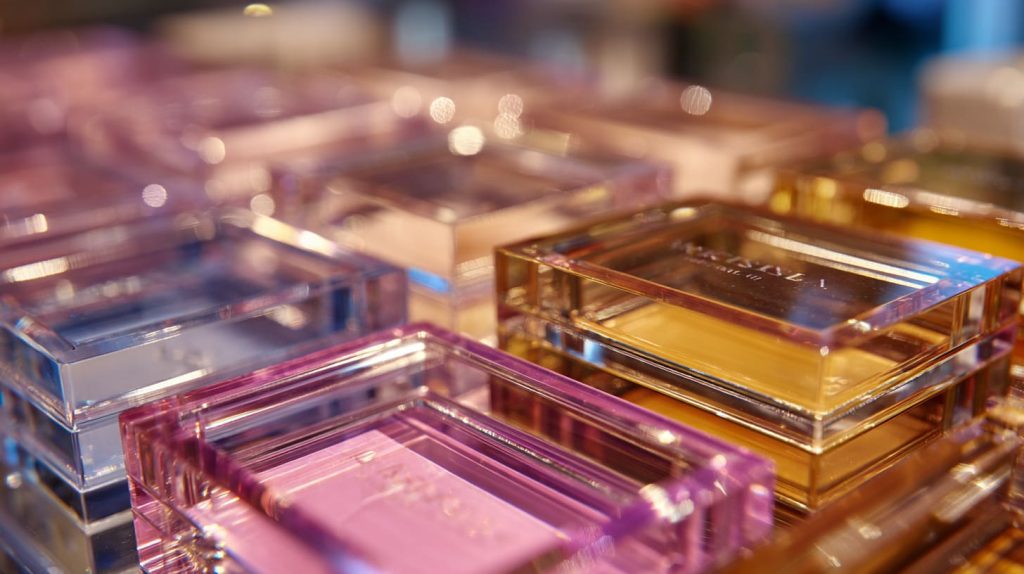
Cosmetic and beauty product displays
This is the most common use I see.
Products include:
- Lipsticks
- Skincare bottles
- Tester units
The tray here does three jobs:
- Hold items
- Keep spacing
- Protect shelf surface
Miss any one, and staff will complain.
Jewelry and accessory presentation
Small items need visual separation more than strength.
Here clarity beats thickness.
| Item | Tray Priority |
|---|---|
| Rings | Compartment depth |
| Watches | Scratch control |
Food and specialty retail (non-direct contact)
This area needs caution.
Acrylic works well for:
- Packaged food
- Display separation
But surface scratches show faster under lighting.
Electronics and lifestyle products
Electronics trays need weight control.
| Product | Tray Risk |
|---|---|
| Chargers | Sliding |
| Gadgets | Cable clutter |
Trays don’t solve everything. They only manage space.
And that leads us to why buyers still choose acrylic.
Key Benefits of Using Acrylic Trays in Retail

Visual clarity and product focus
Clear acrylic does one thing well: it disappears.
Light passes through. Shadows soften. Products lead the story.
Improved shelf organization and restocking efficiency
Standard tray sizes create rhythm.
| Store Type | Result |
|---|---|
| Chain | Faster training |
| Flagship | Cleaner look |
Durability for daily retail handling
Acrylic scratches. That’s a fact.
But it doesn’t dent like metal or shatter like glass.
| Use Level | Expectation |
|---|---|
| High traffic | Micro scratches |
| Low traffic | Long life |
Clean edges send a message.
Not luxury. Not cheap. Controlled.
But this only works if design choices are right.
Design Considerations When Choosing Acrylic Trays

Thickness and load-bearing needs
Thickness should match weight.
| Product Weight | Suggested Thickness |
|---|---|
| Light | 3–4mm |
| Medium | 5–6mm |
| Heavy | 8mm |
Overdesign costs money. Underdesign costs reputation.
Edge finishing and safety
| Finish | Feel | Cost |
|---|---|---|
| Flame | Smooth | Medium |
| Diamond | Sharp clean | Higher |
Edges are touched more than you think.
Surface treatment and scratch control
Matte hides scratches. Gloss shows dust.
There is no perfect choice. Only trade-offs.
Color, tint, and branding options
Branding should support, not dominate.
| Method | Risk |
|---|---|
| Printing | Peeling |
| Engraving | Fixed forever |
Once branding is added, reuse drops.
That’s why buyers often ask about standard vs custom.
Custom vs Standard Acrylic Trays: What Buyers Should Know
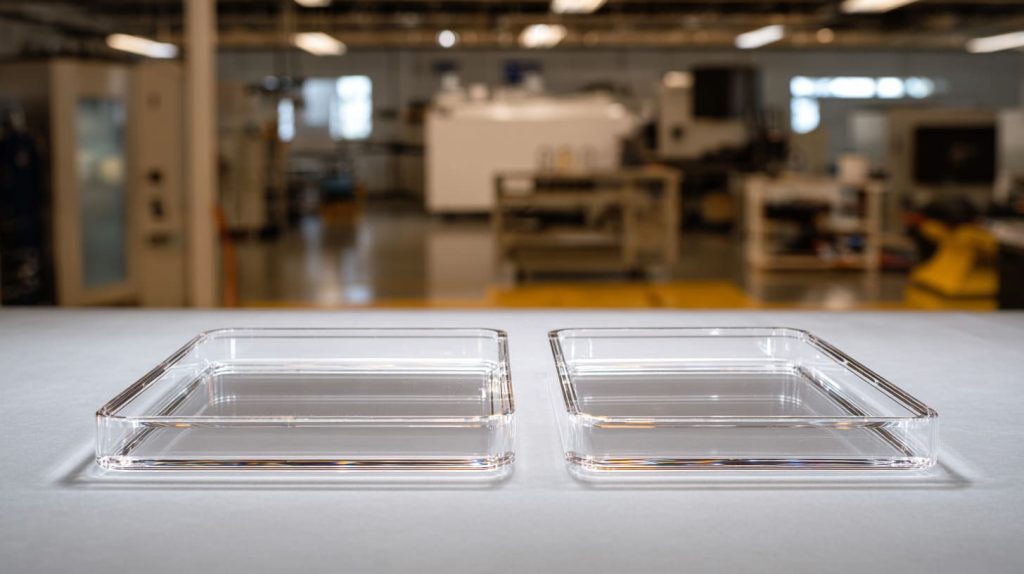
When standard trays are sufficient
Standard works when:
- Budget matters
- Speed matters
- Layout changes often
When custom trays make more sense
Custom fits:
- Chain rollouts
- Fixed SKUs
- Long campaigns
Cost, MOQ, and lead time expectations
| Type | MOQ | Lead Time |
|---|---|---|
| Standard | Low | Fast |
| Custom | 100–200 pcs | 15–25 days |
Custom is not expensive. Mistakes are.
Now let’s talk about what happens inside factories.
Manufacturing and Quality Factors That Affect Performance

Cast acrylic vs extruded acrylic
| Type | Clarity | Stability |
|---|---|---|
| Cast | High | Better |
| Extruded | Medium | Lower |
Cast costs more. But behaves better over time.
CNC cutting vs laser cutting
| Method | Edge | Speed |
|---|---|---|
| CNC | Clean | Slower |
| Laser | Glossy | Fast |
Each has its place.
Quality control points buyers often overlook
| Issue | Result |
|---|---|
| Warping | Poor stacking |
| Film | Scratches |
| Packaging | Transit damage |
Many complaints start here.
Which leads to common mistakes.
Common Mistakes Retail Buyers Make with Acrylic Trays

Over-prioritizing price over consistency
Cheaper trays often mean:
- Mixed thickness
- Color variation
Costs show up later.
Ignoring store environment and handling habits
Cleaning staff matter more than designers think.
Alcohol wipes change surfaces fast.
Underestimating logistics and packaging risks
Trays stack. Or they don’t.
Poor packaging ruins good design.
Before closing, let’s answer a few common questions.
FAQ: Acrylic Trays for Retail Stores

Are acrylic trays easy to clean and maintain?
Yes. Mild soap and soft cloth work best.
Do acrylic trays scratch easily in retail use?
They scratch over time. This is normal.
Can acrylic trays be customized for different store layouts?
Yes. But flexibility drops after tooling.
What is the typical lifespan of an acrylic retail tray?
3–5 years in active stores is common.
How do I choose the right supplier for custom acrylic trays?
Look beyond samples. Ask about process control.
Conclusion

Acrylic trays are not accessories. They are quiet systems. They control space, behavior, and rhythm on a shelf.
Experienced buyers don’t judge trays by shine alone. They look at thickness, consistency, handling, and long-term use.
If you’re planning a new tray project, slow down. Ask better questions early. And if you want a second opinion from someone who builds these every day, I’m always happy to talk.