Skip to content

Acrylic display drawings can look very clean on paper.
A few straight lines. A few holes. A few bend positions. A few numbers beside the dimensions.
Then one small note appears in the corner:
Tolerance: ±0.1 mm
That tiny note can change the whole project.
I have seen this happen many times in custom acrylic display manufacturing. A buyer sends a drawing for a countertop cosmetic display, a product display box, or a retail acrylic stand. The design looks normal. The structure is not too complex. The product does not need to hold a motor, a bearing, or a moving mechanical part.
But the tolerance requirement is written like a precision metal component.
That is where the cost trap begins.
Why Tight Tolerances Are Often Viewed as a Sign of Quality
Many buyers believe tight tolerance means good quality. I understand why.
A tighter number feels safer. It feels more professional. It feels like the factory will pay more attention. If ±0.5 mm is good, then ±0.1 mm must be better, right?
Not always.
In acrylic display manufacturing, smaller tolerance does not always create a better product. Sometimes it only creates a more expensive product. Sometimes it creates more inspection work, more rejected parts, more delays, and more arguments between buyer and supplier.
That is the uncomfortable part.
Acrylic is not steel. A cosmetic display is not a gearbox. A display box for retail products does not always need the same tolerance logic as a CNC aluminum part.
The hidden cost is not only in cutting. It is also in checking, polishing, bonding, packing, and reworking.
Quick Judgment
For most acrylic display projects, I do not judge quality by asking, “How small can we make the tolerance?”
I judge it by asking, “Which dimensions really affect the product, and which numbers only look strict on paper?”
This small question can save a project from wasting money.
A buyer like Jacky, who has real purchasing experience, already knows one thing very well: a factory quote is never only about material. It is also about risk. The tighter the tolerance, the higher the risk. And risk always finds its way into the price.
So let’s talk about the real issue.
Not the theory.
The factory floor version.
What Does Tolerance Mean in Acrylic Display Manufacturing?
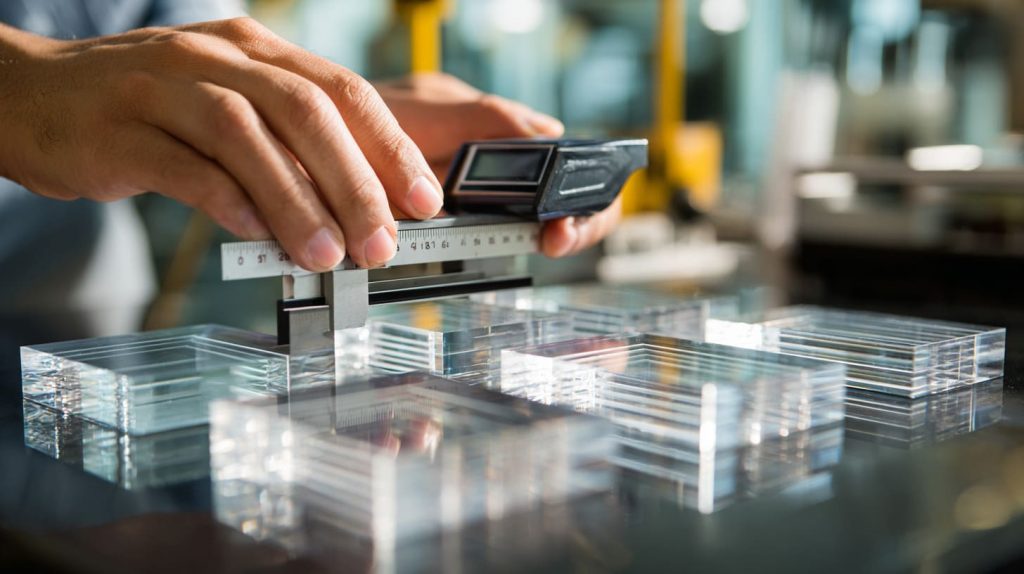
Tolerance means the allowed difference between the drawing size and the finished product size.
If a drawing says a panel should be 300 mm wide, the tolerance tells us how much variation is acceptable. Maybe the finished panel can be 299.5 mm to 300.5 mm. Maybe it must be 299.9 mm to 300.1 mm.
That small range matters.
But it does not matter equally on every part.
A front panel that must fit into a slot may need tighter control. A decorative side panel may not. A screw hole for metal hardware may need more attention. The outside size of a loose countertop riser may not.
The mistake happens when every dimension is treated like a critical dimension.
That is expensive thinking.
The detail I care about most is not the smallest tolerance on the drawing; it is whether the tolerance matches the real function of the part, because a strict but useless tolerance only burns production time.
Understanding Dimensional Tolerance
In acrylic display manufacturing, tolerance usually appears in several areas:
| Tolerance Area | What It Controls | Why It Matters |
|---|---|---|
| Length and width | Panel size | Affects fit, alignment, and visual balance |
| Thickness | Material sheet thickness | Affects slot fit, strength, and bonding |
| Hole position | Screw, magnet, hinge, or hardware location | Affects assembly accuracy |
| Bend position | Heat bending line | Affects final shape and angle |
| Slot size | Interlocking structures | Affects tightness and assembly |
| Edge finish | Polished or machined edge quality | Affects appearance and perceived quality |
Some tolerances are functional. Some are visual.
That difference is important.
A functional tolerance affects whether the display works. A visual tolerance affects whether the display looks clean enough for the customer. Both matter, but they should not be controlled in the same way.
For example:
- A hole for a hinge needs a clear position tolerance.
- A slot for a removable shelf needs a practical fit tolerance.
- A large acrylic base panel may not need a very tight outside tolerance if it only sits on a counter.
- A polished edge may need a visual standard more than a strict numeric rule.
This is where many drawings become too heavy. They control everything by numbers, but they do not explain what matters.
Why Acrylic Behaves Differently from Metal
Acrylic has its own temper.
I say that with respect.
It is beautiful, clear, and useful. It can make a product look clean and high-end. But it is not a cold, stable block of metal.
Acrylic can expand and shrink with temperature changes. It can flex slightly. It can carry internal stress after cutting, bending, polishing, or bonding. It can also react differently depending on sheet quality, thickness, cutting method, and workshop environment.
Metal machining logic does not always work well here.
| Material Behavior | Acrylic | Metal |
|---|---|---|
| Thermal movement | More noticeable | Usually more stable |
| Flexibility | Can bend or flex slightly | Usually more rigid |
| Internal stress | Can appear after cutting or bonding | Usually handled differently |
| Edge finishing | Flame polish, diamond polish, buffing | Deburring, milling, grinding |
| Bonding | Solvent or glue bonding | Welding, screws, rivets, machining |
| Surface sensitivity | Easy to scratch if handled poorly | Often more resistant |
Acrylic parts may look simple, but the process is layered.
Cutting affects size. Polishing affects edge. Bonding affects position. Packing affects surface protection. One part passes through many hands before it becomes a finished display.
So if the tolerance is too tight, every step becomes nervous.
And nervous production is not cheap.
Common Industry Tolerance Standards
There is no single tolerance number for all acrylic display projects.
It depends on the product size, structure, material thickness, process, and function.
But in normal acrylic display manufacturing, the common tolerance logic often looks like this:
| Process | Common Practical Tolerance Range | Notes |
|---|---|---|
| Laser cutting | Around ±0.2 mm to ±0.5 mm | Depends on thickness, machine setup, and shape |
| CNC machining | Around ±0.1 mm to ±0.3 mm | Better for precision holes, grooves, and complex parts |
| Heat bending | Often wider than cutting tolerance | Bend angle and material behavior affect final size |
| Manual bonding | Usually needs visual and assembly standards | Glue position and fixture quality matter |
| Polishing | Can slightly change edge dimensions | Especially on small parts or visible edges |
These are not fixed promises. They are practical reference points.
A 50 mm part and a 1200 mm part cannot be judged the same way. A flat panel and a glued display box cannot be judged the same way either.
That is why I prefer drawing notes that separate tolerance levels.
For example:
| Dimension Type | Suggested Control Style |
|---|---|
| Critical hole position | Tight numeric tolerance |
| Slot fit | Controlled fit tolerance |
| Overall non-critical size | Standard production tolerance |
| Cosmetic edge | Visual inspection standard |
| Bonded assembly | Functional and appearance standard |
This is more useful than writing one strict tolerance for the whole drawing.
A strict drawing can look impressive. But a smart drawing saves money.
And that takes us to the next problem: why buyers over-specify in the first place.
Why Do Buyers Frequently Over-Specify Tolerances?
Buyers do not over-specify tolerances because they want to waste money.
Most of the time, they do it because they want safety.
They want fewer defects. They want fewer complaints. They want fewer surprises after mass production starts. That is normal. I would think the same way if I were responsible for purchasing custom displays for a brand or retail project.
But a strict number can create a false sense of control.
The part that often gets missed is simple: a tighter tolerance does not fix a weak design, a poor material choice, or an unclear inspection standard.
One thing I have learned from real orders is that buyers often use tight tolerance as a shield against uncertainty, but the better move is to remove the uncertainty from the design first.
Engineering Habits Borrowed from Metal Manufacturing
Many designers come from metal, plastic injection, electronics, or mechanical product backgrounds.
So they bring habits with them.
That is not wrong. Experience is valuable. But acrylic display production has its own rules.
A metal bracket may need strict hole accuracy because it connects with a machine frame. A CNC aluminum housing may need tight tolerances because it holds electronic components or seals against dust and water.
But an acrylic retail display often has a different job.
It needs to:
- Hold products safely
- Look clean under store lighting
- Match brand presentation
- Stay stable during use
- Fit into packaging
- Be easy to assemble or place on a counter
That is not the same as a mechanical transmission part.
Here is a simple comparison:
| Product Type | Real Priority | Tolerance Risk |
|---|---|---|
| Metal machine part | Mechanical fit and movement | Loose tolerance may cause failure |
| Aluminum enclosure | Component fit and sealing | Wrong tolerance may affect assembly |
| Acrylic cosmetic display | Visual quality and product placement | Over-tight tolerance may add cost without value |
| Acrylic display box | Clear appearance and stable bonding | Poor bonding may matter more than size |
| Acrylic sign holder | Sheet fit and presentation | Material thickness may matter more than outer size |
When metal logic is copied into acrylic drawings, the project may become over-controlled.
And over-controlled does not always mean better controlled.
Lack of Understanding of End-Use Requirements
Acrylic displays are used in many places.
A countertop lipstick display is different from an acrylic protection cover. A museum-grade display case is different from a simple brochure holder. A wall-mounted display with metal standoffs is different from a small jewelry riser.
The end use decides the tolerance.
Not the fear in the buyer’s mind.
For example, let’s look at two displays:
| Project | Need for Tight Tolerance | Reason |
|---|---|---|
| Simple acrylic riser set | Low to medium | Main concern is appearance and stability |
| Modular display with removable shelves | Medium | Shelf fit and slot alignment matter |
| Lockable acrylic display cabinet | Medium to high | Door gap, hinge, and lock position matter |
| Acrylic part with metal bracket | High in interface areas | Screw holes and hardware fit matter |
| Luxury cosmetic display with visible seams | High in selected areas | Small visual gaps may affect brand feeling |
The key phrase is selected areas.
Not everywhere.
A buyer may request ±0.1 mm on the full product. But maybe only the hinge holes need that level of control. Maybe the base length can be ±0.5 mm. Maybe the shelf slot needs a test fit standard, not just a number.
This is how we control cost while keeping quality.
Fear of Quality Problems
Acrylic display buyers often fear three things:
- The finished product will not match the drawing.
- The product will look cheap.
- The final customer will complain.
I get it.
One bad shipment can hurt trust. One batch with poor glue marks or warped panels can create a painful discussion. Nobody wants that.
But tight tolerances are only one part of quality.
Acrylic quality also depends on:
- Sheet material quality
- Cutting accuracy
- Edge polishing method
- Bending temperature control
- Glue skill
- Fixture design
- Surface protection
- Packing method
- Inspection before shipment
If a supplier uses poor acrylic material, ±0.1 mm tolerance will not save the product.
If glue marks are messy, tight hole tolerance will not make the display look premium.
If packaging is weak, a perfect part can still arrive scratched.
I sometimes tell buyers this in a very simple way: Do not use tolerance to cover every quality fear. Use the right control for the right problem.
That is more practical.
And now we reach the part buyers care about most.
Cost.
How Do Tight Tolerances Increase Manufacturing Costs?

A strict tolerance does not only change the drawing.
It changes the way the factory works.
The machine may need slower cutting. The operator may need more setup time. The inspection team may need more measuring steps. The production manager may need to prepare for more rejected parts.
All of that becomes cost.
A buyer may see only one small note on a PDF file. A factory sees extra risk in every production stage.
Before I quote a project with tight tolerance, I usually ask myself where the real cost will appear: machine time, inspection time, scrap rate, or assembly difficulty, because the highest cost is not always where the buyer expects it.
Additional Machine Time
When tolerance becomes tighter, production often becomes slower.
The factory may need to:
- Adjust machine settings more carefully
- Use slower feed speed
- Use more stable fixtures
- Test cut before production
- Separate parts into smaller batches
- Recheck machine alignment more often
For simple acrylic displays, this extra work may not improve the final product in a way the customer can see.
Here is a basic example:
| Requirement | Production Impact | Cost Result |
|---|---|---|
| Standard tolerance on simple panels | Normal laser cutting speed | Normal cost |
| Tight tolerance on all panels | More setup and checking | Higher cost |
| Tight tolerance on only key slots | Focused control | Better cost balance |
| Tight tolerance plus polished edges | More rework risk | Higher labor cost |
Machine time is not only machine time.
It also affects the schedule. If a machine spends more time on one project, other projects wait. That delay has a value, too.
Higher Inspection Requirements
Tight tolerance means more checking.
If a part has a normal tolerance, inspection may focus on key dimensions, appearance, assembly fit, and sample comparison.
If a part has very tight tolerance, inspection becomes more detailed.
The team may need to check:
- Every hole position
- Every outside dimension
- Every slot width
- Every bend line
- Every assembly gap
- More pieces from each batch
That takes time.
And if the drawing has too many strict dimensions, inspection becomes heavy. The inspector is no longer only checking quality. They are hunting tiny differences that may not affect the display.
| Inspection Level | What Gets Checked | Best Use |
|---|---|---|
| Basic visual check | Surface, edge, glue, obvious size issue | Simple displays |
| Functional check | Fit, assembly, stability | Most custom displays |
| Key dimension check | Critical holes, slots, hardware points | Displays with assembly needs |
| Full dimension check | Many or all dimensions | High-precision or high-risk parts |
Full dimension checking is expensive.
It should be used when the product needs it, not because the drawing feels safer with tight numbers.
Increased Scrap Rates
This is one of the biggest hidden costs.
If the tolerance is too tight, more parts fail inspection.
Some failed parts are truly bad. They should be rejected.
But some parts are functionally good and visually acceptable. They only fail because the drawing tolerance is too strict for the actual use.
That is painful.
Imagine a display base that is 0.25 mm outside the tolerance but still works perfectly. It looks good. It holds the product. It fits the package. The customer would never notice.
But if the drawing says ±0.1 mm, the part becomes rejected.
Who pays for that?
Usually, the cost is built into the quote. If it is not built into the quote, it becomes a dispute later.
| Scrap Cause | Why It Happens | How to Reduce It |
|---|---|---|
| Over-tight dimension limits | Normal variation becomes rejection | Use practical tolerance |
| Too many critical dimensions | More chances to fail | Mark only key dimensions |
| Acrylic stress or movement | Material changes after process | Allow realistic tolerance |
| Manual bonding variation | Assembly cannot match machining tolerance | Use fixtures and visual standards |
| Polishing size change | Edge finishing removes tiny material | Adjust design or tolerance |
Acrylic sheet is not free. Labor is not free. Rework is not free.
A tight tolerance that creates scrap will always come back as cost.
More Skilled Labor Requirements
Some buyers only think about machines.
But acrylic display manufacturing still depends heavily on people.
A good worker knows how much pressure to use during bonding. A good polishing worker knows how to create a clean edge without over-removing material. A good assembly worker knows how to align parts and avoid glue marks.
When tolerance is too tight, the project needs more experienced workers.
That may sound good, but it also affects production flexibility.
The factory cannot assign the project to any production line. It may need the best workers, better fixtures, more supervision, and more time.
That is fine for high-value displays.
It is not always sensible for basic retail displays.
This is the simple factory truth: skilled labor should be used where it creates visible or functional value.
If it only helps meet a number that nobody can see or feel, the buyer is paying for invisible perfection.
And invisible perfection can get very expensive.
Now let’s look at where these costs usually hide inside the product design.
Which Acrylic Display Features Usually Drive Unnecessary Tolerance Costs?

Not every feature causes the same tolerance problem.
Some areas are harmless. Some areas are dangerous. Some areas look simple, but they create a lot of cost when the tolerance is too tight.
This is why I like to review drawings feature by feature.
Acrylic displays are not one single tolerance object. They are a group of parts with different jobs.
When I review a drawing, I do not treat every number with the same respect; I look for the numbers that can hurt assembly, appearance, or packaging, and I let the less important numbers breathe a little.
Excessively Tight Overall Dimensions
Overall size is often over-controlled.
A buyer may request:
- 300 mm ±0.1 mm
- 500 mm ±0.1 mm
- 800 mm ±0.1 mm
This may be needed in some cases. But for many acrylic display bases, panels, or risers, it is too strict.
If a display sits on a retail counter, and the final product size is 500.3 mm instead of 500.0 mm, will the customer care?
Usually not.
If the product must fit into a tight retail fixture, then yes, it may matter.
That is the difference.
| Overall Dimension Situation | Suggested Thinking |
|---|---|
| Freestanding display on counter | Standard tolerance is usually enough |
| Display fits into a fixed shelf space | Tighter tolerance may be needed |
| Display fits into custom packaging foam | Packaging clearance should be checked |
| Display connects with other parts | Interface areas need more control |
| Large acrylic panel | Wider tolerance may be realistic |
The larger the part, the more careful we need to be with tolerance expectations.
A 100 mm part and a 1000 mm part cannot be judged with the same number. That sounds obvious, but many drawings still do it.
Over-Controlled Hole Locations
Hole position matters when hardware is involved.
Screws, hinges, locks, magnets, metal brackets, and standoffs all need alignment.
But again, not every hole needs extreme tolerance.
A hole for a loose cable tie is not the same as a hinge hole. A hole for a decorative screw cover is not the same as a metal bracket mounting hole.
Here is how I usually think:
| Hole Type | Tolerance Priority | Reason |
|---|---|---|
| Hinge hole | High | Door alignment depends on it |
| Lock hole | High | Lock function can fail |
| Metal bracket hole | High | Metal part may not fit |
| Magnet hole | Medium to high | Closure feel depends on position |
| Cable hole | Low to medium | Usually has more clearance |
| Decorative hole | Low to medium | Appearance matters more than function |
A good drawing should mark these differences.
One practical way is to use slotted holes or slightly larger clearance holes where possible. This gives assembly more room without hurting the product.
It is not “lower quality.”
It is smarter design.
Tight Edge and Corner Specifications
Acrylic edges are important because people see them.
A clean polished edge can make a display feel premium. A rough edge can make it feel cheap. So yes, edges matter.
But edge quality is not always best controlled by tiny dimensional tolerance.
Sometimes it is better controlled by:
- Edge finish sample
- Visual inspection standard
- Acceptable burr level
- Polish method
- Corner radius requirement
- Protection film handling
For example, if a drawing says every corner radius must be ±0.1 mm, the factory may need extra machining and checking. But if the real goal is smooth touch and clean appearance, a visual and touch standard may work better.
| Edge Requirement | Better Control Method |
|---|---|
| Clear polished display edge | Define polish method and visual standard |
| Safe hand-touch corner | Define radius range and smoothness |
| Hidden internal edge | Standard deburring may be enough |
| Luxury visible edge | More careful polishing and inspection |
| Interlocking edge | Dimensional tolerance matters more |
I have seen projects where the buyer controlled hidden edges too strictly but forgot to define glue mark standards on visible corners.
That is backwards.
Customers notice glue marks faster than they notice a hidden edge being 0.2 mm different.
Cosmetic Surfaces with Unrealistic Requirements
Acrylic is chosen because it looks clean and transparent.
So surface quality matters a lot.
But here is the trap: buyers sometimes mix surface quality with dimensional tolerance.
They may try to solve all appearance concerns with strict dimensional rules.
That does not work well.
Surface quality should be controlled by surface standards.
For example:
| Concern | Better Standard |
|---|---|
| Scratches | Define acceptable scratch size, position, and quantity |
| Dust | Define cleaning and packing standard |
| Glue mark | Define visible glue limit |
| Bubble | Define acceptable size and location |
| Color variation | Approve material sample before production |
| Protective film marks | Define handling requirement |
Acrylic surfaces can be damaged during cutting, polishing, assembly, inspection, and packing.
So surface protection matters from start to finish.
If a buyer wants a premium retail display, I would rather spend more energy on material selection, film protection, glue control, and packing than force every non-critical dimension into ±0.1 mm.
That is how quality becomes visible.
And now comes the fair question: are tight tolerances ever worth it?
Yes.
Sometimes they are not only useful. They are necessary.
When Are Tight Tolerances Actually Justified?
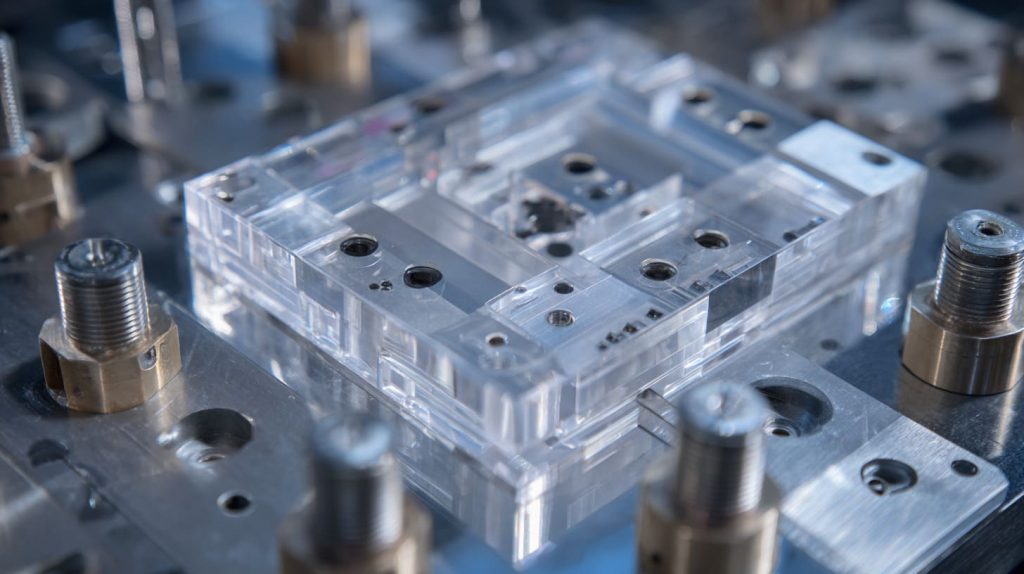
I do not believe loose tolerance is always better.
That would be lazy thinking.
Some acrylic projects need tight tolerance. Some projects fail without it. The real skill is knowing where precision creates value and where it only creates cost.
Acrylic can be used for simple displays, but it can also be used in complex assemblies. The tolerance strategy should change with the product.
The way I decide is simple: if a dimension affects fit, movement, safety, or high-value appearance, I give it more attention; if it only satisfies a neat-looking drawing, I question it.
Multi-Part Assembly Systems
Multi-part displays often need tighter tolerance.
For example:
- A display with removable shelves
- A multi-layer cosmetic stand
- A lockable display cabinet
- A modular display system
- A display with sliding panels
- A display with replaceable trays
In these products, one part affects another part.
If a slot is too narrow, the shelf cannot fit. If the slot is too loose, the shelf shakes. If the hole is off, the whole display twists during assembly.
This is where tolerance has real value.
| Assembly Feature | Why Tolerance Matters |
|---|---|
| Slot and tab structure | Controls fit tightness |
| Removable shelves | Controls ease of use |
| Sliding doors | Controls smooth movement |
| Hinged doors | Controls gap and alignment |
| Layered cosmetic trays | Controls visual alignment |
| Stackable display parts | Controls stability |
For these parts, I prefer to test the fit with real samples before mass production.
A drawing is useful. But a sample tells the truth.
Acrylic Components Combined with Metal Hardware
Metal hardware has less patience than acrylic.
A hinge will not forgive a bad hole position. A lock will not work well if the cutout is off. A metal bracket may not align if acrylic holes are too loose or too tight.
This is one of the clearest cases where tight tolerance may be needed.
Common hardware includes:
- Hinges
- Locks
- Screws
- Magnets
- Standoffs
- Aluminum frames
- Stainless brackets
- LED channels
| Hardware Type | Key Control Point |
|---|---|
| Hinge | Hole spacing and door gap |
| Lock | Cutout size and center position |
| Magnet | Depth and alignment |
| Screw | Clearance and strength |
| Standoff | Hole position and panel flatness |
| LED channel | Slot width and heat space |
Here, I do not recommend guessing.
The factory should receive hardware samples or exact hardware drawings. If possible, the acrylic sample should be assembled with the real hardware.
A 0.2 mm mistake may not matter on a flat panel. It may matter a lot on a lock.
High-End Retail and Luxury Displays
Luxury retail displays are different.
Sometimes the function is simple, but the visual expectation is high.
A small gap may look cheap. A misaligned edge may hurt brand feeling. A slightly uneven tier may stand out under strong store lighting.
For luxury cosmetic, jewelry, watch, or perfume displays, appearance becomes part of the product value.
So tighter control may be justified in selected areas.
| Display Type | High-Value Visual Area |
|---|---|
| Jewelry display | Edge polish, seam alignment, clear surface |
| Watch display | Slot alignment, base balance, hardware fit |
| Perfume display | Tier height, logo position, surface clarity |
| Cosmetic display | Product pocket fit, front visual line |
| Museum display case | Panel alignment, door gap, clean bonding |
But even in luxury displays, I still do not tighten everything.
I tighten what people see and touch.
That is the difference between quality thinking and fear-based thinking.
Functional Products Beyond Display Applications
Some acrylic products are not only displays.
They may be used in:
- Laboratory covers
- Medical equipment shields
- Machine guards
- Protective boxes
- Instrument panels
- Industrial fixtures
- Optical or lighting parts
These products may need tighter tolerance because function, safety, or compatibility matters more.
For example, a protective acrylic cover for equipment may need precise mounting holes. A lab part may need exact inner dimensions. A machine guard may need stable fit and clear spacing.
In these cases, the factory should review the drawing more like a technical part, not only a retail display.
That means:
- More detailed inspection
- Better fixtures
- More controlled machining
- Better sample approval
- Clearer material requirements
- More careful packaging
This is fair.
A tight tolerance is not the enemy.
A blind tolerance is the enemy.
Now let’s talk about how designers can choose the right tolerance level before the project becomes expensive.
How Can Designers Determine the Right Tolerance Level?

Good tolerance planning starts before production.
It starts when the designer looks at the product and asks, “What does this part actually need to do?”
That sounds simple. But in real work, it is often skipped.
Many drawings are made from design habit. The dimensions are added. The tolerance note is copied. The file is sent to suppliers. Then the quote comes back higher than expected.
At that point, everyone starts negotiating price.
But the real negotiation should have started inside the drawing.
I like to check tolerance from the user’s side first, because the end user does not care about the drawing note; they care whether the display looks right, holds the product, and works without trouble.
Start With Functional Requirements
The first question is not, “What tolerance can the factory achieve?”
The first question is, “What does the product need to do?”
For an acrylic display, the function may be:
- Holding a product in place
- Showing products clearly
- Preventing dust
- Locking valuable items
- Supporting product weight
- Fitting a shelf or counter
- Allowing easy cleaning
- Matching brand appearance
Each function creates different tolerance needs.
| Function | Important Dimension |
|---|---|
| Holds lipstick tubes | Pocket size and spacing |
| Holds skincare bottles | Base strength and hole diameter |
| Locks product inside | Door gap, lock cutout, hinge hole |
| Fits retail shelf | Overall width, depth, height |
| Ships in foam packaging | Outer size and corner space |
| Shows premium brand image | Front alignment and visible seams |
| Allows removable shelves | Slot width and shelf thickness |
This is practical.
Acrylic display tolerance should come from use, not from guesswork.
Separate Critical and Non-Critical Dimensions
A good drawing should not treat all dimensions equally.
Some dimensions are critical. Some are normal. Some are only reference dimensions.
This makes production easier and cheaper.
Here is a simple tolerance planning table:
| Dimension Type | Example | Control Level |
|---|---|---|
| Critical | Hinge holes, lock cutouts, shelf slots | Tight |
| Important | Main visible alignment, product pocket size | Medium |
| Standard | Outer size of simple panels | Normal |
| Visual only | Polished edge, glue line | Visual standard |
| Reference | Non-functional spacing | Flexible |
This kind of thinking helps both sides.
The buyer gets better control where it matters. The factory avoids wasting time where it does not.
I like this method because it creates a cleaner conversation. Instead of saying, “Can you meet ±0.1 mm everywhere?” the buyer can say, “These five dimensions are critical. Please control them tightly.”
That is much easier to manage.
Consider Manufacturing Methods Early
Different processes create different tolerance realities.
Acrylic displays may use several processes:
- Laser cutting
- CNC machining
- Diamond polishing
- Flame polishing
- Heat bending
- Solvent bonding
- UV printing
- Assembly with hardware
Each process has its own limits.
| Process | Design Question to Ask |
|---|---|
| Laser cutting | Will the edge quality and size be acceptable? |
| CNC machining | Does the part need high accuracy or grooves? |
| Heat bending | Is the bend angle critical? |
| Bonding | Can fixtures hold the parts in position? |
| Polishing | Will edge finishing affect final size? |
| Printing | Does the logo position need tight control? |
| Hardware assembly | Are real hardware samples available? |
If the designer considers these early, the drawing becomes more realistic.
For example, if a slot must fit a 3 mm acrylic shelf, the designer should remember that acrylic sheet thickness itself may vary. A “3 mm” sheet may not always measure exactly 3.00 mm.
So the slot design should allow real material behavior.
That small detail can prevent a big assembly headache.
Consult Manufacturers During Design Review
I know some buyers worry that factories will always push for looser tolerance to make life easier.
That can happen.
But a good manufacturer should not only say, “No, too tight.”
A good manufacturer should explain:
- Which dimensions are risky
- Which tolerance is realistic
- Which process can achieve the requirement
- Which design change can reduce cost
- Which sample test should be done first
That is why design review matters.
At Feilong Acrylic, we often help buyers review drawings before production. We do this because a small drawing adjustment can reduce cost and prevent problems later.
Here is what a useful review may include:
| Review Point | Why It Helps |
|---|---|
| Material thickness check | Prevents slot and fit problems |
| Hole and hardware review | Prevents assembly failure |
| Edge and polish review | Improves appearance control |
| Glue joint review | Reduces visible defects |
| Packaging review | Prevents shipping damage |
| Tolerance review | Balances cost and function |
Acrylic display manufacturing is not just “cut according to drawing.”
It is a chain of decisions.
And one weak decision can travel through the whole order like a small crack in clear acrylic.
Now we need to look beyond cost, because over-specified tolerances can create other problems too.
What Problems Can Over-Specified Tolerances Create Beyond Cost?
Cost is only the first problem.
Over-specified tolerances can also affect lead time, supplier choice, production stability, and long-term scalability.
This matters a lot for B2B buyers.
A one-time sample can be controlled with extra care. But mass production is different. A project that looks possible for 5 samples may become painful for 1,000 pieces.
The risk I watch for is not whether we can make one perfect sample; it is whether we can repeat the same quality in mass production without turning every batch into a fight.
Longer Lead Times
Tight tolerance slows down production.
The factory needs more time for:
- Drawing review
- Process planning
- Sample testing
- Fixture making
- Machine setup
- Inspection
- Rework
- Final approval
This may be acceptable for technical parts. But for seasonal retail displays, promotion displays, or trade show displays, time is often limited.
Acrylic display buyers usually care about delivery dates.
A late display may miss a launch.
A late cosmetic stand may miss a store opening.
A late sample may delay the whole purchasing decision.
| Tolerance Level | Lead Time Impact |
|---|---|
| Standard tolerance | Normal lead time |
| Selected tight tolerance | Slightly longer, manageable |
| Tight tolerance on all parts | Longer review and production |
| Unrealistic tolerance | High delay and dispute risk |
A strict tolerance can look safe at the beginning and dangerous near the deadline.
That is why lead time should be part of tolerance planning.
Supplier Selection Challenges
The tighter the requirement, the fewer suppliers can accept the project.
That may sound good because it filters out weak factories. But it can also reduce your options too much.
Some suppliers may refuse the job. Some may quote very high. Some may accept it but fail later. That last one is the worst.
A serious buyer should not only ask, “Can you do it?”
They should ask, “Can you repeat it in mass production at this price and lead time?”
There is a big difference.
| Supplier Response | What It May Mean |
|---|---|
| “Yes, no problem” too quickly | May not understand the risk |
| Very high quote | Supplier priced in risk |
| Refuses selected tolerance | May be honest about process limits |
| Suggests tolerance adjustment | May have real production experience |
| Requests sample testing | Usually a healthy sign |
I respect suppliers who explain limits clearly.
Acrylic manufacturing has real boundaries. A supplier who pretends there are no limits may create more trouble later.
Increased Production Delays
Production delays often come from rework.
A part is cut. It is checked. It fails. It is cut again. Then another issue appears during bonding. Then the assembly does not fit. Then the team adjusts the fixture.
This cycle eats time.
And if the tolerance is too strict in too many areas, the cycle repeats more often.
The painful part is that many rejected parts may not be visually bad. They may only fail on paper.
That creates frustration on both sides.
The buyer says, “The drawing is clear.”
The factory says, “The product works.”
Both may be right.
But the order still gets delayed.
A better drawing prevents this argument before it starts.
Reduced Scalability
Acrylic display projects often begin with a sample.
Then maybe 100 pieces.
Then 500 pieces.
Then a repeat order.
If tolerance is over-specified, scaling becomes harder.
Small-batch production can use more manual adjustment. Large-batch production needs stable process control.
| Production Stage | Tolerance Risk |
|---|---|
| Prototype | Can be adjusted by hand |
| Small batch | Still manageable with careful inspection |
| Medium batch | Scrap and labor cost become clearer |
| Large batch | Over-tight tolerance becomes expensive |
| Repeat order | Consistency becomes the main issue |
This is why tolerance should be designed for the real order plan.
If the buyer expects repeat orders, the drawing should support stable production. It should not depend on heroic effort from a few skilled workers every time.
Heroic production sounds nice.
It is not a business system.
And if the goal is stable quality, buyers need a better way to reduce cost without losing control.
How Can Buyers Reduce Costs Without Sacrificing Quality?
Reducing tolerance cost does not mean accepting poor quality.
That is important.
Some buyers hear “looser tolerance” and feel nervous. They imagine crooked displays, loose shelves, uneven edges, and unhappy customers.
But smart tolerance planning is not about being careless.
It is about spending precision where precision matters.
For me, the best cost reduction is not cutting corners; it is removing requirements that do not improve the product, so the budget can go into the details customers actually notice.
Focus on Functional Performance Instead of Numerical Precision
Acrylic displays are judged by real use.
Does the product fit?
Does the display stand stable?
Does the door open smoothly?
Does the shelf sit flat?
Does the display look clean under light?
Does the final customer feel the brand quality?
These questions are more useful than asking whether every dimension is within ±0.1 mm.
For many projects, a functional standard works better.
For example:
| Product Requirement | Better Quality Control |
|---|---|
| Shelf must fit | Test shelf insertion and removal |
| Door must close well | Check door gap and lock function |
| Cosmetic bottles must stand straight | Check pocket fit with real product |
| Display must look premium | Check surface, edge, glue, alignment |
| Product must ship safely | Check packaging drop and protection |
| Logo must look centered | Check visual position and print quality |
Acrylic display quality should be visible and useful.
If a tolerance does not improve either one, it deserves a second look.
Use Tolerance Zones Strategically
Tolerance zones are one of the best tools.
Instead of one strict tolerance for the whole drawing, the designer can divide the product into zones.
For example:
| Zone | Example Area | Control Level |
|---|---|---|
| Functional zone | Holes, slots, locks, hinges | Tight |
| Visual zone | Front edge, visible seams, display face | Medium to tight |
| Support zone | Base, back panel, hidden brace | Standard |
| Hidden zone | Internal support, non-visible edge | Standard |
| Packaging zone | Outer size for foam or carton | Practical fit tolerance |
This helps the factory focus attention.
It also helps the buyer avoid paying for unnecessary precision.
I like this method because it feels fair. The buyer still protects important areas. The factory still has room to produce efficiently.
Good projects often come from this kind of balance.
Not from one side pushing too hard.
Build Design-for-Manufacturing Principles Into Drawings
Design for manufacturing sounds like a big term.
But in acrylic display work, it often means simple things.
For example:
- Avoid unnecessary sharp internal corners.
- Use practical hole clearance.
- Allow room for material thickness variation.
- Avoid very thin weak acrylic strips.
- Use slots that match real sheet thickness.
- Do not place holes too close to edges.
- Avoid glue joints that are hard to access.
- Design packing space early.
These small choices reduce cost and defects.
| Design Choice | Possible Benefit |
|---|---|
| Slightly larger clearance holes | Easier assembly |
| Reasonable slot gap | Less rework |
| Rounded internal corners | Lower cracking risk |
| Better glue access | Cleaner bonding |
| Fewer over-controlled hidden edges | Lower labor cost |
| Practical packing design | Less shipping damage |
Acrylic displays are often custom-made. That gives buyers freedom.
But freedom needs judgment.
A design can be beautiful and still hard to produce. A design can look simple and still hide expensive tolerance traps.
The best drawing is not the most complex drawing.
It is the drawing that helps the factory make the right product again and again.
Work Closely With Experienced Acrylic Manufacturers
Acrylic manufacturers see production risks every day.
We see which designs are easy to make. We see which structures create glue marks. We see which hole positions cause cracking. We see which tolerance notes create unnecessary scrap.
A buyer should use that experience early.
Before finalizing the drawing, it helps to ask:
- Which dimensions are critical?
- Which tolerances are realistic?
- Which parts may cause assembly problems?
- Can the design be simplified?
- Should we make a sample first?
- Can we use a different structure to reduce cost?
This is not about giving control to the factory.
It is about using the factory as a second pair of eyes.
For custom acrylic displays, that second pair of eyes can save money.
Sometimes a 10-minute drawing review prevents a 10-day production problem.
And that brings us to a useful checklist.
The kind of checklist I wish more buyers used before writing tight tolerances on every part.
What Questions Should Buyers Ask Before Specifying Tight Tolerances?
Before a buyer writes a tight tolerance, they should slow down.
Not too much. Just enough to ask a few sharp questions.
These questions can protect cost, quality, and delivery time. They also make communication with the factory much easier.
The small test I use is this: if nobody can explain why a tolerance must be tight, I do not accept it as a serious requirement yet.
Does This Dimension Affect Product Function?
This is the first question.
If the dimension affects function, control it.
If it does not, think again.
| Dimension | Function Impact | Tolerance Need |
|---|---|---|
| Lock cutout | High | Tight |
| Hinge holes | High | Tight |
| Shelf slot | High | Medium to tight |
| Product pocket | Medium to high | Depends on product |
| Back panel height | Low to medium | Usually standard |
| Hidden support strip | Low | Standard |
A tight tolerance should earn its place.
It should not appear just because the drawing template includes it.
Does This Tolerance Improve Customer Experience?
This question is easy to forget.
The end customer does not see the tolerance note. They see the display.
They notice:
- Scratches
- Glue marks
- Uneven gaps
- Poor edge polish
- Weak structure
- Bad product fit
- Difficult assembly
- Poor packaging
They usually do not notice a 0.3 mm difference in a non-critical outside dimension.
So ask: will this tolerance improve what the customer sees or uses?
If yes, keep it.
If no, relax it.
Can the Manufacturing Process Consistently Achieve This Requirement?
One sample is not enough.
A good sample can be made with extra care. Mass production needs repeatability.
A buyer should ask whether the process can hold the tolerance consistently across the full order quantity.
| Question | Why It Matters |
|---|---|
| Can laser cutting meet this tolerance? | Prevents wrong process choice |
| Does CNC machining need to be used? | Affects cost |
| Will polishing affect the size? | Prevents edge-related issues |
| Will bonding change alignment? | Prevents assembly problems |
| Can inspection check this efficiently? | Affects lead time |
| Can this be repeated in 500 pieces? | Affects real production risk |
This is where factory experience matters.
A tolerance that is possible once may not be practical for a full production run.
What Additional Cost Does This Requirement Create?
Every strict requirement has a cost.
Maybe small. Maybe large.
The buyer should ask the supplier to explain where the cost appears.
Does it come from:
- Better material?
- CNC machining?
- Extra fixtures?
- More inspection?
- Higher scrap rate?
- Skilled labor?
- Longer lead time?
This question makes the quote clearer.
| Cost Source | Typical Trigger |
|---|---|
| Machine time | Tight cutting or machining tolerance |
| Labor time | Careful bonding or polishing |
| Inspection cost | Many controlled dimensions |
| Scrap cost | High rejection risk |
| Fixture cost | Complex assembly |
| Packaging cost | High surface protection needs |
This does not mean the buyer should always choose the cheapest option.
It means the buyer should know what they are paying for.
That is real purchasing control.
Is There a More Practical Alternative?
Sometimes there is a better design solution.
Instead of forcing a very tight hole position, use a clearance hole.
Instead of forcing a perfect slot fit, adjust the slot and test with real sheet thickness.
Instead of using one glued structure, design a removable or screw-fixed part.
Instead of controlling every surface with strict rules, define visible surface standards.
| Problem | Possible Alternative |
|---|---|
| Hole alignment risk | Use slightly larger clearance holes |
| Shelf fit too tight | Adjust slot width after sample test |
| Door gap hard to control | Improve hinge position and fixture |
| High surface requirement | Improve film protection and packing |
| Tight outer size for packaging | Adjust foam clearance |
| Complex bonding | Split structure or use hardware |
Acrylic display manufacturing is full of trade-offs.
A practical alternative can often give the same customer experience at lower cost.
That is not compromise.
That is good product development.
Now we can pull all these points together and look at the real lesson behind this topic.
Conclusion
Over-specified tolerance is a quiet cost trap.
It does not shout. It does not look dangerous. It appears as a small number on a drawing. But that number can push the whole project into higher machine time, more inspection, more scrap, longer lead time, and more supplier risk.
The Real Cost of Over-Specified Tolerances
I do not believe tight tolerances are bad.
I believe careless tolerance planning is bad.
There is a big difference.
Acrylic displays need quality control. They need clean edges, good bonding, proper fit, stable structure, clear surfaces, and safe packaging. Some dimensions truly need tight control. Hinges, locks, slots, product pockets, hardware interfaces, and luxury visible seams deserve attention.
But many dimensions do not need extreme precision.
A countertop acrylic display does not become better just because every panel is controlled like a metal machine part. A cosmetic display does not sell more products because a hidden support strip meets ±0.1 mm. A display box does not look premium if the size is perfect but the glue marks are ugly.
That is why I think tolerance should serve the product, not the other way around.
The judgment I trust most is not the strictest number on the drawing; it is the ability to decide where precision protects the product and where it only protects our anxiety.
Practical Recommendation for Buyers and Designers
If I were helping a buyer like Jacky review an acrylic display project, I would not start by asking for the tightest possible tolerance.
I would ask:
- Which parts affect assembly?
- Which parts affect appearance?
- Which parts affect product fit?
- Which parts affect packaging?
- Which parts can be standard?
- Which requirements will increase cost without adding value?
That is how I would protect the project.
At Feilong Acrylic, we work with custom acrylic displays, boxes, stands, racks, frames, cabinets, organizers, and other acrylic products for B2B buyers. Because we handle custom orders, we know one thing very clearly: good manufacturing is not only about saying yes to every number. It is about helping the buyer find the right number.
A good tolerance plan makes production smoother. It also helps the buyer control price, delivery time, and final quality.
So my advice is simple.
Do not make every dimension tight.
Make every important dimension clear.
If you are developing a custom acrylic display and you are not sure whether your tolerance requirements are practical, send your drawing for review before mass production. A small adjustment at the drawing stage may save real money later.
And in custom manufacturing, that is often where the best profit hides.
Not in squeezing the cheapest quote.
But in removing the wrong cost before it starts.