Skip to content
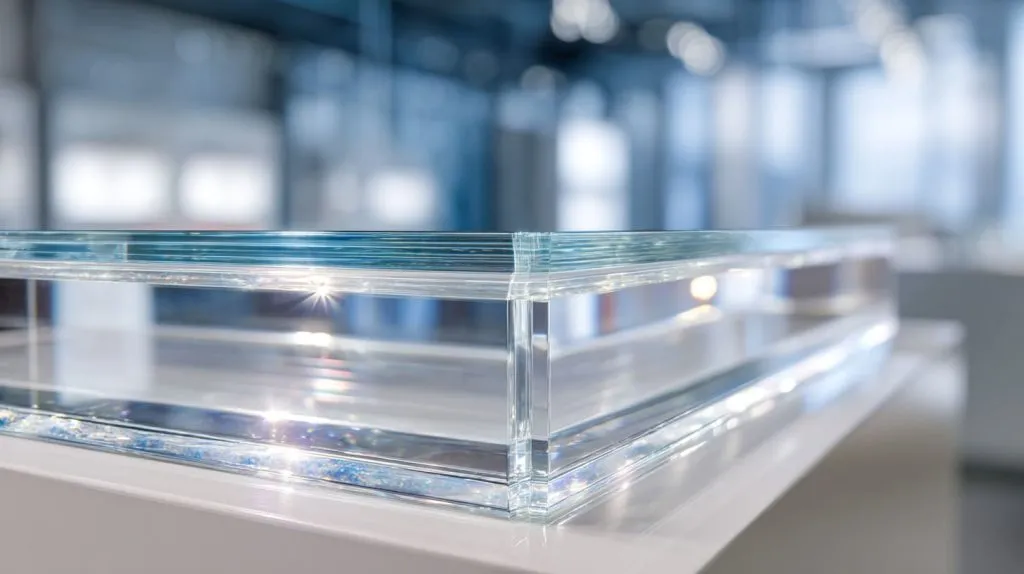
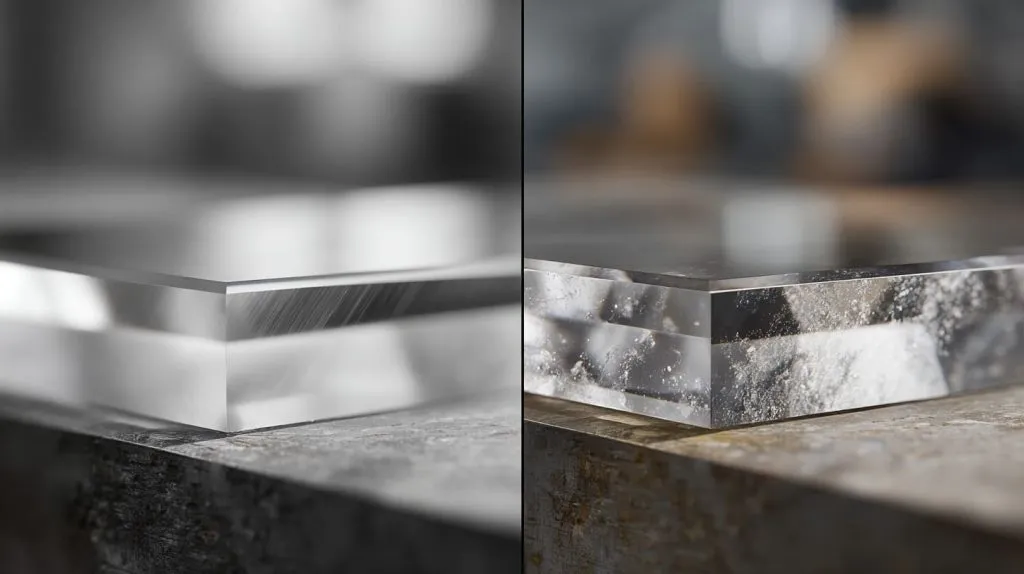
A polished acrylic edge can fool the eye very fast.
I have seen this happen many times in acrylic projects. A buyer receives a sample. The edge is clear. The corner shines. The surface reflects light like glass. Everyone around the table feels good. The product looks expensive, clean, and ready for a premium retail display.
Then the real trouble starts later.
Not during the sample review.
Not during the photo check.
Sometimes not even during the first week after delivery.
The risk hides quietly inside the edge.
That is why polished acrylic edges are a strange topic. They look simple. They look beautiful. They look like a finishing detail. But in real production, edge polishing can become a structural risk if the process is not controlled well.
I have worked with many custom acrylic displays, boxes, stands, cosmetic organizers, and store fixtures. I have learned one thing the hard way: a beautiful acrylic edge does not always mean a safe acrylic edge.
A polished edge can hide:
- small internal stress
- micro cracks
- stress whitening
- solvent crazing
- shipping damage risk
- screw pressure problems
- corner weakness
- long-term cracking after assembly
For a product designer or buyer like Jacky, this is not a small detail. He has seen many samples from China factories. He knows how good photos can look. He also knows that real products must survive packing, shipping, installation, cleaning, and daily use.
That is where polished acrylic edges become tricky.
A showroom sample only needs to look good.
A real product needs to stay good.
The gap between these two is where many failures begin.
In my own factory work, I do not judge a polished acrylic edge only by how clear it looks under light; I also ask where the product will be used, how it will be assembled, and what kind of pressure the edge will carry later.
That small question changes the whole decision.
So in this article, I want to talk about why polished acrylic edges look so attractive, what happens inside the material, why edge failure often comes late, and how experienced buyers can reduce the risk before mass production.
Not every polished edge is bad.
But every polished edge deserves respect.
Acrylic is beautiful, yes.
But it also remembers stress.
And sooner or later, stress likes to speak.
Why Do Polished Acrylic Edges Look So Attractive?

A polished acrylic edge has a special kind of charm.
It catches light. It gives the product a clean outline. It makes a simple acrylic box look more expensive than it really is. I understand why buyers love it. I also understand why factories love showing it in sample photos.
A dull edge feels unfinished.
A clear polished edge feels complete.
That is the emotional trap.
Acrylic is often selected because it can offer a glass-like look with lighter weight and easier processing. So when the edge is polished, the whole product feels more “premium.” This is especially true for cosmetic displays, jewelry stands, luxury retail fixtures, and transparent storage boxes.
Visual clarity creates a “high-end” impression
A clear polished edge gives the product a deep, shiny look. It makes the acrylic sheet feel thicker and richer. When light passes through the edge, the product can look almost like crystal.
This matters a lot in retail.
In a store, customers do not study material stress. They notice shine. They notice clarity. They notice whether the display makes the product feel valuable.
For example, a lipstick display with polished edges can make the lipstick tubes look cleaner and more elegant. A perfume stand with clear edges can make the brand feel more expensive. A museum display cover with polished edges can reduce visual distraction.
The edge becomes part of the selling feeling.
But here is the uncomfortable part.
The customer sees beauty.
The material feels stress.
Those two things are not always moving in the same direction.
| Visual Benefit | Why Buyers Like It | Hidden Question I Ask |
|---|---|---|
| Clear edge | Looks like glass | Was heat stress created during polishing? |
| Shiny corner | Feels premium | Is the corner too sharp? |
| Smooth surface | Looks clean in photos | Will it crack during shipping? |
| Luxury appearance | Helps retail display value | Will cleaners or alcohol touch it later? |
A polished edge is like a nice suit. It gives a strong first impression. But a nice suit does not tell me whether the person can carry heavy boxes all day.
The same idea applies here.
Flame polishing improves perceived product value
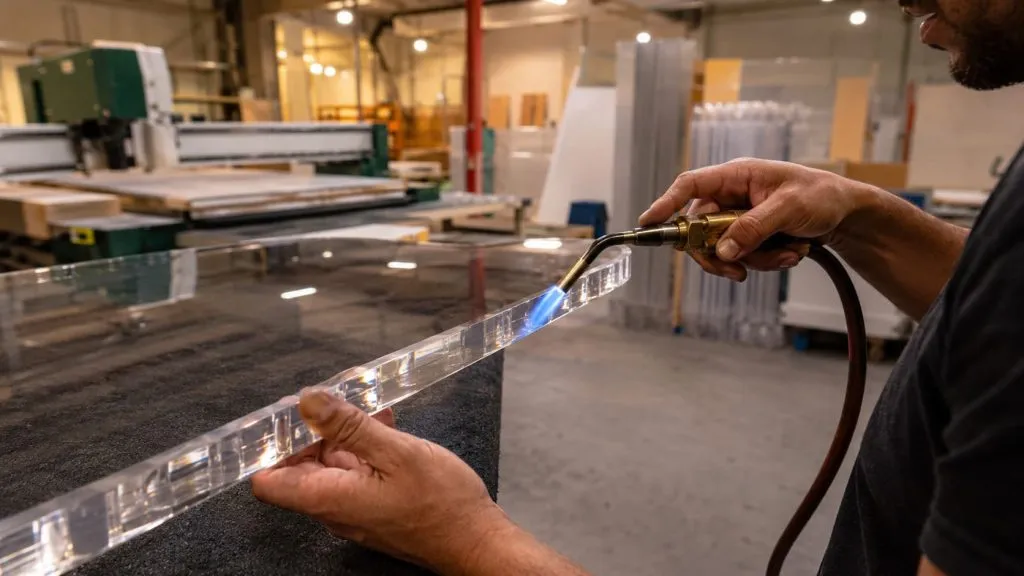
Flame polishing is common because it is fast and visually effective.
The edge is exposed to flame. The surface melts slightly. The rough cutting marks become smoother. The edge turns clear. For many products, this gives a quick “wow” effect.
For factories, flame polishing is attractive because it can improve appearance without too much extra cost. Compared with more controlled finishing methods, it can be faster. That matters when a project has a tight price target or short lead time.
I do not blame factories for using it.
I also do not blame buyers for liking it.
The problem starts when flame polishing is used as a universal solution. Some suppliers treat it like magic. Cut the sheet, flame the edge, make it shine, take a photo, send the sample.
Nice and simple.
Too simple.
Buyers often judge samples mainly by appearance
Sample approval is dangerous because samples are often judged in a comfortable environment.
The sample sits on a clean desk.
The buyer checks the transparency.
The sales team takes a photo.
Everyone zooms in and says, “Looks good.”
But the sample has not yet lived a real life.
It has not been packed in a carton.
It has not crossed the ocean.
It has not sat inside a hot warehouse.
It has not been cleaned with alcohol.
It has not been assembled by a worker who tightens screws a little too much.
This is what I sometimes call the beautiful sample problem.
The sample tells one story.
Mass production tells another.
A polished edge can pass the first story very easily.
The second story is harder.
I once saw a buyer approve a very shiny acrylic display sample. The edge looked perfect. The corners looked clean. But the design had small screw holes close to the polished edge. During assembly, the workers tightened the screws by hand. A few pieces showed tiny white marks near the holes. Not all. Just enough to make everyone nervous.
The edge was not the only problem.
The design, assembly pressure, polishing method, and material choice all worked together.
That is usually how failures happen. They do not come from one monster problem. They come from five small decisions standing too close together.
And that leads us to the next question: what is really happening inside that shiny edge?
What Actually Happens Inside a Polished Acrylic Edge?
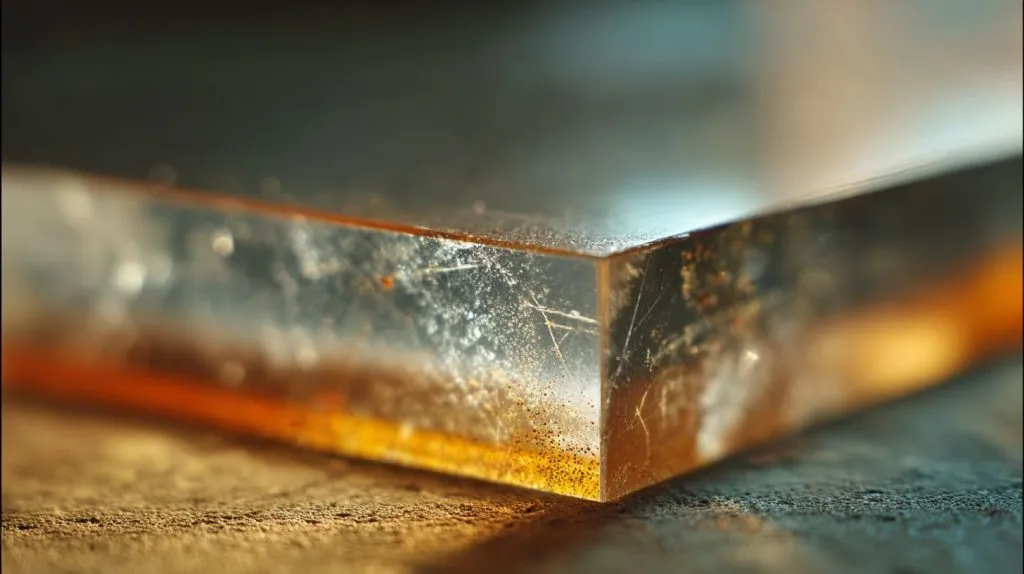
A polished acrylic edge looks calm from the outside.
Inside, it may not be calm at all.
Acrylic is sensitive to heat, pressure, chemicals, and sharp geometry. When we cut, machine, drill, polish, glue, bend, or assemble it, we can create stress inside the material. Some stress is normal. The key question is whether that stress stays within a safe range.
With polished edges, the tricky part is this: the edge can look better while the internal condition becomes worse.
That sounds strange. But in production, it is very real.
When I check polished acrylic parts, I pay attention to the edge zone first because the edge is where cutting marks, heat, handwork, and assembly pressure often meet in one small area.
Flame polishing changes the acrylic surface structure
Flame polishing uses heat. That heat changes the surface of the acrylic edge.
The outside layer softens for a very short time. The surface flows slightly. Small tool marks become less visible. Light can pass through more cleanly. That is why the edge becomes transparent.
But heat is not polite.
It does not only improve appearance. It also changes the stress condition near the edge. If the flame is too strong, too slow, too close, or repeated too many times, the acrylic can receive more heat than it should.
This can create:
- local heat stress
- uneven shrinkage
- micro-level surface deformation
- brittle edge zones
- hidden weak points near corners
Think of it like cooking sugar. A little heat gives a smooth shine. Too much heat changes the whole structure. Acrylic is not sugar, of course, but the feeling is similar. Timing matters. Distance matters. Skill matters.
A good worker knows this.
A careless worker only sees whether the edge turns clear.
That difference matters more than many people think.
Internal stress becomes trapped inside the material
Internal stress is difficult because it is often invisible.
A product can leave the factory looking perfect. Then after a few weeks, cracks appear. The buyer asks, “Why did it crack now? It was fine before.”
That question is painful because the answer may be: the risk was already there.
It was just waiting.
Stress can stay trapped inside acrylic after cutting, drilling, polishing, bonding, or forming. When another trigger appears, that stress can finally release as cracking, crazing, or whitening.
Common triggers include:
- shipping vibration
- pressure from screws
- temperature change
- alcohol cleaning
- glue contact
- heavy load
- tight packaging
- poor corner design
The polished edge becomes the weak door.
The trigger knocks.
The crack walks in.
| Process Step | Possible Hidden Stress | Later Trigger |
|---|---|---|
| Laser cutting | Heat-affected edge | Solvent or bending pressure |
| CNC cutting | Tool marks and edge stress | Screw pressure |
| Flame polishing | Heat stress | Temperature cycle |
| Drilling near edge | Stress concentration | Assembly tightening |
| Gluing | Chemical stress | Cleaning or handling |
A polished edge is not always the root cause. But it often becomes the place where the problem shows itself.
Different acrylic materials react differently
Not all acrylic behaves the same way.
Cast acrylic and extruded acrylic can react differently to heat and stress. In many custom projects, cast acrylic is preferred for better clarity, machining behavior, and stability. Extruded acrylic can be more economical and useful for some applications, but it may be more sensitive in certain cutting, polishing, and solvent conditions.
The material grade also matters.
Good acrylic sheet gives the process more safety space.
Cheap material gives the process less forgiveness.
That is why two samples can look similar at first, but behave very differently later.
I have seen buyers compare only the visible result. Same thickness. Same size. Same polished edge. Same clear look.
But inside the material, the story may be different.
| Material Factor | Better Condition | Higher Risk Condition |
|---|---|---|
| Sheet quality | Stable, clean acrylic | Mixed or unstable material |
| Material type | Suitable cast acrylic for the job | Wrong material selected for price only |
| Thickness consistency | More predictable processing | Uneven stress behavior |
| Internal stress from sheet | Lower | Higher before fabrication starts |
Acrylic does not forgive bad choices forever.
It may stay quiet for a while.
But it keeps the receipt.
Now we can look at why this becomes a hidden failure risk in actual products.
Why Can Polished Edges Become a Hidden Failure Risk?
The word “hidden” is important here.
If a polished edge failed immediately, everyone would notice. The factory would reject it. The buyer would ask for changes. The issue would be obvious.
But many polished edge failures do not appear right away.
They appear later.
That is what makes them expensive.
A delayed crack is worse than a visible defect because it can pass inspection, enter shipping, reach the client, and fail in the final market.
The painful part is not only the broken product. It is the broken trust.
Before I approve polished edges for a product with holes, corners, glue, or heavy load, I always ask myself one plain question: will this edge still be safe after the product has been touched, packed, cleaned, moved, and assembled by real people?
Cracks may appear weeks or months later
Delayed cracking can happen when internal stress meets the right trigger.
The product may look fine after production. It may even pass normal visual inspection. But during storage or transport, temperature and vibration can work on the weak edge. The crack may start very small. It may look like a thin line. Then it grows.
This is especially risky for export orders.
Acrylic parts often travel far. They go through:
- factory packing
- truck loading
- container shipping
- warehouse storage
- unpacking
- installation
- retail use
Each step adds a little stress.
A weak polished edge may survive the first step and fail at the fifth.
That is why buyers sometimes feel confused. They may say, “The cartons were not badly damaged. Why did the acrylic crack?”
Because the carton was not the whole story.
The edge was already nervous.
Shipping just gave it a push.
Assembly pressure amplifies edge weakness
Assembly pressure is one of the most common hidden killers.
Acrylic products often use screws, slots, pins, metal brackets, glue, or interlocking parts. If the polished edge is close to a screw hole or cutout, stress can gather in that area.
A worker may tighten a screw just a little more.
A metal fitting may press against the acrylic.
A slot may be too tight.
A sharp inside corner may hold stress like a trap.
Then the polished edge starts to show whitening or small cracks.
This is not always a worker mistake. Sometimes the design gives the worker no room to succeed.
| Design Feature | Risk Near Polished Edge | Safer Thinking |
|---|---|---|
| Screw hole close to edge | Cracking from pressure | Increase distance or add washer |
| Sharp inner corner | Stress concentration | Add radius |
| Tight slot | Pressure during assembly | Add tolerance |
| Metal-to-acrylic contact | Local stress | Use soft gasket or spacer |
| Heavy panel load | Edge bending stress | Improve support |
I always feel a little uneasy when a drawing asks for a bright polished edge and also places holes very close to that edge.
That is like asking someone to wear shiny shoes and run on wet stairs.
Maybe it works.
Maybe it does not.
But the risk is obvious.
Solvents and cleaners can trigger crazing
Crazing is one of those words that sounds small until it happens on a finished product.
It appears as tiny cracks or cloudy lines. It often looks like the acrylic has become dry or damaged from inside. Polished edges can be sensitive to solvent contact if stress already exists.
Common triggers include:
- alcohol cleaners
- some glues
- chemical vapors
- strong cleaning liquids
- perfume or cosmetic liquids
- certain packaging materials
This matters a lot for cosmetic displays.
Think about where those displays live.
They sit near perfume, makeup, lotion, alcohol wipes, and daily cleaning routines. A beautiful polished edge may look perfect in the factory, but it may suffer in a cosmetics retail store if the edge has hidden stress.
Acrylic does not like every chemical.
A stressed acrylic edge likes chemicals even less.
Thermal expansion increases long-term instability
Acrylic expands and contracts with temperature changes. That is normal. But when a polished edge already has stress, temperature cycles can make the problem worse.
This can happen during:
- container shipping
- warehouse storage
- outdoor use
- LED lighting applications
- areas near heat sources
- stores with strong spotlights
LED display projects are a good example.
Acrylic near LEDs can face both heat and light. If the edge is polished and under stress, long-term exposure can increase the chance of cracking or deformation.
Acrylic wants room to move.
Bad design gives it no room.
Then the edge pays the price.
The thing that looks like a small finishing detail now becomes a product life problem. And this is why we need to compare flame polishing with more controlled edge methods.
Why Are Flame-Polished Edges More Vulnerable Than Machined Edges?
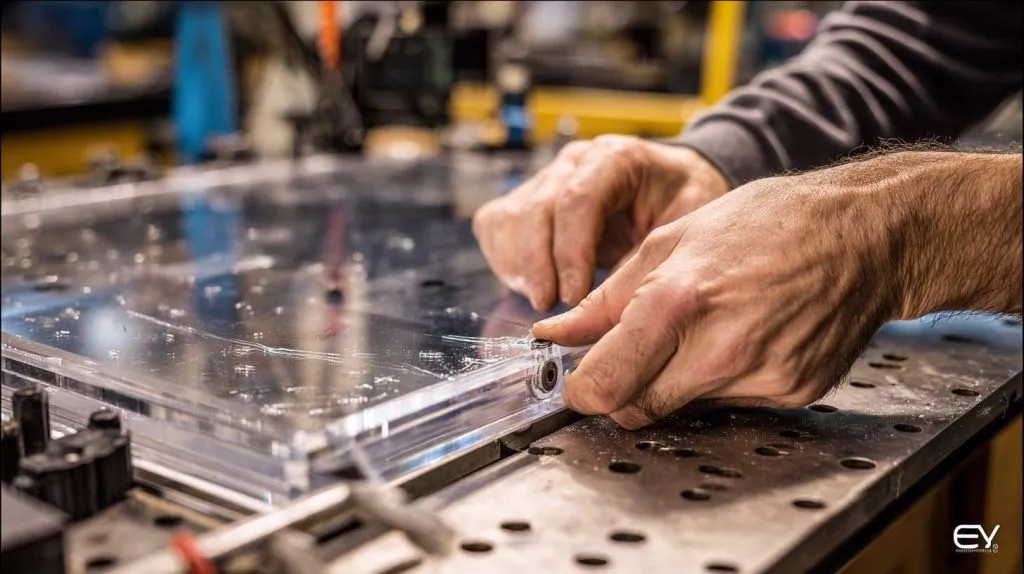
Flame-polished edges and machined edges are not only different in appearance.
They are different in how they treat the material.
Flame polishing uses heat to improve clarity. Machining uses controlled cutting or polishing tools to shape and finish the edge. Each method has a place. But they do not carry the same risk.
A flame-polished edge can look very clear. A properly machined or diamond-polished edge can also look clean, but it usually gives better control.
The decision is not “which one looks better in a photo.”
The decision is “which one fits the product risk.”
For engineering parts, I tend to trust a stable edge more than a dramatic shiny edge because customers do not complain when an edge is slightly less flashy, but they complain loudly when cracks appear after installation.
Machined edges keep better structural stability
A machined edge can be made with cutting, sanding, buffing, diamond polishing, or other controlled finishing methods. The exact process depends on the product and quality target.
The main advantage is control.
A good machined finish can reduce tool marks and avoid excessive heat. It can also keep the edge geometry more predictable. This matters for parts that need tight assembly, long service life, or repeated handling.
Machined edges are often better for:
- engineering displays
- thick panels
- load-bearing acrylic parts
- parts near screw holes
- long-life retail fixtures
- premium custom boxes
- museum covers
- furniture parts
This does not mean machined edges are perfect. Poor machining can also create stress. Bad tools, wrong feed speed, or rough sanding can damage the edge.
But the process can be controlled more carefully.
That control is the real value.
Flame polishing prioritizes appearance over durability
Flame polishing is often chosen because it gives fast beauty.
It can be the right choice for many decorative products. But if a factory uses it only because it makes photos look good, that is a problem.
Appearance is easy to sell.
Durability is harder to explain.
This creates a pricing trap. A supplier may offer a polished-edge product at a very attractive price. The sample looks good. The buyer compares quotes. The cheaper one wins.
But the quote may not include:
- proper edge preparation
- stress control
- annealing
- material selection
- extra inspection
- safe packaging
- better design review
So the buyer saves money at the beginning and may pay later through returns, complaints, or replacement shipments.
| Edge Method | Main Strength | Main Risk | Best Use |
|---|---|---|---|
| Flame polishing | Fast clear appearance | Heat stress | Low-stress decorative parts |
| Diamond polishing | Clean and controlled finish | Higher cost | Premium and long-life products |
| Sanded matte edge | Stable and simple | Less glossy | Industrial or practical parts |
| Buffed edge | Smooth appearance | Quality depends on skill | Medium-grade display parts |
Flame polishing is not the villain.
Blind flame polishing is the villain.
Thick acrylic reacts differently from thin acrylic
Thickness changes everything.
Thin acrylic edges heat quickly. Thick acrylic edges may need more flame time to become clear. More flame time can mean deeper heat influence. If the worker is not careful, the surface may look good while deeper stress remains.
Thick acrylic also carries more weight. A thick panel may be used in larger boxes, furniture parts, luxury displays, or heavy covers. These products face more force during handling and shipping.
That makes edge quality more important.
A thick polished edge can look beautiful, almost like crystal. But that beauty can hide a more serious stress story.
For thick acrylic, I usually become more cautious about:
- flame distance
- polishing speed
- corner design
- annealing
- packing support
- edge load
- screw locations
A thick acrylic panel with a bad polished edge is not just a cosmetic problem.
It is a heavy object with a weak border.
That is a different level of risk.
And now, let us talk about where this risk appears most often.
Which Acrylic Products Commonly Suffer From Edge Failures?

Not all acrylic products face the same edge risk.
A small decorative sign may never experience serious pressure. A large acrylic display case may face daily handling, cleaning, and shipping stress. A museum cover may need to stay clear and stable for years. A cosmetic organizer may meet alcohol and perfume every day.
The product environment decides how much risk the polished edge must carry.
When I review a project, I do not only ask what the acrylic product is; I ask how people will touch it, clean it, move it, install it, and sometimes misuse it.
Acrylic display cases and cosmetic organizers
Display cases and cosmetic organizers often use polished edges because the visual effect matters.
Customers want clean, transparent edges. Brands want their products to look premium. Retail buyers want the display to make the product shine, not steal attention.
But these products face daily contact.
Acrylic cosmetic organizers may touch:
- perfume bottles
- makeup powder
- lotion
- alcohol wipes
- cleaning sprays
- hands with skincare products
- metal caps or glass bottles
That environment is not gentle.
If the polished edge has stress, chemical exposure can trigger crazing. If the organizer has tight slots or assembled pieces, pressure can create small cracks around joints.
A cosmetic organizer may look like a simple item.
It is not always simple.
It lives in a chemical-rich world.
LED light guide panels and illuminated signs
LED acrylic products bring another challenge: heat.
Acrylic is often used in light guide panels, illuminated signs, and edge-lit displays. Polished edges may help with light transmission and appearance. But heat buildup near LEDs can increase long-term stress.
The risk can be worse if:
- LEDs are too close to the edge
- heat is not managed
- the panel is tightly fixed
- the edge was flame polished too aggressively
- the acrylic has no room to expand
- the product is used for long hours
| LED Product Condition | Possible Edge Risk |
|---|---|
| Long operating hours | Heat stress builds over time |
| Tight frame | Acrylic cannot expand freely |
| Poor ventilation | Temperature rises |
| Strong edge polishing | Hidden stress near light source |
| Thin support design | Edge carries extra load |
A lighted acrylic product can look amazing during testing.
The question is whether it still looks amazing after six months of heat and cleaning.
That is the part I care about.
Large acrylic boxes and furniture panels
Large acrylic parts are risky because size adds stress.
A small acrylic box can be easy to control. A large acrylic box is different. The panels are heavier. The edges carry more load. The corners face more force during shipping and installation.
Large acrylic furniture panels can also face bending, vibration, and user pressure. People may lean on them. Workers may drag them during setup. The product may twist slightly during transportation.
If the edge is polished but not stable, cracks can appear near corners or along bonded seams.
This is why large acrylic projects need more than a pretty edge.
They need:
- correct thickness
- proper bonding
- safe corner radius
- strong packaging
- controlled polishing
- stress relief when needed
- realistic handling planning
A large acrylic box should not be designed like a small gift box.
That mistake can be expensive.
Museum and luxury retail displays
Museum displays and luxury retail displays often demand excellent appearance. The edges must look clean. The transparency must be high. The finish must feel premium.
But these products also need long service life.
That creates a trade-off.
A museum cover cannot crack after a few months. A luxury retail display cannot show crazing under store lights. Replacement cost is not only the product cost. It includes installation, downtime, brand image, and sometimes overseas shipping again.
For these projects, I prefer to slow down the decision.
A polished edge may still be used. But the process must be chosen carefully.
| Product Type | Appearance Demand | Failure Cost | Edge Strategy |
|---|---|---|---|
| Temporary event display | High | Low to medium | Flame polishing may be okay |
| Cosmetic organizer | High | Medium | Test for cleaner exposure |
| Large acrylic box | High | High | Better edge control needed |
| Museum display | Very high | Very high | Use premium process and testing |
| Luxury retail fixture | Very high | High | Balance beauty and service life |
The more expensive the failure, the less I trust appearance alone.
And that brings us to the factory side. How can a good factory reduce polished edge risks before they become client problems?
How Do Experienced Factories Reduce Polished Edge Risks?

A good acrylic factory does not treat edge polishing as a final beauty step only.
It treats it as part of the whole product risk plan.
The edge connects cutting, material, design, assembly, packaging, and final use. If one part is careless, the edge may show the failure.
In my work, I feel more confident when the polishing decision comes after the product use is understood, not before.
Annealing after polishing
Annealing is a stress relief process.
In simple words, the acrylic part is heated in a controlled way and then cooled slowly. This helps reduce internal stress. It does not make bad design good. It does not fix every mistake. But it can reduce the chance of delayed cracking or crazing in some products.
Annealing takes time, space, energy, and planning.
That is why some low-cost suppliers skip it.
They may think, “The product looks fine. Why add another step?”
That thinking can work for low-risk products. But for high-risk polished edges, it can be dangerous.
Annealing is especially worth considering when:
- the product has thick acrylic
- the edge is heavily polished
- the part will be glued
- the part has holes near edges
- chemical exposure is possible
- the product is expensive to replace
- the buyer needs long service life
| Project Condition | Annealing Value |
|---|---|
| Simple decorative sign | May not be needed |
| Thick polished acrylic block | Often useful |
| Glued display case | Worth checking |
| Cosmetic display exposed to cleaners | Strongly worth testing |
| Engineering acrylic part | Often important |
| Low-cost temporary display | Depends on budget |
Annealing is not a marketing word to me.
It is a risk control step.
Better edge geometry design
Edge geometry can either reduce stress or invite stress.
Sharp corners are risky. Tight inside corners are risky. Holes too close to polished edges are risky. Thin bridges between cutouts are risky.
A small radius can make a big difference.
I often see drawings where the designer wants a perfect sharp corner because it looks clean in 3D. But acrylic is a real material. It does not care about the 3D render. It cares about stress.
Good edge design may include:
- rounded corners
- enough distance from holes to edge
- smooth transitions
- wider support areas
- less sharp internal cuts
- correct tolerance for slots
- washers or soft spacers for screws
| Design Choice | Risk Level | Better Option |
|---|---|---|
| Sharp outside corner | Medium | Small radius |
| Sharp inside corner | High | Larger radius |
| Screw very close to edge | High | Move hole inward |
| Tight slot | Medium to high | Add clearance |
| Heavy part supported by edge only | High | Add support structure |
Sometimes the safest edge is not created by polishing.
It is created by better geometry.
That is a design lesson many people learn too late.
Using proper polishing methods for different applications
There is no single best polishing method for every product.
That is the honest answer.
Flame polishing can be good for certain decorative parts. Diamond polishing can be better for premium products. Sanding or matte finishing can be safer for industrial products where appearance is less important than function.
The right method depends on:
- product use
- material thickness
- edge load
- visual requirement
- cleaning environment
- budget
- quantity
- expected lifespan
| Application | Suggested Edge Thinking |
|---|---|
| Temporary retail display | Flame polishing may be acceptable |
| Premium cosmetic display | Test flame or use better finishing |
| Museum cover | Prefer controlled premium process |
| Industrial cover | Matte or machined edge may be safer |
| Thick acrylic block | Avoid aggressive flame polishing |
| Parts with screw holes | Reduce stress before chasing shine |
A buyer may ask, “Can you make the edge polished?”
The better question is, “Which polishing method fits this product?”
That question sounds small.
But it can save a project.
Material selection matters more than many buyers realize
Material quality is the foundation.
If the acrylic sheet already has high internal stress or unstable composition, the edge finishing process becomes harder to control. Good material gives us more room. Poor material gives us fewer chances.
For many export projects, I prefer stable, high-transparency acrylic from trusted sources. It is not only about clarity. It is about predictable behavior during cutting, polishing, bonding, packing, and use.
Cheaper material may reduce the unit cost.
But it can raise the failure risk.
This is a common B2B trade-off.
| Buyer Focus | Hidden Factory Concern |
|---|---|
| Lowest sheet cost | Higher stress risk |
| Best visual clarity | Need stable material and process |
| Fast delivery | Less time for stress relief |
| Thin budget | Fewer process options |
| Premium retail use | Better material is worth it |
A good edge starts before polishing.
It starts when the right sheet is chosen.
That is why I never like choosing acrylic only by price per kilogram. That number tells me something, but it does not tell me the whole story.
Next, let us move to the buyer side. How can buyers catch edge problems before mass production?
How Can Buyers Detect Hidden Edge Problems Before Mass Production?
A buyer does not need to become a materials scientist.
But a buyer should not judge polished acrylic edges by photos only.
Photos are useful. Videos are useful. Samples are useful. But hidden stress needs better questions and simple tests.
For important projects, I like to turn edge approval into a small risk check, not just a visual check.
My own rule is simple: if the product will be polished, assembled, shipped overseas, and used for a long time, I want at least one test that tries to make the hidden weakness show itself before production starts.
Cross-polarization stress testing
Cross-polarization testing can help reveal stress inside transparent plastic parts.
The idea is simple. Under polarized light, stressed areas can show color patterns or bright lines. This helps engineers see areas that may carry higher internal stress.
This is especially useful near:
- polished edges
- drilled holes
- corners
- glued joints
- bent areas
- machined cutouts
Not every buyer will request this test for every project. That would be too much. But for high-value or high-risk acrylic products, it can be a useful check.
It helps answer a better question:
Not “Does the edge look clear?”
But “Is the edge quietly stressed?”
That is a more serious question.
Solvent resistance testing
Solvent testing can expose weak polished edges faster.
This must be done carefully because solvents can damage acrylic. The point is not to abuse the product randomly. The point is to simulate risks that may happen in real use.
For example, if a cosmetic display may be cleaned with alcohol wipes, the sample should be tested in a controlled way. If a product may contact glue vapor, that should be considered. If a retail display sits near perfume or skincare liquids, the edge should not be judged only in a clean office.
Possible test ideas include:
- controlled alcohol wipe test
- cleaner contact test
- glue vapor risk check
- edge observation after 24 to 72 hours
- checking for crazing near polished edges
| Test | What It Helps Reveal |
|---|---|
| Alcohol wipe test | Chemical sensitivity |
| Cleaner exposure | Real retail cleaning risk |
| Glue vapor check | Bonding-related stress risk |
| Delayed observation | Slow crazing or cracking |
| Edge comparison | Difference between polishing methods |
Acrylic failures often need a trigger.
Testing gives the trigger early, before the product enters the market.
That is much cheaper than learning from customer complaints.
Shipping and vibration simulation
Many acrylic products look perfect before packing.
Then shipping happens.
Shipping is not gentle. Even with good cartons, products face vibration, pressure, stacking, temperature change, and handling shock.
For polished edges, packaging matters a lot.
Good packaging should avoid:
- direct edge pressure
- panel movement inside carton
- corner impact
- tight wrapping that bends parts
- hard contact between acrylic pieces
- heavy loading on polished edges
A simple shipping simulation can help. It may include drop testing, vibration testing, or practical carton movement checks. The level depends on order value and product risk.
For fragile acrylic products, I care about packaging almost as much as polishing.
A strong edge can still fail in bad packaging.
A weak edge almost certainly will.
Ask the supplier the right technical questions
Buyers can reduce risk by asking better questions early.
Not aggressive questions.
Smart questions.
Here are some I like:
| Buyer Question | Why It Matters |
|---|---|
| What polishing method will be used? | Different methods create different stress levels |
| Is flame polishing necessary for this product? | Sometimes it is only chosen for appearance |
| Was annealing performed or recommended? | Shows whether stress relief was considered |
| What acrylic material grade is used? | Material stability affects edge risk |
| Are holes or corners close to polished edges? | Design may increase cracking risk |
| Can you test cleaner or solvent exposure? | Useful for retail and cosmetic displays |
| How will polished edges be protected in packing? | Shipping damage often starts at edges |
A good supplier will not be offended by these questions.
A good supplier will respect them.
Because these questions show the buyer understands real production.
And sometimes, after all this, flame polishing is still the right choice. So let us be fair.
When Is Flame Polishing Still the Right Choice?
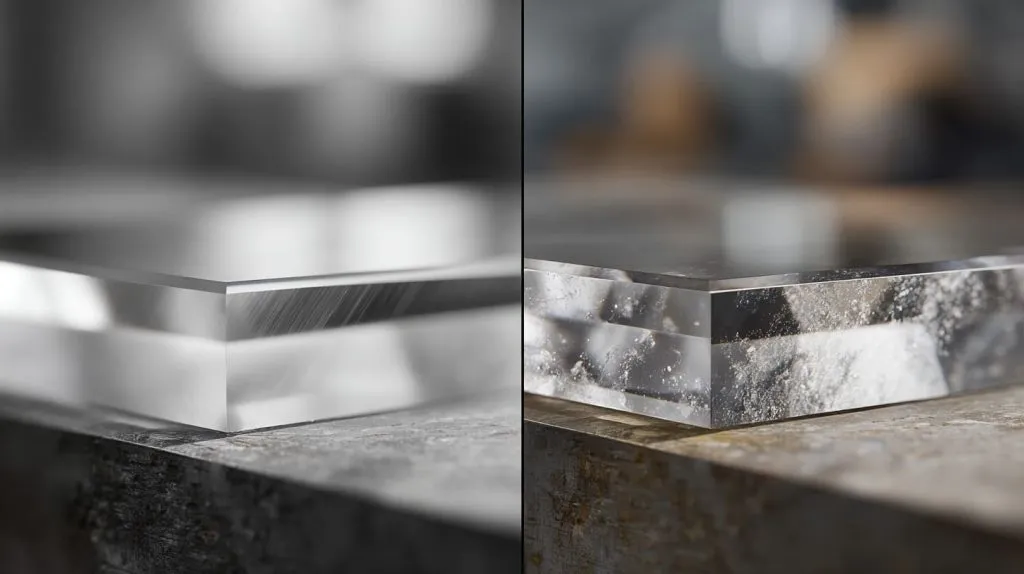
Flame polishing is not bad by itself.
I want to say that clearly.
A lot of acrylic products use flame polishing successfully. It can create a clean visual effect at a reasonable cost. It can be efficient. It can be suitable for many display products.
The problem is not the method.
The problem is using the method without thinking.
When cost, appearance, and product risk are balanced properly, flame polishing can still make sense.
I choose flame polishing more comfortably when the product is decorative, low-stress, not heavily assembled, and not expected to survive harsh cleaning or heavy loading.
Low-stress decorative applications
For low-stress decorative parts, flame polishing can be a practical choice.
Examples include:
- small display signs
- decorative acrylic name blocks
- simple retail risers
- light-duty presentation stands
- short-term product displays
- small clear accessories
These products do not carry heavy loads. They may not have screw pressure near the edge. They may not face strong chemicals. They may be used indoors for visual display only.
In this case, the benefit is clear.
The buyer gets a polished look without paying for a more expensive edge process.
That is reasonable.
Not every product needs museum-grade finishing.
Sometimes a simple, beautiful edge is enough.
Projects where appearance matters more than lifespan
Some displays are temporary.
Event displays, exhibition props, seasonal retail fixtures, and short campaign displays may only need to look excellent for a limited time.
For these projects, flame polishing may be a smart choice because the product’s life goal is different.
A display used for two weeks at a trade show does not need the same edge strategy as a museum case used for five years.
That is common sense.
But it is easy to forget when everyone wants the “best” finish.
Best for what?
Best for photos?
Best for cost?
Best for long-term use?
Best for fast delivery?
Different answers lead to different edge choices.
| Project Type | Flame Polishing Fit |
|---|---|
| Short-term event display | Often good |
| Indoor decorative sign | Usually acceptable |
| Heavy load display case | Needs caution |
| Cosmetic display exposed to cleaners | Needs testing |
| Premium long-life fixture | Consider better process |
| Thick acrylic furniture part | Be careful |
The product’s real life should decide the edge finish.
Not only the sample photo.
Situations where controlled polishing works well
Flame polishing can work well when the factory controls the process.
Control means:
- proper flame distance
- correct speed
- clean edge preparation
- suitable acrylic material
- trained workers
- no over-burning
- stress relief when needed
- inspection after polishing
Good flame polishing is not just waving fire along an edge.
It is a skill.
The worker must know when to stop.
That sounds simple, but it is not always easy in mass production. When orders are large and deadlines are tight, process control becomes the difference between a good batch and a risky batch.
Acrylic rewards patience.
It punishes rushing.
That is why I still use flame polishing when it fits, but I do not worship it. Shine is useful. Stability is better.
Now let us look at the safer choices when long-term reliability matters more.
What Is the Better Alternative for Long-Term Reliability?

If the product must last, the edge strategy should become more serious.
Long-term acrylic products need more than a shiny first impression. They need stable processing, smart design, and honest trade-offs.
A better alternative does not always mean the most expensive method. It means the method that fits the real risk.
For long-service acrylic products, I often accept a slightly higher edge cost if it reduces the chance of cracks, returns, and uncomfortable emails later.
Diamond polishing can create a clear, clean edge with better process control than aggressive flame polishing.
It is often used for premium acrylic products where appearance and durability both matter. The cost can be higher, and the process may need better equipment. But for certain projects, that cost is easier to accept than failure.
Diamond polishing can be useful for:
- premium retail displays
- luxury product stands
- thick acrylic blocks
- museum covers
- high-end acrylic boxes
- engineering display parts
- products with longer service requirements
It is not perfect. It still needs good material and good design. But it often gives a better balance between clarity and stability.
| Factor | Flame Polishing | Diamond Polishing |
|---|---|---|
| Visual clarity | High | High |
| Process speed | Fast | Slower |
| Cost | Lower | Higher |
| Heat stress risk | Higher if uncontrolled | Lower |
| Consistency | Worker-dependent | More controlled |
| Best use | Decorative low-stress parts | Premium long-term parts |
If the product is expensive to replace, better edge control is not a luxury.
It is insurance.
Satin or matte edges in industrial applications
Not every acrylic product needs glossy edges.
For some industrial or practical products, satin or matte edges can be better. They may not look as “luxury” as polished edges, but they can reduce the pressure to chase perfect transparency.
Industrial buyers often care more about:
- fit
- safety
- durability
- easy assembly
- stable tolerance
- lower cracking risk
- lower maintenance
A matte edge can also hide minor handling marks better than a glossy edge. That matters for products that will be touched, moved, or installed often.
Sometimes the less glamorous finish is the smarter finish.
That is a hard truth in manufacturing.
A beautiful surface can become a maintenance problem.
A practical finish can quietly do its job for years.
Designing around edge vulnerability
The best solution is not always a different polishing method.
Sometimes the best solution is better design.
Good design can reduce how much stress the edge must carry. This is especially important for large acrylic products, assembled displays, and export orders.
Useful design ideas include:
- move screw holes away from edges
- add corner radius
- avoid sharp internal corners
- use washers or soft spacers
- add support under heavy panels
- allow thermal expansion
- reduce tight slots
- avoid over-reliance on glued polished edges
- improve packaging around corners
| Risky Design | Better Design Direction |
|---|---|
| Screw near polished edge | Move screw inward |
| Sharp 90-degree inside cut | Add radius |
| Heavy panel supported by edge | Add frame or base support |
| Tight acrylic slot | Add clearance |
| Glossy edge in harsh cleaning area | Use safer finish or test first |
| Large panel with no expansion gap | Add movement allowance |
Acrylic design is not only about shape.
It is about respect for the material.
When the design respects acrylic, polishing becomes easier.
When the design fights acrylic, even a beautiful edge may fail.
And this is where good buyers and good factories meet. The buyer brings the market need. The factory brings the material experience. The best result usually comes from both sides asking better questions early.
Conclusion
Polished acrylic edges are not automatically bad.
I still like them. I still use them. I still understand why buyers ask for them. A clean polished edge can make an acrylic product feel sharp, premium, and carefully made.
But I do not trust shine by itself.
That is the main point.
I have seen too many acrylic products where the edge looked beautiful at first, but the hidden stress showed up later as cracking, whitening, crazing, or shipping damage. The problem was not always one bad worker or one bad sheet. It was often a chain of small decisions.
A sharp corner.
A hole too close to the edge.
A fast flame polish.
No stress relief.
A tight assembly.
A cleaner used in the store.
A carton that pressed on the corner.
Each choice looked small.
Together, they became a failure.
This is why I care so much about polished acrylic edges. I do not see them only as a finishing detail. I see them as a place where design, production, material, and real-world use all meet.
For B2B buyers, especially experienced buyers like Jacky, the lesson is simple:
Do not approve acrylic edges only by appearance. Approve them by use condition, stress risk, material choice, polishing method, and testing.
A beautiful sample is helpful.
But it is not enough.
Ask how the edge was made.
Ask whether the material is suitable.
Ask whether annealing is needed.
Ask how the product will be packed.
Ask what happens when the product is cleaned, assembled, shipped, and used by real people.
That is how serious buyers protect their projects.
At Feilong Acrylic, this is also how I prefer to work. We make custom acrylic products, not catalog items. So I do not want to give every buyer the same answer. A cosmetic organizer, a museum display cover, a large acrylic box, and a temporary event stand should not all receive the same edge solution.
The right edge depends on the product’s real life.
If you are developing a custom acrylic display, box, stand, rack, organizer, or furniture part, and you are not sure whether polished edges are safe for your design, you can send us your drawing, usage details, and target quality level.
I will not only look at whether the edge can shine.
I will look at whether the edge can survive.
That is the difference between a product that looks good in photos and a product that stays good in the customer’s hands.