Skip to content
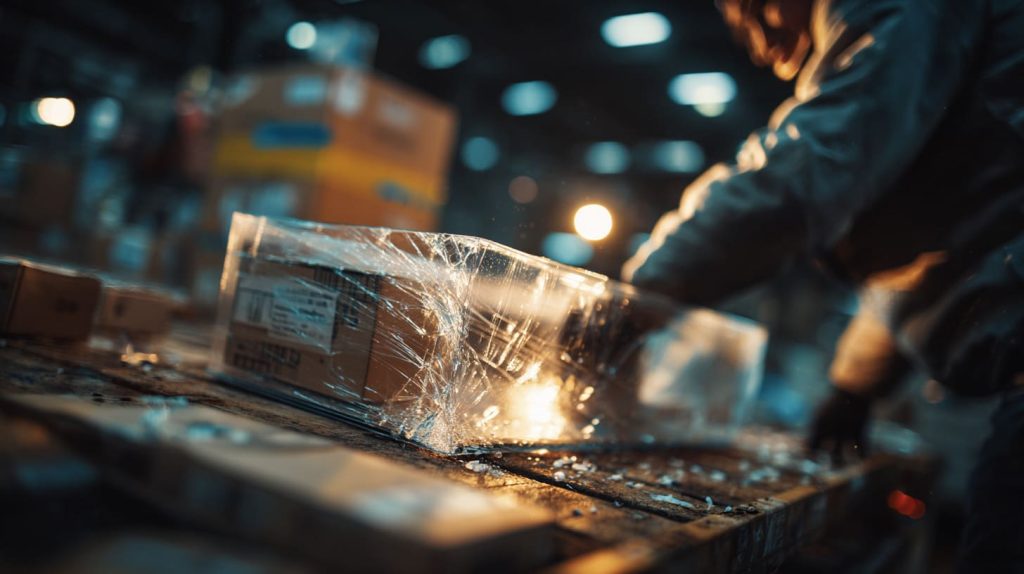
Acrylic products can look perfect inside the factory.
The edges are polished. The glue joints look clean. The surface has no visible scratches. The packaging team checks the cartons one by one. Then the goods leave the factory, travel across the sea, pass through ports, warehouses, trucks, and customs inspection.
A few weeks later, the buyer opens the carton.
One corner has a hairline crack.
One display box has a broken glued edge.
One thick acrylic block has a strange internal stress mark near the polished side.
That moment is painful. I know it because I have seen it from the factory side. The product may pass inspection before loading, but shipping has its own temper. It is like a quiet stress test that does not care about our confidence.
Many people blame packaging first. I understand why. Packaging is easy to see. Foam thickness, carton strength, corner guards, pallet condition — these things are obvious.
But in acrylic products, shipping failure is not only a packaging issue.
The material type also matters.
Cast acrylic and extruded acrylic may look similar to a buyer at first glance. Both are transparent. Both can be cut, polished, glued, and shaped. Both can be used for displays, boxes, frames, racks, organizers, and many other custom products.
But after shipping, they do not always behave the same.
Acrylic material has memory. It remembers heat. It remembers cutting. It remembers bending. It remembers glue. It remembers stress. During shipping, that hidden stress can wake up.
This is why I never judge an acrylic product only by how it looks under factory lights. I also think about how it will survive inside a carton for 30 to 45 days.
For buyers like Jacky, who already understand China manufacturing and custom acrylic projects, this topic is not just technical. It is commercial. A cracked product means replacement cost, delayed selling time, unhappy customers, and sometimes a damaged supplier relationship.
In this article, I want to talk about a very practical question:
Cast vs extruded acrylic: which one fails more often after shipping?
I will not answer it like a material textbook. I will answer it like someone who has handled custom acrylic products, export packaging, buyer complaints, and real production trade-offs.
Because in real business, the question is never only “Which material is stronger?”
The better question is:
Which material is safer for this product, this thickness, this design, this process, and this shipping route?
That is where the real decision begins.
Before I choose acrylic material for export goods, I always ask myself one simple thing: if this product is dropped, squeezed, heated, cooled, and opened by a tired warehouse worker, where will it fail first?
And usually, the answer is hiding in the material before the carton is even closed.
What Is Cast Acrylic?
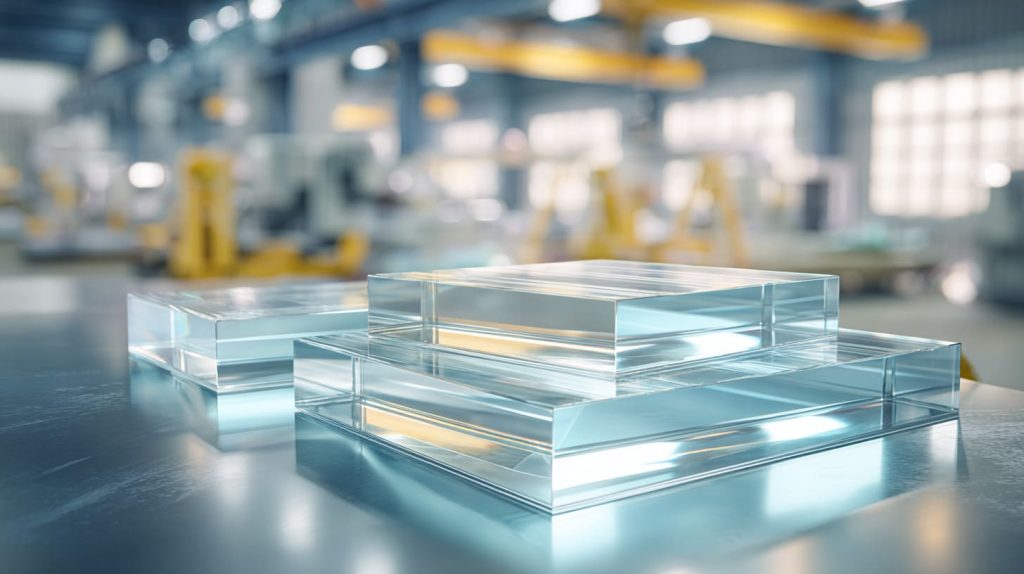
Cast acrylic is the material many people think of when they imagine “high-quality acrylic.”
It usually feels harder. It looks clear. It has a more premium touch. When we make luxury displays, thick blocks, museum-style covers, or high-end boxes, cast acrylic is often the safer choice.
But cast acrylic is not magic. It can still crack. It can still scratch. It can still fail if the design is wrong or the processing is careless.
So I like to look at cast acrylic from three angles: how it is made, how it behaves, and where it makes sense.
How Cast Acrylic Is Manufactured
Cast acrylic is made by pouring liquid MMA between molds or glass plates. Then the material slowly cures into solid acrylic sheet.
This process is slower than extrusion. It is not the fastest way to make acrylic sheet. But the slower process gives cast acrylic one important advantage: better internal stability.
Think of it like cooking.
If you rush a thick piece of food with too much heat, the outside may look done, but the inside may still be uneven. If you cook it slowly, the result is more balanced.
Cast acrylic is similar. The slower process usually creates less internal stress than extruded acrylic.
| Point | Cast Acrylic |
|---|---|
| Production method | Liquid MMA poured into molds |
| Speed | Slower |
| Internal stress | Usually lower |
| Surface hardness | Usually higher |
| Cost | Usually higher |
| Best for | Premium and thick custom products |
For shipping, this matters a lot.
When a product is inside a carton, the material may face vibration, pressure, temperature changes, and small impacts. If the sheet already has high internal stress, those outside forces may turn a small problem into a visible crack.
Cast acrylic usually starts with a calmer internal structure.
That calmness is useful.
Main Characteristics of Cast Acrylic
Cast acrylic usually has strong optical clarity. It also has good surface hardness. It is often more resistant to chemicals and scratches than extruded acrylic.
That does not mean it is impossible to damage. Acrylic is still acrylic. A sharp metal part, rough packaging, or sand-like dust can still scratch the surface.
But when buyers care about premium appearance, cast acrylic gives us more confidence.
Here is how I usually explain it to customers:
| Feature | Why It Matters in Real Products |
|---|---|
| Better clarity | Important for display boxes, photo blocks, and retail displays |
| Higher surface hardness | Helps reduce fine handling scratches |
| Better chemical resistance | Reduces risk from glue, cleaner, or packaging residue |
| Better stability | Helps with thick parts and long-distance shipping |
| Better polishing result | Useful for premium edges and luxury appearance |
For thick custom acrylic products, cast acrylic is often my first thought.
If a buyer asks for a 20 mm, 30 mm, or thicker acrylic block, I do not want to treat the material like a simple plastic board. Thick acrylic carries weight. It holds stress. It reacts to cutting heat and polishing heat.
The thicker the product, the more important material stability becomes.
A thin sheet can sometimes forgive small mistakes. A thick block does not forgive so easily.
Common Applications of Cast Acrylic
Cast acrylic is often used when the product needs a high-end look or better durability.
Common examples include:
- Luxury acrylic displays
- Museum-grade acrylic boxes
- High-end retail fixtures
- Thick acrylic blocks
- Acrylic furniture parts
- Premium cosmetic organizers
- Transparent display covers
- Custom awards and trophies
For example, if a cosmetics brand needs a clear acrylic display for a store counter, the customer may care about every small visual detail. The edge must look clean. The surface must feel smooth. The product cannot arrive with cloudy glue marks or small cracks near the corners.
In that case, cast acrylic makes sense.
But here is the trade-off. Cast acrylic costs more. It may also have slight thickness variation compared with extruded acrylic. For some products, that is not a big issue. For other products, especially parts that require very tight fitting, it may need better production control.
I do not choose cast acrylic only because it sounds more premium. I choose it when the product needs better stress resistance, better surface feel, or a stronger premium appearance after international shipping.
That small difference matters because a product does not only need to look good when it leaves the factory.
It needs to look good when the buyer opens the carton.
And that brings us to the other material in this conversation: extruded acrylic.
What Is Extruded Acrylic?
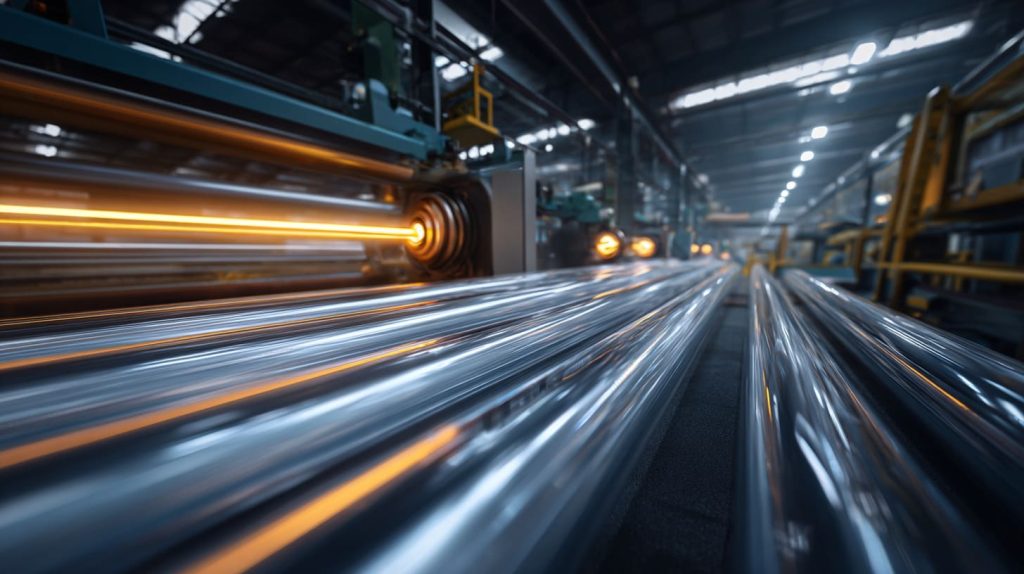
Extruded acrylic is not “bad acrylic.”
I want to say that clearly.
Some people talk about extruded acrylic like it is always cheap, weak, and risky. That is too simple. In real production, extruded acrylic has a very useful place. It can be cost-effective. It can have consistent thickness. It can be easier for some cutting and forming jobs.
But it has a personality.
And if we ignore that personality, shipping problems can appear fast.
How Extruded Acrylic Is Manufactured
Extruded acrylic is made through a continuous extrusion process. The acrylic material is pushed through rollers or a die to form sheets.
This method is faster than cast acrylic production. It is also usually cheaper.
That is why extruded acrylic is popular for mass production and cost-sensitive products.
| Point | Extruded Acrylic |
|---|---|
| Production method | Continuous extrusion |
| Speed | Faster |
| Thickness control | Usually more consistent |
| Internal stress | Usually higher |
| Cost | Usually lower |
| Best for | Thin, flat, cost-sensitive products |
The problem is not the speed itself.
The problem is the stress that can be created during the process. When acrylic is pushed, stretched, cooled, and formed quickly, the sheet can hold more internal tension.
Most of the time, this stress is invisible.
The sheet looks fine. The product looks fine. The sample may even look fine.
Then we cut it, laser it, polish it, bend it, or glue it.
The stress starts to show.
Sometimes it shows immediately. Sometimes it shows after shipping.
That delayed failure is the frustrating part.
Main Characteristics of Extruded Acrylic
Extruded acrylic usually has more consistent thickness. This is helpful when we need parts to fit together closely.
It is also lower in cost. For large-volume orders, that cost difference can be important. A buyer may not want to pay for cast acrylic if the product is a simple thin sign holder or a budget POP display.
Extruded acrylic can also be easier for some laser cutting and thermoforming jobs. Because the sheet is softer, it can cut smoothly and form more easily in some cases.
But the softer surface can also scratch more easily.
Here is a practical comparison:
| Feature | Extruded Acrylic Behavior |
|---|---|
| Thickness | More consistent |
| Cost | Lower |
| Surface | Softer than cast acrylic |
| Cutting | Often easy to laser cut |
| Forming | Good for simple thermoforming |
| Stress risk | Higher if not handled well |
| Shipping risk | Higher in some bonded or stressed products |
I often see extruded acrylic used successfully in simple flat products.
But when the design becomes larger, thicker, glued, or structurally stressed, I start to pay closer attention.
The material cost may look attractive at the quote stage. But if the product cracks after delivery, the “saving” disappears quickly.
Common Applications of Extruded Acrylic
Extruded acrylic is often used for:
- Budget retail displays
- Thin acrylic signage
- POP displays
- Simple shelf dividers
- Mass-market acrylic packaging
- Thin protective covers
- Low-cost display stands
For example, if a customer needs a simple thin acrylic sign holder in high quantity, extruded acrylic may be fine. The product is light. The structure is simple. The buyer may care more about price and basic clarity than long-term premium appearance.
But if that same buyer wants a large glued acrylic box with polished edges and long sea shipment, I become more careful.
The material may still work, but the design and packaging must be controlled.
A small sign holder and a large acrylic box are not the same animal. One is like a paper folder. The other is like a glass suitcase pretending to be plastic.
The material choice must follow the product, not the price list.
This is where many shipping failures begin.
Why Do Acrylic Products Fail During Shipping?
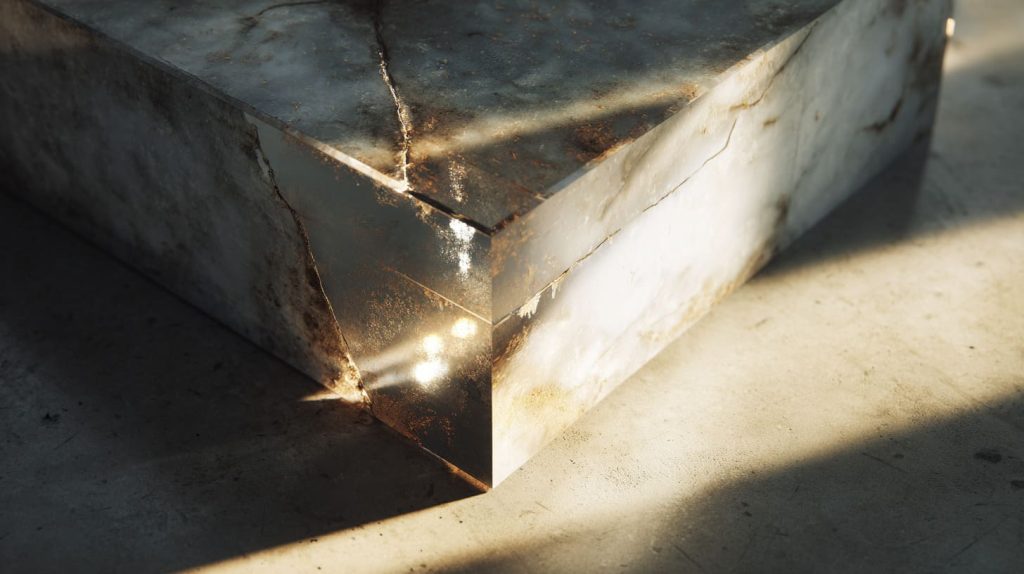
Shipping does not break products in only one way.
It is not always a dramatic carton drop. Sometimes the damage is slow and quiet. A carton sits under pressure. A container gets hot. The product vibrates for days. A glued joint carries stress. A sharp edge inside the package rubs against the surface.
Then the buyer opens the carton and sees the result.
Acrylic products fail during shipping because material, processing, design, and packaging all meet at the same point.
If one of them is weak, the whole product may suffer.
The Most Common Shipping Damages
From what I have seen, acrylic shipping damage usually appears in a few common forms.
| Damage Type | What It Looks Like | Common Cause |
|---|---|---|
| Corner cracks | Small cracks at sharp corners | Impact, poor radius, internal stress |
| Surface scratches | Fine lines or rubbing marks | Weak protection film, dust, movement inside carton |
| Internal stress fractures | White or cloudy lines inside acrylic | Material stress, cutting heat, temperature change |
| Glue joint separation | Bonded parts come apart | Poor glue choice, weak bonding area, vibration |
| Warping | Product shape changes | Heat, thin material, poor storage pressure |
| Edge chips | Small broken areas on polished edge | Rough handling, hard contact, weak edge protection |
One thing is easy to miss: different damage types tell different stories.
A broken corner may point to impact.
A cloudy crack near a glued edge may point to stress crazing.
A separated joint may point to bonding design.
A warped panel may point to heat or weak material thickness.
So when a customer sends me damage photos, I do not only ask, “Was the carton damaged?”
I also look at the crack location.
The crack location is like a witness. It quietly tells us what happened.
Why Shipping Damage Is Often Misunderstood
Packaging is the easiest thing to blame because it is visible.
If the carton is crushed, we blame the carton. If foam is thin, we blame the foam. If the pallet is broken, we blame the forwarder.
Sometimes that is correct.
But sometimes the real problem started before packaging.
Acrylic can hold internal stress from:
- Sheet production
- Laser cutting
- CNC routing
- Flame polishing
- Bending
- Gluing
- Tight assembly
- Poor annealing
- Wrong material thickness
This stress may not be visible during inspection.
I have seen products that looked clean before shipping but developed small cracks later near bonded areas. The surface looked fine. The carton looked fine. But the stress was already inside the product.
Shipping only exposed it.
This is where I slow down and check the full chain, because replacing foam without fixing material stress is like putting a thicker bandage on a bone problem.
For B2B buyers, this matters because a supplier may say, “We will improve packaging next time.”
That sounds responsible.
But the better question is:
What exactly failed?
Was it the carton?
Was it the product design?
Was it the material?
Was it the glue joint?
Was it the edge polishing?
Without that answer, the next shipment may fail again.
The Impact of International Shipping Environments
International shipping is not gentle.
Even if nobody throws the carton, the product still faces real stress.
| Shipping Factor | Possible Effect on Acrylic |
|---|---|
| Sea freight vibration | Weakens glue joints and rubs surfaces |
| Container heat | Increases expansion and stress |
| Cold weather | Makes stressed areas more brittle |
| Carton stacking | Pressures flat panels and corners |
| Customs inspection | May disturb original packing position |
| Truck transport | Adds impact and repeated shaking |
| Warehouse storage | Can cause compression or bending |
Acrylic is lighter than glass, but it is not soft like rubber. It is rigid. It does not like concentrated stress.
A sharp corner, a tight glued joint, or a thin oversized panel can become the failure point.
That is why I do not think shipping failure is bad luck. Most of the time, it is a signal.
The signal may say:
- The material was not suitable.
- The design was too sharp.
- The acrylic was too thin.
- The package allowed movement.
- The glue joint had hidden stress.
- The edge process created small cracks.
Acrylic is honest after shipping. It shows us where we were too optimistic.
And when we compare cast acrylic and extruded acrylic, this honesty becomes even clearer.
Does Cast Acrylic Fail Less Often After Shipping?
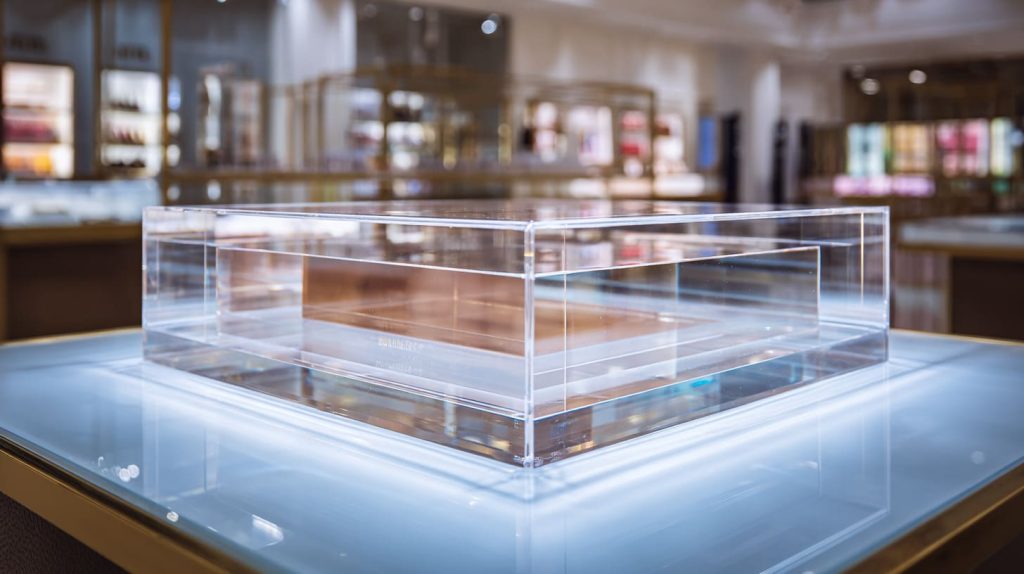
In many custom acrylic projects, yes, cast acrylic usually fails less often after shipping.
But I want to be careful with that answer.
Cast acrylic is not unbreakable. It is not a free pass. It only gives us a better starting point because it often has lower internal stress and better structural stability.
If the design is wrong, the packaging is weak, or the edge process is too aggressive, cast acrylic can still crack.
Why Cast Acrylic Usually Survives Shipping Better
Cast acrylic usually has lower internal stress than extruded acrylic. This is the main reason it often performs better during shipping.
Lower stress means the material is less likely to crack when it faces vibration, impact, heat, cold, or pressure.
In thicker products, this difference becomes more important.
| Factor | Why Cast Acrylic Helps |
|---|---|
| Lower internal stress | Reduces delayed cracking risk |
| Better structure | Helps thick parts stay stable |
| Harder surface | Reduces some handling scratches |
| Better chemical resistance | Reduces glue and cleaner-related crazing |
| Premium edge quality | Helps high-end products keep a better look |
For example, if we make a thick acrylic display block, I prefer cast acrylic. The product is heavy. The polished edges matter. The customer may use it for premium retail display.
If that product cracks after shipping, the loss is not only material cost. The buyer loses time. The brand loses display schedule. The supplier loses trust.
So I do not only compare sheet prices. I compare failure risk.
The choice becomes more obvious when the product is thick, heavy, polished, or expensive to replace.
Real Situations Where Cast Acrylic Performs Better
Cast acrylic usually performs better in products like:
- Large acrylic display boxes
- Thick acrylic furniture parts
- Luxury cosmetic organizers
- Museum-style acrylic covers
- Transparent protective cases
- Acrylic awards and trophies
- Premium photo blocks
- High-end retail fixtures
Let me give a simple example.
A buyer wants a large acrylic display box for a collectible item. The box has four glued sides, one top panel, and polished edges. The product will ship from China to Canada by sea.
If we use low-cost material and only think about appearance, the sample may pass. But after mass production, several boxes may arrive with cracks near the bonded corners.
Why?
Because large glued structures collect stress.
The bigger the box, the more the panels pull against each other. If the material has higher internal stress, the glue joint becomes a risk point.
Cast acrylic gives the product more tolerance.
Not perfect protection. More tolerance.
That is often enough to reduce damage rate.
The Hidden Downside of Cast Acrylic
Cast acrylic also has weaknesses.
It can be more expensive. It may have slight thickness variation. It can also become brittle near edges if the polishing process is too aggressive.
Flame polishing is a good example.
A beautiful flame-polished edge can make acrylic look clean and premium. But too much heat can create stress near the edge. That stress may not show right away.
Then the product ships.
The edge faces vibration or impact.
A small crack appears.
So even with cast acrylic, process control matters.
| Possible Cast Acrylic Problem | Why It Happens | How I Reduce Risk |
|---|---|---|
| Edge cracking | Too much heat during polishing | Control flame polishing and use proper finishing |
| Corner breakage | Sharp inside or outside corners | Add radius where possible |
| Thick part cracking | Poor packaging or heavy pressure | Use floating packaging and corner protection |
| Surface marks | Rough handling before packing | Keep protective film and clean work area |
| Fit issue | Slight thickness variation | Check tolerance before production |
For a high-value export project, I usually care more about total risk than material pride; even a better material can fail if the factory treats it like it cannot fail.
That is the part many people miss.
Cast acrylic gives us a stronger foundation, but the house still needs good construction.
And when we move to extruded acrylic, the foundation needs even more attention.
Why Does Extruded Acrylic Crack More Easily?
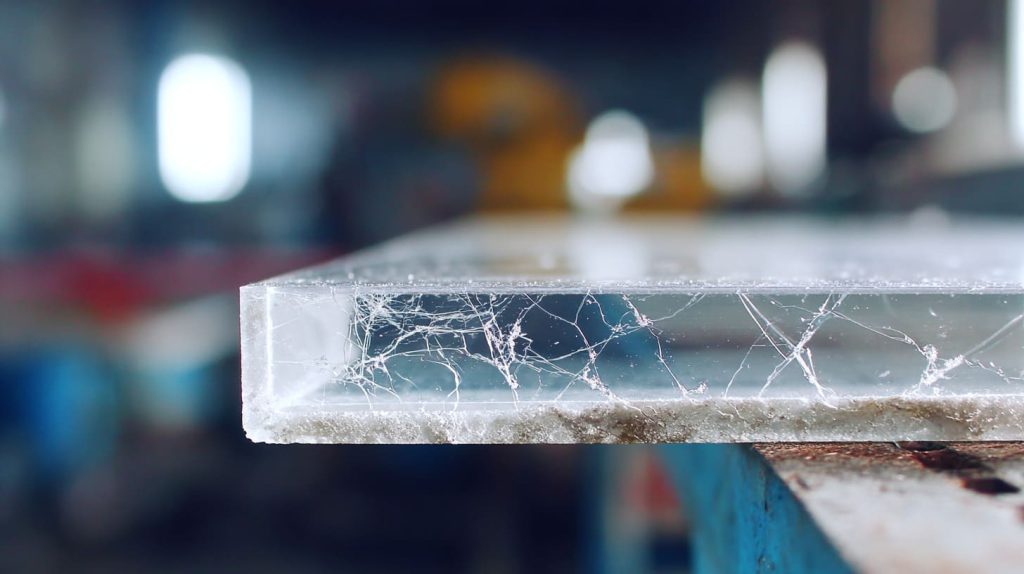
Extruded acrylic often cracks more easily because it usually has higher internal stress.
That sentence sounds simple. But in real production, this stress can hide behind a very clean surface.
The sheet looks good. The cutting edge looks good. The finished product looks good.
Then a crack appears after shipping.
This is why extruded acrylic can be tricky. It may not warn you early enough.
Internal Stress Problems in Extruded Acrylic
During extrusion, the acrylic sheet is formed through a continuous process. The material is pushed and cooled quickly. This can create internal stress.
When we later cut, polish, bend, or glue the sheet, that stress may increase.
Laser cutting can add heat.
Bonding can add chemical stress.
Bending can add mechanical stress.
Shipping can add vibration and temperature changes.
It is like stacking small debts.
One debt is fine. Two debts are fine. But at some point, the material cannot pay anymore.
| Stress Source | What It Can Cause |
|---|---|
| Extrusion process | Hidden internal tension |
| Laser cutting heat | Edge stress and small cracks |
| Solvent glue | Crazing near bonded areas |
| Tight assembly | Constant pressure on panels |
| Shipping vibration | Crack growth from weak points |
| Temperature change | Expansion and contraction stress |
A common problem is stress crazing.
Stress crazing looks like tiny white lines or cloudy cracks. It often appears near glue joints, edges, holes, or bent areas.
It may not look like a full break at first. But for a buyer, it is still a failure. A display product must look clean. A cloudy crack ruins the visual value.
How Temperature Affects Extruded Acrylic During Shipping
Temperature changes can make extruded acrylic problems worse.
Containers can get hot. In winter, warehouses and trucks can get cold. Acrylic expands and contracts with temperature.
If the material is already stressed, this movement can create cracks.
For thin and flat products, the risk may be manageable. For glued boxes or larger panels, the risk becomes higher.
| Temperature Condition | Risk for Extruded Acrylic |
|---|---|
| Hot container | Expansion, warping, glue joint stress |
| Cold weather | More brittle response to impact |
| Fast temperature change | Stress near edges and glued areas |
| Stacked cartons in heat | Panel bending or shape change |
This matters a lot for international buyers.
A product may be produced in a warm factory, shipped through a hot port, stay in a container, then arrive in a cold warehouse in Canada or Europe.
The material experiences a journey.
Not just distance.
A climate journey.
That journey can expose weak points.
Common Factory Mistakes With Extruded Acrylic
Extruded acrylic can work well when the product is designed for it. The failures often come from using it in the wrong way or processing it too aggressively.
Common mistakes include:
- Using thin material for oversized products
- Laser cutting too fast or too hot
- Skipping annealing when stress is high
- Choosing the wrong glue
- Making sharp corners with no radius
- Designing tight slots that force panels together
- Using weak packaging for large flat panels
- Treating a sample result as proof for mass production
The most dangerous mistake is using extruded acrylic only because it is cheaper.
Lower material cost is easy to see on a quotation. Future failure cost is harder to see.
But it is still real.
| Mistake | Short-Term Benefit | Long-Term Risk |
|---|---|---|
| Thin sheet choice | Lower cost | Warping or cracking |
| Fast laser cutting | Faster production | Edge stress |
| Strong solvent glue | Quick bonding | Crazing |
| Tight design | Cleaner assembly look | Constant stress |
| Weak foam | Lower packing cost | More breakage |
| No stress testing | Faster sample approval | Hidden mass production risk |
A buyer may save a little on material and lose much more on replacements. That is why I get cautious when a product is large, glued, or shipped far, and the only reason for extruded acrylic is “better price.”
Price is important.
I respect price.
But price without failure control is not really cheap. It is just a delayed invoice.
That is especially true when laser cutting and bonding enter the picture.
Which Acrylic Performs Better for Laser Cutting and Bonding?
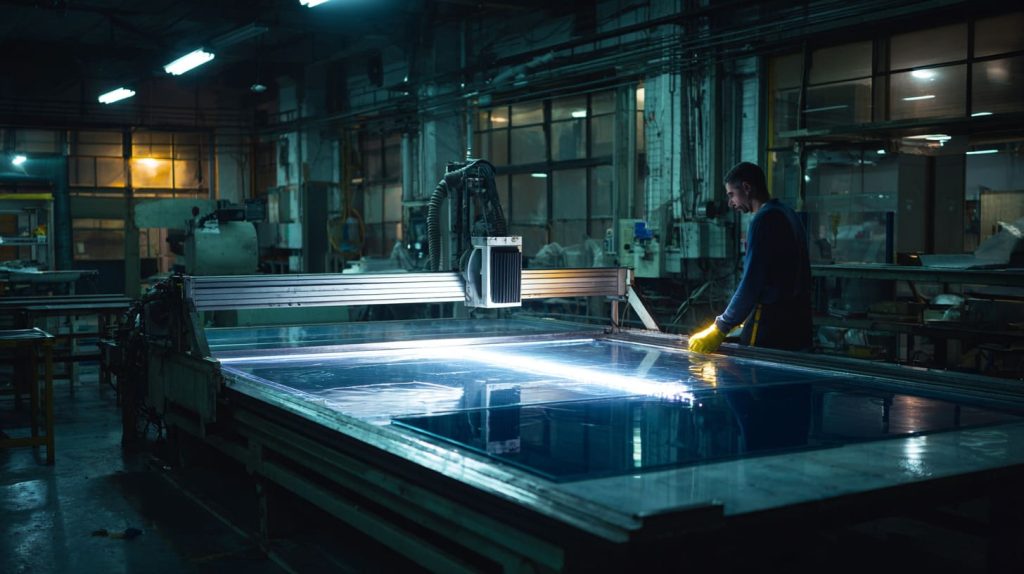
Laser cutting and bonding are two of the most common processes in custom acrylic products.
They are also two places where hidden stress can quietly grow.
Acrylic does not only fail because the material is weak. It often fails because the process adds stress to the material.
So when we compare cast and extruded acrylic, we must talk about cutting and glue.
Cast Acrylic vs Extruded Acrylic for Laser Cutting
Both cast and extruded acrylic can be laser cut.
But they behave differently.
Extruded acrylic often cuts with a smoother, more flame-polished edge from the laser. It can look very clean right after cutting.
Cast acrylic may produce a slightly different edge and may need more polishing depending on the product requirement.
But edge appearance is not the only thing that matters.
The real question is:
How stable is the edge after cutting, polishing, packing, and shipping?
| Point | Cast Acrylic | Extruded Acrylic |
|---|---|---|
| Laser edge appearance | Clean but may need finishing | Often very smooth |
| Internal stress risk | Usually lower | Usually higher |
| Edge cracking risk | Lower if processed well | Higher if heat and stress are not controlled |
| Best use | Premium and thick parts | Thin and simple parts |
| Concern | Heat from polishing | Heat plus existing stress |
Extruded acrylic can look beautiful right after laser cutting. That can trick people.
A clean edge is not always a low-stress edge.
If the laser settings are too aggressive, the edge may hold heat stress. If the sheet already has internal stress, the risk increases.
After shipping, small cracks may appear near the edge.
This is why inspection should not only check beauty. It should also check risk.
Bonding and Glue Performance Differences
Bonding acrylic is not just “put glue and wait.”
Solvent cement works by slightly softening the acrylic surface so the parts can join. If the material is stressed, the solvent can trigger crazing.
Extruded acrylic is often more sensitive to this problem.
Cast acrylic usually handles bonding better, but it still needs proper glue choice, clean surfaces, and correct bonding design.
| Bonding Factor | What Can Go Wrong |
|---|---|
| Too much solvent | Bubbles, white marks, crazing |
| Poor surface fit | Weak bond and visible gaps |
| High material stress | Cracks near glue line |
| No drying time | Weak joint before packing |
| Dirty surface | Poor bonding and cloudy marks |
| Tight assembly | Constant stress after bonding |
I have seen buyers focus only on whether the glue line is clear.
That is understandable. Clear glue lines look professional.
But I also care about the size of the bonding surface, the stress direction, and whether the product will vibrate during shipping.
A clear but weak joint is not good enough.
It is like a nice-looking bridge with loose bolts.
Why Some Bonded Products Fail Weeks After Delivery
Delayed failure is one of the most annoying acrylic problems.
The product passes inspection.
The shipment arrives.
The buyer stores the goods.
Then, after some days or weeks, cracks appear near bonded joints.
This can happen because stress and solvent continue to interact after production. Shipping may speed up the problem, but sometimes the failure appears after delivery.
Common delayed failures include:
- Fine cracks near glued corners
- White lines around bonded areas
- Small bubbles growing near seams
- Corner separation after vibration
- Surface crazing after cleaning
| Delayed Problem | Possible Root Cause |
|---|---|
| Cracks near glue line | Solvent stress and material tension |
| White marks | Crazing or poor glue control |
| Joint opening | Small bonding area or vibration |
| Edge cracks | Laser or polishing stress |
| Panel distortion | Thin sheet or heat exposure |
Before I approve a bonded acrylic structure for export, I like to think about the glue joint as a long-term stress point, not just a cosmetic line.
This is why samples matter, but sample timing also matters.
A sample checked five minutes after bonding tells very little.
A sample checked after 24 to 72 hours tells more.
A sample checked after packaging and vibration testing tells even more.
In acrylic production, time is also an inspector.
And after processing, packaging becomes the next inspector.
How Packaging Changes the Failure Rate
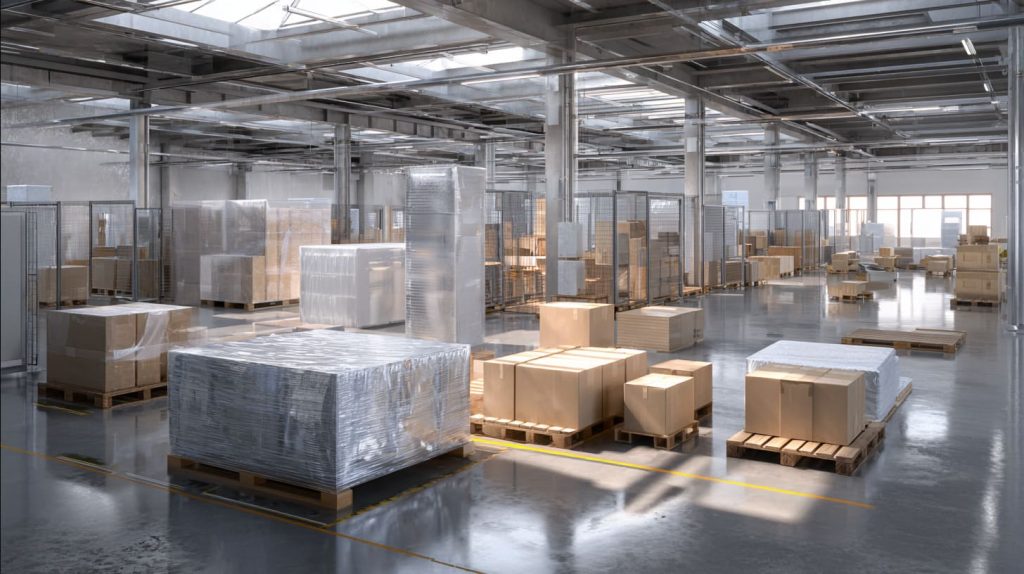
Packaging can reduce shipping failure a lot.
But packaging cannot fix every problem.
This is where some projects go wrong. The buyer sees damage, and everyone says, “Use thicker foam next time.”
Sometimes that works.
Sometimes it does not.
If the product already has high internal stress, weak glue joints, sharp corners, or poor material choice, better packaging may only reduce the damage. It may not remove the root cause.
Why Packaging Alone Cannot Fully Prevent Breakage
Good packaging protects acrylic from outside force.
It can reduce impact. It can reduce rubbing. It can reduce compression. It can keep parts from moving inside the carton.
But packaging cannot remove stress inside the acrylic.
If an extruded acrylic box has stressed glue joints, the cracks may still appear even if the carton looks perfect.
If a large flat panel is too thin, it may still warp in heat.
If a polished edge has micro-cracks from too much heat, foam cannot repair that edge.
| Problem Type | Can Packaging Help? | Can Packaging Fully Solve It? |
|---|---|---|
| Corner impact | Yes | Often, if designed well |
| Surface rubbing | Yes | Usually |
| Internal stress cracking | Limited | No |
| Weak glue joint | Limited | No |
| Warping from thin sheet | Limited | No |
| Poor material choice | Limited | No |
This is why I see packaging as the last shield, not the first solution.
The first solution is still correct material, correct thickness, correct processing, and correct design.
Packaging comes after that.
Best Packaging Methods for Acrylic Products
For export acrylic products, I usually think about packaging in layers.
The product needs surface protection, corner protection, movement control, carton strength, and sometimes pallet protection.
Acrylic likes space, but not too much space.
If the product is too tight, pressure may crack it.
If the product is too loose, vibration may damage it.
Good packaging finds the middle point.
| Packaging Method | Purpose |
|---|---|
| PE protective film | Protects acrylic surface from scratches |
| Soft foam sheet | Reduces rubbing and light impact |
| Foam corner guards | Protects weak corners |
| Inner box | Keeps product position stable |
| Floating structure | Creates buffer space around product |
| Double-wall carton | Improves compression resistance |
| Wooden crate or pallet | Helps heavy or fragile export orders |
| Moisture protection | Reduces carton weakness in humid transport |
For premium acrylic display boxes, I often prefer a floating inner box structure. The product should not touch the outer carton directly. It should sit inside a protected space.
For polished acrylic blocks, I care a lot about edge protection. The edge is not only structural. It is also visual. A small chip can make the whole product look cheap.
For large flat acrylic panels, I care about bending support. Flat panels should not be allowed to flex inside the carton.
Packaging Differences for Cast and Extruded Acrylic
Cast and extruded acrylic may need different packaging attention.
Cast acrylic is usually more stable, but polished edges and premium surfaces still need careful protection.
Extruded acrylic may need more help around corners, edges, glued joints, and large panels.
| Product Situation | Cast Acrylic Packaging Focus | Extruded Acrylic Packaging Focus |
|---|---|---|
| Polished edge products | Prevent edge chips | Prevent edge cracks and chips |
| Glued boxes | Protect corners and seams | Add stronger corner and joint protection |
| Thin panels | Surface and bending control | Strong bending and heat control |
| Luxury displays | Cosmetic protection | Cosmetic plus stress protection |
| Long sea freight | Stable carton and pallet | Extra movement control and foam |
For extruded acrylic, I may use thicker foam or more stable inner packaging, especially if the product has glued corners.
But again, packaging cannot carry all the responsibility.
If the material and design are wrong, packaging becomes a poor worker doing too much overtime.
The smartest approach is to choose the right material for the product type first.
Then packaging becomes support, not a rescue mission.
Which Acrylic Is Better for Different Product Types?

There is no single answer for every acrylic product.
Cast acrylic is not always the best choice.
Extruded acrylic is not always the wrong choice.
The right choice depends on product type, thickness, design, appearance requirement, budget, and shipping route.
This is where real project thinking matters.
Best Choice for Luxury Display Products
For luxury display products, I usually prefer cast acrylic.
Premium displays need clean edges, better clarity, better surface feel, and lower failure risk. The buyer may use these products in retail stores, showrooms, museums, cosmetic counters, or brand displays.
In these settings, small defects become big problems.
A tiny crack near a corner can ruin the whole display.
A scratch on the front face can make the product unacceptable.
A cloudy glue line can make a premium brand feel cheap.
| Luxury Product Need | Better Choice |
|---|---|
| High clarity | Cast acrylic |
| Polished edges | Cast acrylic |
| Lower crack risk | Cast acrylic |
| Better surface hardness | Cast acrylic |
| Premium appearance | Cast acrylic |
The buyer may pay more for cast acrylic, but the product has a better chance of arriving in good condition and keeping its premium look.
That is not about luxury for luxury’s sake.
It is about protecting the product’s final purpose.
Best Choice for Cost-Sensitive Bulk Orders
For cost-sensitive bulk orders, extruded acrylic can make sense.
If the product is thin, simple, flat, and not heavily bonded, extruded acrylic can be a practical choice.
Examples include:
- Simple sign holders
- Thin POP displays
- Basic acrylic covers
- Flat protective panels
- Budget shelf dividers
- Light packaging inserts
In these products, the buyer may care about quantity and price. The risk may be acceptable if the design is simple and packaging is proper.
| Cost-Sensitive Product | Possible Material |
|---|---|
| Thin sign holder | Extruded acrylic |
| Simple POP display | Extruded acrylic |
| Flat panel | Extruded acrylic |
| Basic cover | Extruded acrylic |
| Premium thick display | Cast acrylic |
The mistake is using extruded acrylic for a product that behaves like a premium structural product.
If a buyer wants low price, thick structure, polished edge, perfect clarity, and zero breakage risk, something has to give.
The factory cannot fight physics with a nice quotation.
Best Choice for Large Acrylic Furniture
Large acrylic furniture needs careful thinking.
Acrylic furniture may look simple, but it carries weight and stress. Chairs, tables, shelves, and side panels are not only decorative. They must support force.
For large furniture parts, cast acrylic is often safer, especially when thickness, clarity, and long-term stability matter.
But weight also matters.
Thicker cast acrylic can be heavy. Heavy products are harder to pack and ship. They may need wooden crates, strong pallets, and better handling instructions.
| Furniture Concern | Practical Thinking |
|---|---|
| Weight | Heavy acrylic needs stronger packaging |
| Thickness | Too thin may flex or crack |
| Edge quality | Polished edges need protection |
| Stress load | Product must support real use |
| Shipping route | Long transport increases risk |
Here, the material choice is only one part.
The design must avoid sharp inside corners. The thickness must match the load. The packaging must support the product shape.
For acrylic furniture, I treat shipping as part of the design, not as the final step after production.
Best Choice for International Export Projects
For international export, I usually become more conservative.
A local delivery and a long sea shipment are not the same.
Acrylic that survives a short truck ride may not survive 35 days in cartons and containers.
For export projects, I look at:
- Product size
- Product thickness
- Glue joints
- Edge treatment
- Shipping method
- Destination climate
- Replacement difficulty
- Customer quality standard
| Export Situation | Safer Choice |
|---|---|
| Large glued acrylic box | Cast acrylic |
| Thick premium block | Cast acrylic |
| Thin simple display | Extruded acrylic may work |
| Long sea freight | Cast acrylic preferred for risky designs |
| High-value retail display | Cast acrylic |
| Low-cost flat panel | Extruded acrylic may work |
My decision often changes when I think about replacement cost, because a cheaper material can become expensive if the buyer needs replacements across the ocean.
Acrylic export is not only about making the product.
It is about making the product survive distance.
That is why experienced buyers ask better questions before ordering.
How Experienced Buyers Reduce Shipping Failures

Experienced buyers do not only ask for the lowest price.
They ask questions that reveal risk.
I like working with buyers who ask sharp questions. It may take more time at the beginning, but it usually saves trouble later.
A good buyer does not treat acrylic products like simple plastic items. A good buyer understands that material, process, design, and packaging must work together.
Questions Professional Buyers Ask Before Ordering
Professional buyers usually ask questions like:
- Is the material cast acrylic or extruded acrylic?
- What thickness tolerance should I expect?
- Is the product laser cut, CNC cut, or both?
- Will the parts be flame polished?
- Will the product be annealed after processing?
- What glue will be used?
- How will bonded joints be tested?
- What packaging method will be used?
- Can we do a drop test or vibration test?
- Can the supplier provide photos before shipment?
These questions are not “difficult.”
They are responsible.
| Buyer Question | Why It Matters |
|---|---|
| Material type? | Affects stress and shipping risk |
| Thickness tolerance? | Affects fitting and assembly |
| Cutting method? | Affects edge stress |
| Glue type? | Affects crazing and joint strength |
| Annealing? | Reduces internal stress |
| Packaging test? | Shows real export readiness |
| Pre-shipment photos? | Helps confirm quality before loading |
A buyer like Jacky may already know many factories can make a good sample.
The real question is whether the factory can repeat that quality in bulk production and protect it through shipping.
That is a different skill.
Why Factory Experience Matters More Than Price
Acrylic manufacturing looks simple from the outside.
Cut the sheet. Polish the edge. Glue the parts. Pack the carton.
But small decisions matter.
The speed of laser cutting matters.
The angle of polishing matters.
The glue amount matters.
The drying time matters.
The corner radius matters.
The foam density matters.
The carton stacking direction matters.
These details decide whether the product arrives clean or damaged.
| Factory Skill | Real Impact |
|---|---|
| Material handling | Reduces scratches and stress |
| CNC and laser control | Improves edge quality |
| Glue process control | Reduces bubbles and cracks |
| Packaging design | Reduces shipping damage |
| Export experience | Helps match packing to route |
| QC process | Finds problems before shipment |
I never think a factory is good only because it can make one beautiful sample. I trust a factory more when it can explain where the sample might fail in mass production.
That kind of honesty is valuable.
Because in custom acrylic work, every project has a weak point.
The goal is not to pretend there is no risk.
The goal is to find the risk early.
How to Evaluate a Supplier Before Placing a Bulk Order
Before a bulk order, buyers can do several simple checks.
They do not need to be engineers to ask smart questions.
They can ask for:
- Material confirmation
- Sample photos from different angles
- Edge close-up photos
- Glue joint close-up photos
- Packaging photos
- Carton structure details
- Drop test result if needed
- Stress test suggestion
- Mass production tolerance range
- Product handling instructions
For complex acrylic products, a buyer can also request a sample shipment instead of only checking a sample at the factory.
A sample that survives international shipping gives more useful information than a sample sitting on a clean office table.
| Evaluation Step | What Buyer Learns |
|---|---|
| Check material | Confirms cast or extruded acrylic |
| Inspect sample edges | Finds cutting or polishing risk |
| Inspect glue joints | Finds bonding quality |
| Test packaging | Finds movement and impact risk |
| Ship sample | Tests real logistics |
| Review QC photos | Confirms mass production consistency |
| Ask about failure points | Tests supplier experience |
One of the smartest things a buyer can ask is:
“Where do you think this product may fail during shipping?”
A weak supplier may avoid the question.
A strong supplier will discuss corners, joints, thickness, packaging, and material choice.
That conversation is worth having.
It can save money, time, and a lot of unpleasant emails later.
Cast vs Extruded Acrylic: Quick Comparison Table
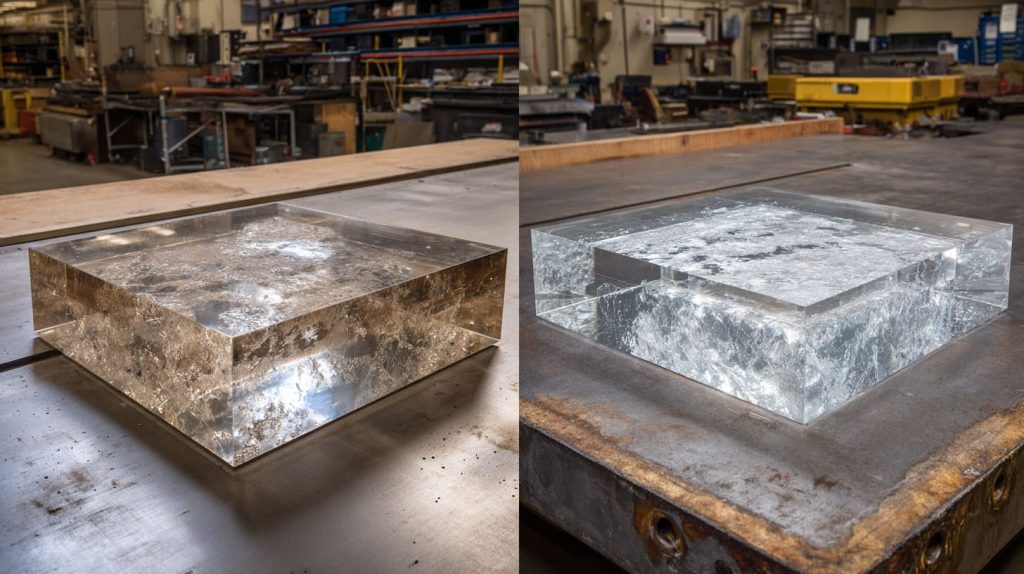
Sometimes buyers do not need a long lecture.
They need a clear comparison.
So here is the simple version.
Cast acrylic usually performs better for premium, thick, polished, glued, or high-risk export products.
Extruded acrylic can work well for thinner, simpler, cost-sensitive products when design and packaging are controlled.
The mistake is not choosing extruded acrylic.
The mistake is choosing it for the wrong product and expecting it to behave like cast acrylic.
Side-by-Side Comparison
| Comparison Point | Cast Acrylic | Extruded Acrylic | My Practical View |
|---|---|---|---|
| Strength | Usually better for thick products | Good for simple thin products | Cast is safer for structural parts |
| Scratch resistance | Usually better | Softer surface | Cast is better for premium visible surfaces |
| Shipping durability | Usually better | Higher risk in stressed products | Cast often fails less after shipping |
| Cost | Higher | Lower | Extruded helps budget orders |
| Laser cutting quality | Good, may need finishing | Often smooth laser edge | Smooth edge does not always mean low stress |
| Bonding reliability | Usually better | More sensitive to solvent stress | Cast is safer for glued boxes |
| Thickness consistency | May vary slightly | Usually more consistent | Extruded can help tight fitting parts |
| Chemical resistance | Better | Lower | Cast handles glue and cleaner better |
| Edge polishing | Excellent if controlled | Can look clean but may stress | Process control matters for both |
| Thick product use | Strong choice | Riskier | Cast preferred |
| Thin flat product use | Good but may cost more | Often practical | Extruded can be enough |
| Luxury display use | Strong choice | Possible but riskier | Cast fits premium projects |
| Budget POP display use | May be too costly | Good choice | Extruded makes sense |
| Long-distance export | Safer for risky designs | Needs better control | Choose based on product risk |
A Simple Decision Guide
| Product Type | Better Material Choice | Reason |
|---|---|---|
| Thick acrylic block | Cast acrylic | Better stability and clarity |
| Luxury cosmetic display | Cast acrylic | Better surface and lower crack risk |
| Museum-style box | Cast acrylic | Better optical and structural performance |
| Thin sign holder | Extruded acrylic | Cost-effective and simple |
| Budget POP display | Extruded acrylic | Lower cost for high volume |
| Large glued box | Cast acrylic | Lower stress and better bonding reliability |
| Flat protective panel | Extruded acrylic may work | Simple structure and consistent thickness |
| Acrylic furniture part | Cast acrylic | Better for load and premium finish |
| Export display with long sea freight | Cast acrylic preferred | Lower shipping failure risk |
For a real order, I do not stop at this table. I still check size, thickness, design, glue, edge process, packaging, and shipping route.
But this table gives a useful starting point.
If the product is simple, thin, and price-sensitive, extruded acrylic may be a good choice.
If the product is thick, premium, glued, polished, or expensive to replace, cast acrylic is usually the safer bet.
Acrylic material selection is not about winning an argument.
It is about reducing regret after the cartons arrive.
Conclusion
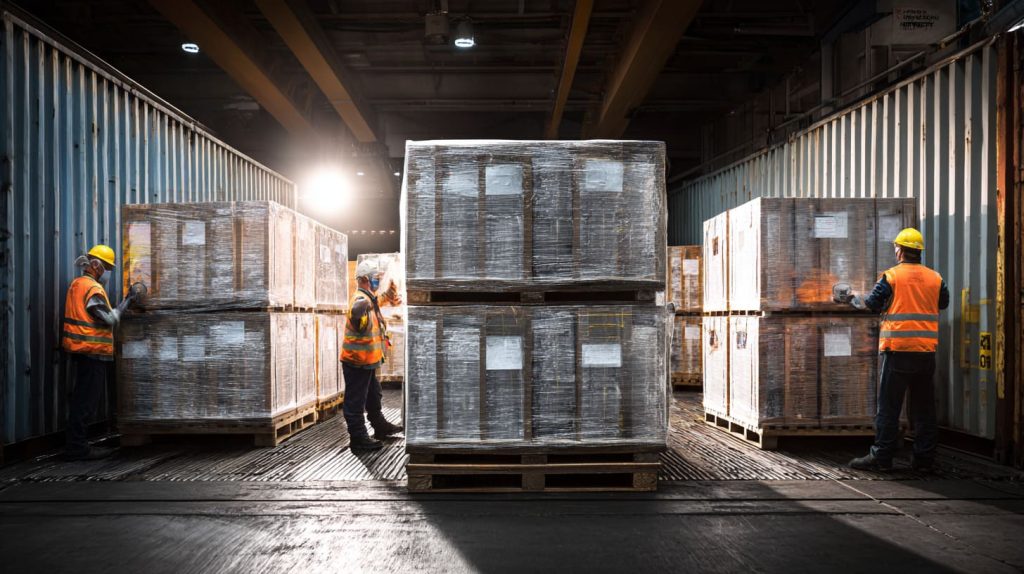
Cast acrylic usually fails less often after shipping.
That is my honest view from real custom acrylic work.
The reason is not mysterious. Cast acrylic usually has lower internal stress, better stability, better surface hardness, and better performance in thick or premium products. When a product faces long-distance shipping, those details matter.
Extruded acrylic can still be a good material. I use it when the product is simple, thin, flat, and cost-sensitive. It can be practical. It can help buyers control budget. It can work well when the design, process, and packaging are suitable.
But extruded acrylic becomes risky when people use it only to reduce cost on products that need better stress resistance.
That is where failures happen.
A large glued box is not the same as a thin sign holder.
A luxury cosmetic display is not the same as a budget POP display.
A thick acrylic block is not the same as a simple flat panel.
So my thinking is simple:
I do not ask which acrylic is cheaper first. I ask which acrylic is less likely to create trouble after shipping.
That is why I often recommend cast acrylic for high-value custom export products, especially when the product has thick panels, polished edges, glued joints, premium appearance requirements, or a long shipping route.
I also do not blame packaging for everything.
Good packaging is important. We need protective film, foam, corner guards, strong cartons, floating inner structures, and sometimes pallets or crates. But packaging is the last protection layer.
The product must already be right before it enters the carton.
This is the reason I care about material choice, thickness, edge processing, bonding, drying time, and stress control. These details may not look exciting on a quotation sheet, but they decide whether the buyer receives a clean product or a complaint case.
For B2B buyers, product designers, and purchasing teams, my advice is clear:
Do not choose cast or extruded acrylic by name only.
Choose it by risk.
Ask what the product must survive.
Ask where the stress will collect.
Ask what happens during sea freight.
Ask what happens if one corner takes impact.
Ask what happens if the container becomes hot.
Ask what happens if the glue joint is still holding hidden stress.
That is how experienced buyers think.
At Feilong Acrylic, we work with custom acrylic products every day, from displays and boxes to frames, stands, racks, blocks, organizers, and furniture parts. If you are developing a custom acrylic product for export, you can send us your drawing, sample idea, size, thickness, quantity, and application.
We can help you review the material choice, product structure, production method, and export packaging before mass production.
Because a good acrylic product should not only look good in the factory.
It should arrive safely, open cleanly, and make your customer feel that the project was handled by people who cared about the small things.